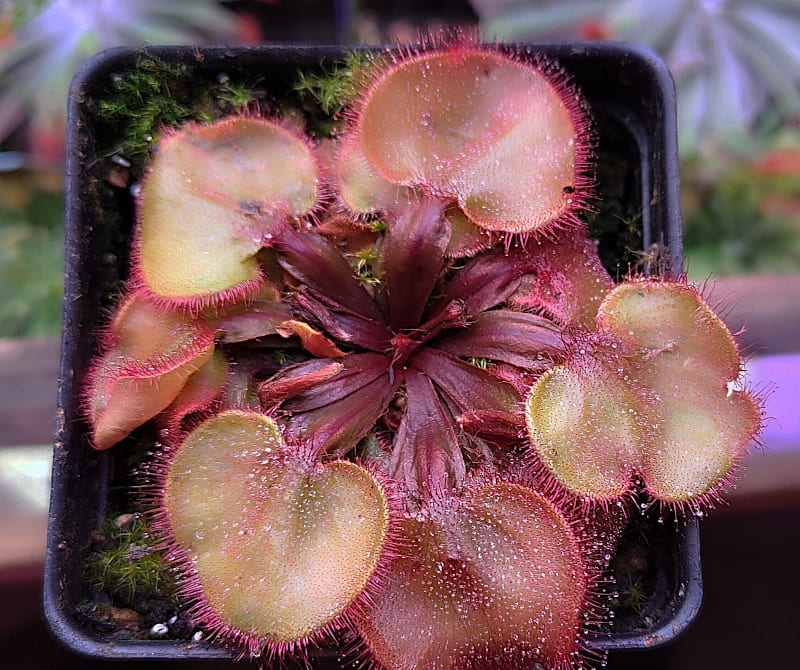
Source: Wikimedia Commons
Drosera falconeri
AdvancedDrosera falconeri
A sundew that lays large kidney-shaped leaves flat on the ground, looking rather like a Venus flytrap. Native to tropical northern Australia, it rests as a bud at soil level in the dry season. Unusually for a carnivorous plant it grows on alkaline, calcareous soil.
About
Drosera falconeri is a perennial sundew from the northern coastal Northern Territory of Australia, a member of the Drosera petiolaris complex (subgenus Lasiocephala). The rosette leaves lie flat against the ground; mature blades are kidney-shaped, about 1.5 cm long and 2 cm wide, and up to 3 cm wide on old plants. Such large, prostrate leaves are unique in the group and make the plant resemble a Venus flytrap. Most relatives protect themselves from drought with dense white hairs, but this species drops its leaves in the dry season and survives as a tight, bulb-like bud of leaf bases just below the soil surface. While most carnivorous plants need acid soil, it grows on calcareous sands with a pH around 8 and on grey silty clays. It was announced in 1980 and named after its finder, Mr Falconer, and formally described in 1984 by Katsuhiko Kondo, with the holotype held at Hiroshima University. It hybridises readily with relatives, and natural and artificial hybrids are known. In Japan, flask-grown seedlings appear regularly at online auctions. It is considered difficult in cultivation, the biggest challenge being to keep it warm enough.
Source: Wikipedia (CC BY-SA 4.0)
Size of the Drosera falconeri
The Drosera falconeri grows to Leaf blades about 1.5 cm long and 2 cm wide (to 3 cm wide on old plants).
Basic Info
Origin
Northern Australia (coastal Northern Territory)
Lifespan
Perennial (rests as a bud in the dry season)
Size
Leaf blades about 1.5 cm long and 2 cm wide (to 3 cm wide on old plants)
Temperature
10〜30℃
Humidity
60〜90%
Watering & Fertilizer
No fertilizer (catches small insects)
Growing Tips
Temperature & Overwintering
The petiolaris-complex sundews like the low 30s °C in summer and dislike falling below 18°C at any time. Japanese winters require heating; many growers use heat mats.
Light & Placement
Needs strong light. Wild plants are deep red, but in cultivation weaker light tends to leave them greener.
Watering
Keep small pots in a tray of water: higher in summer, lower in winter, even letting it dry for a few days. Use pure water.
Dormancy Care
In cultivation it may grow year-round without a dry-season rest. If it does rest, it forms a tight bud at soil level; do not mistake it for dead.
Propagation
It rarely divides and leaf cuttings often fail; submerging pulled leaves in pure water is a known method.
Drosera falconeri FAQ
QWhat is the growing difficulty level for Drosera falconeri?
Advanced. A variety suitable for advanced growers. Requires advanced cultivation techniques and specialized equipment, with careful environmental adjustments needed.
QHow large does Drosera falconeri get?
The mature size of Drosera falconeri is Leaf blades about 1.5 cm long and 2 cm wide (to 3 cm wide on old plants). This may vary slightly depending on cultivation environment and individual differences.
QHow should I water and fertilize Drosera falconeri?
Drosera falconeri: watering & fertilizer — No fertilizer (catches small insects). Aim for appropriate frequency and amount.
QWhat is the typical price for Drosera falconeri?
The price of Drosera falconeri varies significantly by variety, characteristics, size, and lineage. Please check GrowerDirect's price guide for the latest market information.
Last updated: September 23, 2026
References & Sources
Edited & verified by: GrowerDirect Editorial Team
The classifications, regulations, and growing data on this page are created and verified based on the primary information database below.
Taxonomy & Authority
Accepted name: Drosera falconeri Tsang ex Kondo
Authority databases: GBIF · GBIF Drosera falconeri Tsang ex Kondo
Nomenclature follows global taxonomic authority databases.
Regulations & Conservation Status
Not listed under CITES. Because the genus Drosera includes a designated Invasive Alien Species in Japan (D. intermedia), any Drosera imported into Japan must be accompanied by a species-name certificate. No paperwork is needed to buy or grow plants already in domestic trade.
Regulations may change. Always verify the latest information with the relevant authorities.
Related Species
Find listings for this species
Related Articles
Drosera (Sundew) Care Guide | Diverse Carnivorous Plants That Trap Insects with Sticky Secretions
Explanation of how to grow carnivorous Drosera (Sundew). We introduce the characteristics of beginner-friendly varieties such as Spatulata, Capensis, and Adelae, methods for water tray watering, light conditions, overwintering, and propagation through leaf cuttings.
Drosera Propagation Guide — Leaf Cuttings, Division & Seeds
Propagating sundews: leaf cutting technique, division method, seed sowing, and species-specific propagation recommendations.
Complete Guide to Sundew (Drosera) Cultivation | How to Bring Out the Beauty of Its Sticky Secretions
Explains varieties such as D. adelae and D. capensis, water-tray management, light requirements, and differences between temperate and tropical species.
Sundew Species and Cultivation Techniques | Bringing Out the Beauty of Mucilage
This article explains the characteristics of major sundew species and cultivation techniques (light, humidity, soil) for making mucilage shine beautifully.
Can't find the plant you're looking for?
Post your wishes for free and growers with matching plants will contact you with introductions.