Source: Wikimedia Commons
Rosy sundew
IntermediateDrosera hamiltonii
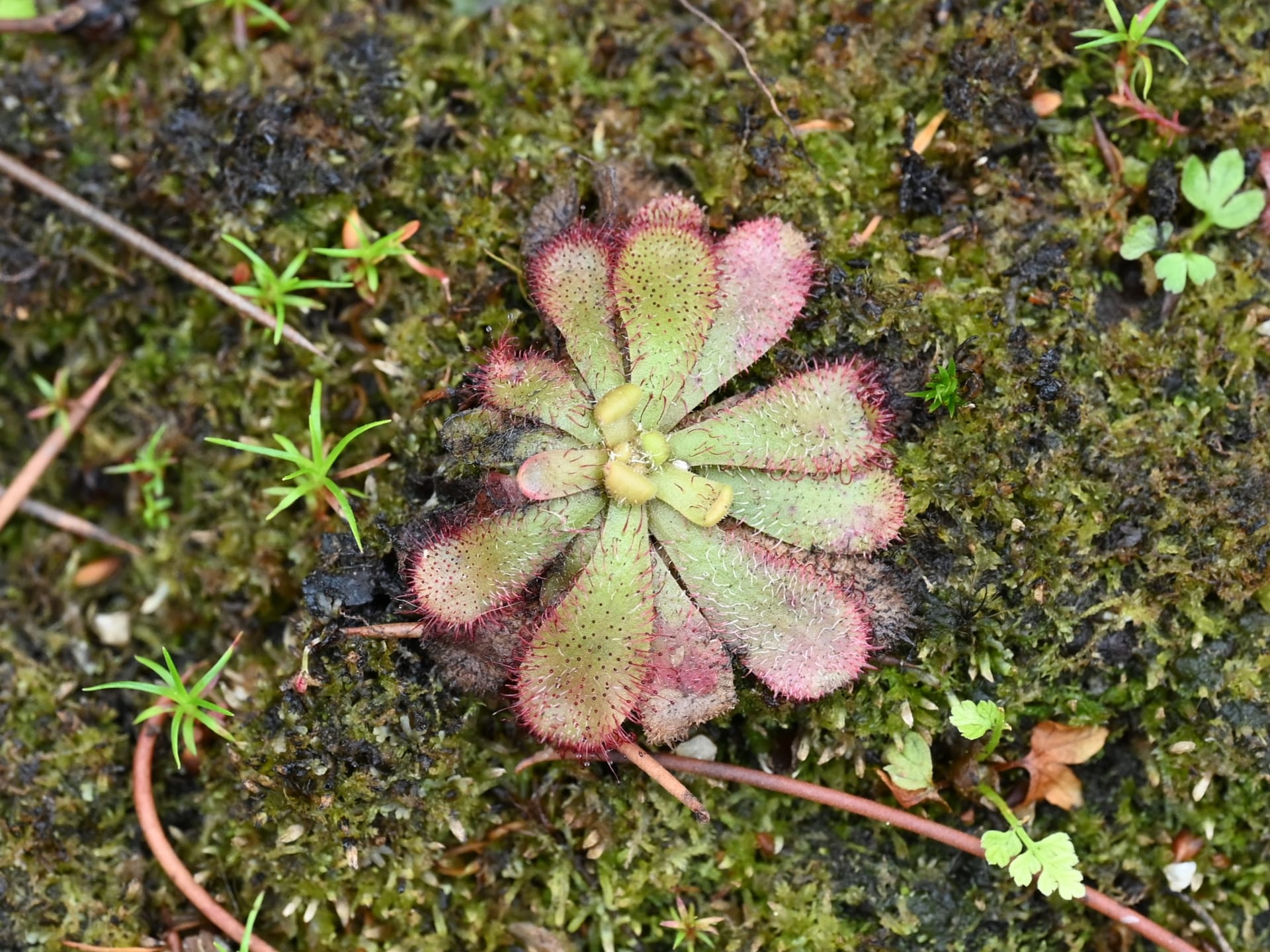
A sundew from south-western Western Australia forming rosettes 4-6 cm across of spoon-shaped leaves. Stalks 30-40 cm tall carry large deep-pink flowers with fused styles, a feature that places it alone in its own section.
About
Drosera hamiltonii is a perennial sundew found only along the coast between Albany and Augusta at the far south-western tip of Western Australia. It grows on wet peat in swamps and along streams, alongside plants such as Cephalotus follicularis. From a short rhizome it forms a ground-level rosette 4-6 cm across of spoon-shaped leaves 3-4 cm long and about 1 cm wide. The roots are black, thick, branched and well developed. In the wild it flowers in November and December; the hairy, reddish flower stalk is 30-40 cm tall, occasionally 75 cm, and carries 20-30 deep pink flowers, each opening only every other day. Its five styles are fused lengthwise, a rare trait in the genus; after C. R. P. Andrews described it in 1903 it was placed alone in section Stelogyne, which some authors have raised to subgenus. Its English name is rosy sundew. Its habitat is reportedly shrinking through farming. In Japan it is offered by specialist nurseries, wildflower shops and online auctions, though not in large numbers. Grow it in wet peaty soil with pure water and good light; because it comes from a winter-rainfall climate, protect it from stuffy heat in midsummer.
Source: Wikipedia (CC BY-SA 4.0)
Size of the Rosy sundew
The Rosy sundew grows to Rosette 4-6 cm across (flower stalks 30-40 cm).
Basic Info
Origin
South-western Western Australia (coast between Albany and Augusta)
Lifespan
Perennial
Size
Rosette 4-6 cm across (flower stalks 30-40 cm)
Temperature
10〜30℃
Humidity
60〜90%
Watering & Fertilizer
No fertilizer (catches small insects)
Growing Tips
Light & Placement
Grow in good light; in low light the leaves stretch and colour poorly.
Watering
It grows on wet peat in the wild, so keep the soil constantly moist on a water tray, using pure or rain water.
Soil & Repotting
Plant in a peat-based mix or sphagnum. The roots are thick and long, so a fairly deep pot suits it.
Temperature & Overwintering
From a winter-rainfall region, it dislikes midsummer heat and stuffiness; keep it bright, airy and not too hot in summer.
Fertilizer
No fertilizer in the soil; small insects supply nutrients.
Rosy sundew FAQ
QWhat is the growing difficulty level for Rosy sundew?
Intermediate. A variety suitable for intermediate growers. Requires some cultivation experience and knowledge of environment management. Pay careful attention to temperature and humidity control.
QHow large does Rosy sundew get?
The mature size of Rosy sundew is Rosette 4-6 cm across (flower stalks 30-40 cm). This may vary slightly depending on cultivation environment and individual differences.
QHow should I water and fertilize Rosy sundew?
Rosy sundew: watering & fertilizer — No fertilizer (catches small insects). Aim for appropriate frequency and amount.
QWhat is the typical price for Rosy sundew?
The price of Rosy sundew varies significantly by variety, characteristics, size, and lineage. Please check GrowerDirect's price guide for the latest market information.
Last updated: September 23, 2026
References & Sources
Edited & verified by: GrowerDirect Editorial Team
The classifications, regulations, and growing data on this page are created and verified based on the primary information database below.
Taxonomy & Authority
Accepted name: Drosera hamiltonii C.R.P.Andrews
Authority databases: GBIF · GBIF Drosera hamiltonii C.R.P.Andrews
Nomenclature follows global taxonomic authority databases.
Regulations & Conservation Status
Not listed under CITES. Because the genus Drosera includes a designated Invasive Alien Species in Japan (D. intermedia), any Drosera imported into Japan must be accompanied by a species-name certificate. No paperwork is needed to buy or grow plants already in domestic trade.
Regulations may change. Always verify the latest information with the relevant authorities.
Related Species
Find listings for this species
Related Articles
Drosera (Sundew) Care Guide | Diverse Carnivorous Plants That Trap Insects with Sticky Secretions
Explanation of how to grow carnivorous Drosera (Sundew). We introduce the characteristics of beginner-friendly varieties such as Spatulata, Capensis, and Adelae, methods for water tray watering, light conditions, overwintering, and propagation through leaf cuttings.
Drosera Propagation Guide — Leaf Cuttings, Division & Seeds
Propagating sundews: leaf cutting technique, division method, seed sowing, and species-specific propagation recommendations.
Complete Guide to Sundew (Drosera) Cultivation | How to Bring Out the Beauty of Its Sticky Secretions
Explains varieties such as D. adelae and D. capensis, water-tray management, light requirements, and differences between temperate and tropical species.
Sundew Species and Cultivation Techniques | Bringing Out the Beauty of Mucilage
This article explains the characteristics of major sundew species and cultivation techniques (light, humidity, soil) for making mucilage shine beautifully.
Can't find the plant you're looking for?
Post your wishes for free and growers with matching plants will contact you with introductions.