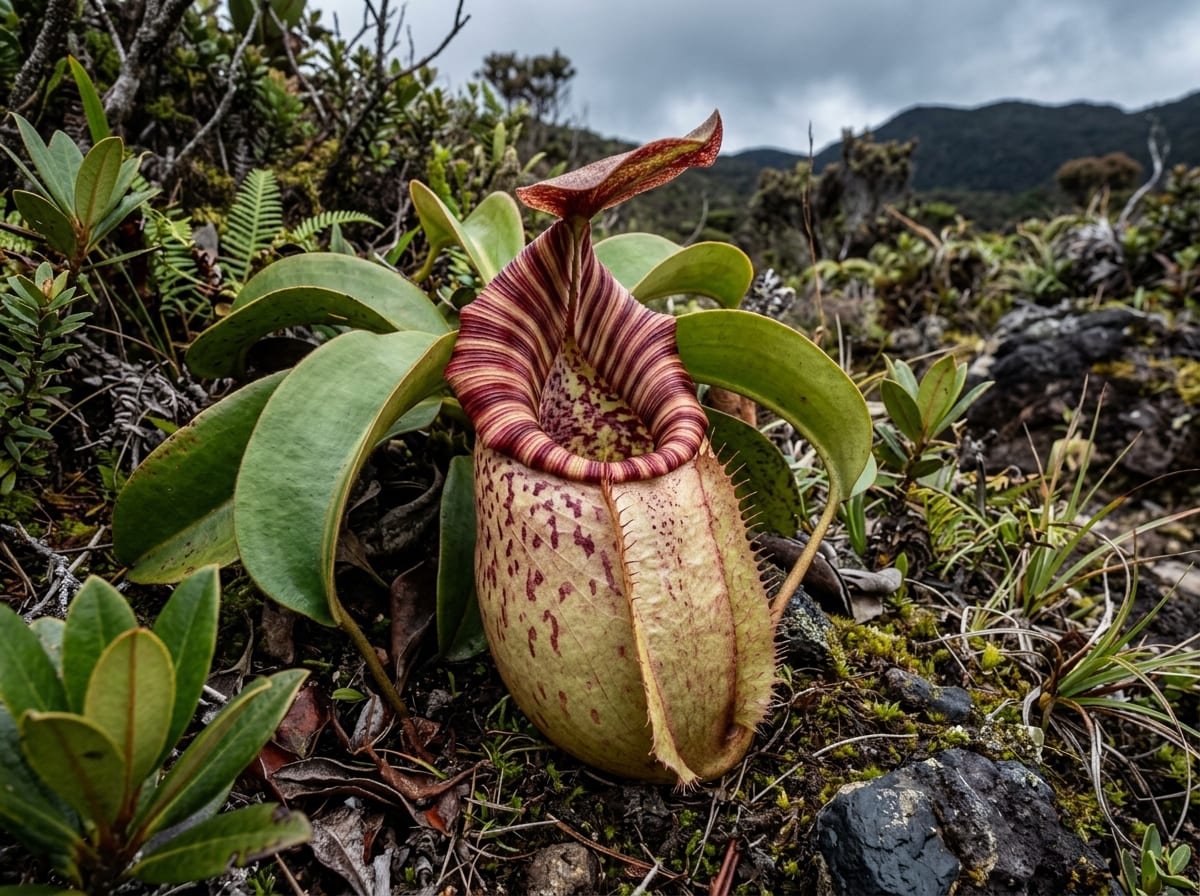
AI-generated image
Nepenthes attenboroughii
AdvancedNepenthes attenboroughii
A large pitcher plant found only on Mount Victoria on Palawan in the Philippines. Its bell-shaped pitchers reach 30 cm tall, with volumes over 1.5 litres recorded. Named after the naturalist David Attenborough.
About
Nepenthes attenboroughii is a pitcher plant species found only in the Victoria Massif of central Palawan, the Philippines. It was discovered in 2007 by A. Robinson, S. McPherson and V. Heinrich and described in 2009, and is named after the British naturalist David Attenborough, a keen admirer of the genus. It grows from 1,450 m to the summit of Mount Victoria at 1,726 m, on rocky ultramafic soil among shrubs 0.8-1.8 m tall. The stem, up to 3.5 cm thick, forms an upright or scrambling shrub about 1.5 m tall, with thick, leathery leaves. The lower pitchers are brittle and bell-shaped, up to 30 cm tall and 16 cm wide, among the largest in the genus, with volumes of over 1.5 litres recorded; upper pitchers are more funnel-shaped and about 25 cm tall. Colour ranges from green or yellow to dark purple throughout. The open pitchers often fill with rain water, and in 2012 the remains of a shrew were found in one, though large insects are thought to be the usual prey. Because of its tiny range and the threat from poachers it is listed as Critically Endangered by the IUCN. In Japan seed-grown plants are sold by specialist nurseries.
Source: Wikipedia (CC BY-SA 4.0)
Size of the Nepenthes attenboroughii
The Nepenthes attenboroughii grows to Lower pitchers up to 30 cm tall and 16 cm wide; plant about 1.5 m tall.
Basic Info
Origin
Philippines (Victoria Massif, Palawan, 1,450-1,726 m)
Lifespan
Perennial (upright to scrambling shrub)
Size
Lower pitchers up to 30 cm tall and 16 cm wide; plant about 1.5 m tall
Temperature
10〜30℃
Humidity
60〜90%
Watering & Fertilizer
Very dilute fertilizer at most (catches large insects)
Growing Tips
Temperature & Overwintering
A highland species that needs cool nights to thrive long term; warm Japanese summer nights are the main challenge.
Light & Placement
Its summit habitat is open scrub, so it likes bright light.
Watering
Use rain water or water low in dissolved minerals and water before the mix dries out. Do not leave the pot standing in water; a free-draining mix keeps the roots healthy.
Soil & Repotting
It grows on rocky ultramafic soil; in cultivation use a free-draining mix and avoid soggy roots.
Fertilizer
If using chemical fertilizer, use it at very low strength; an occasional insect dropped into a pitcher is enough.
Pests & Cautions
Critically Endangered, with poaching a threat in the wild. Buy only seed-grown or tissue-cultured plants.
Nepenthes attenboroughii FAQ
QWhat is the growing difficulty level for Nepenthes attenboroughii?
Advanced. A variety suitable for advanced growers. Requires advanced cultivation techniques and specialized equipment, with careful environmental adjustments needed.
QHow large does Nepenthes attenboroughii get?
The mature size of Nepenthes attenboroughii is Lower pitchers up to 30 cm tall and 16 cm wide; plant about 1.5 m tall. This may vary slightly depending on cultivation environment and individual differences.
QHow should I water and fertilize Nepenthes attenboroughii?
Nepenthes attenboroughii: watering & fertilizer — Very dilute fertilizer at most (catches large insects). Aim for appropriate frequency and amount.
QWhat is the typical price for Nepenthes attenboroughii?
The price of Nepenthes attenboroughii varies significantly by variety, characteristics, size, and lineage. Please check GrowerDirect's price guide for the latest market information.
Last updated: September 23, 2026
References & Sources
Edited & verified by: GrowerDirect Editorial Team
The classifications, regulations, and growing data on this page are created and verified based on the primary information database below.
Taxonomy & Authority
Accepted name: Nepenthes attenboroughii A.S.Rob., S.McPherson & V.B.Heinrich
Authority databases: GBIF · GBIF Nepenthes attenboroughii A.S.Rob., S.Mc Pherson & V.B.Heinrich
Nomenclature follows global taxonomic authority databases.
Regulations & Conservation Status
The whole genus Nepenthes is listed in CITES Appendix II (apart from a few Appendix I species), and this covers hybrids and cultivars too. Import and export across borders require CITES permits; buying, selling and growing within Japan require no paperwork. It is Critically Endangered on the IUCN Red List.
Sources: Species+ (CITES) Nepenthes
Regulations may change. Always verify the latest information with the relevant authorities.
Related Species
Find listings for this species
Related Articles
Developing Nepenthes Pitcher Traps Completely: Cultivation Secrets Through Environmental Management and Physiological Approaches
The carnivorous leaves of Nepenthes represent the masterpiece of an insect-trapping mechanism evolved over 200 million years. This article explains how to mature the carnivorous leaves completely and develop healthy plants with actual predatory function through humidity, light, and nutrient management.
Growing Pitcher Plants Without a Greenhouse: How to Get Pitchers to Form Indoors
Explains how to grow carnivorous pitcher plants (Nepenthes) indoors without a greenhouse. Covers reasons why pitchers fail to form and solutions, methods for maintaining humidity, variety selection, and tips for winter care.
Highland Nepenthes Growing Guide | Cool Management for High-Altitude Pitcher Plants
Explains the characteristics of high-altitude nepenthes (highland nepenthes), summer air conditioning management, and methods for controlling humidity and temperature.
How to Grow Nepenthes | Cultivation Techniques to Grow Larger Pitchers
We explain the basic cultivation methods for Nepenthes and the humidity, temperature, and light management techniques to grow beautiful pitchers large.
Can't find the plant you're looking for?
Post your wishes for free and growers with matching plants will contact you with introductions.