Source: Wikimedia Commons
Nepenthes albomarginata
IntermediateNepenthes albomarginata
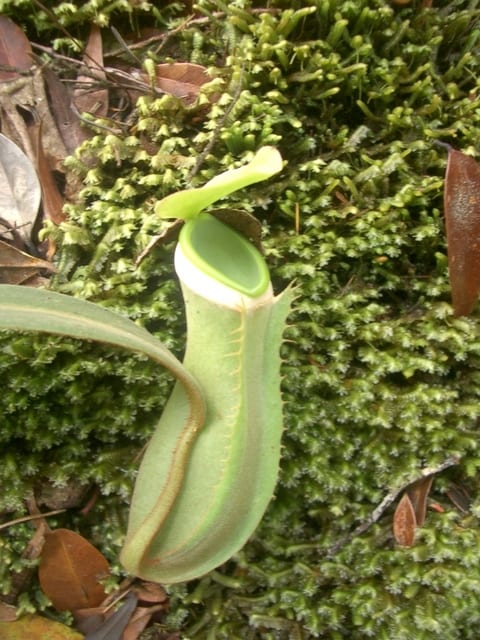
True to its name ('white-margined'), this pitcher plant has a band of white hairs just below the rim. The hairs lure termites, making it known as a termite-specialist carnivore. Pitchers are about 15 cm tall.
About
Nepenthes albomarginata is a pitcher plant species widespread in Borneo, Peninsular Malaysia, Sumatra and smaller nearby islands. The name combines the Latin for 'white' and 'margin', after the band of white hairs just below the peristome. Thomas Lobb collected it in 1848 and Lindley described it the following year; it has been grown in Britain since 1856. The stem climbs to 4 m and the leaves lack a petiole. The pitchers are cylindrical with a swollen lower third, and small at about 15 cm tall and 4 cm wide. Most of the plant is covered in short white star-shaped hairs. The white band serves as bait for termites: when a foraging column comes to graze on the hairs, many termites fall into the pitcher and cannot climb out. Such specialisation on a single prey group is unusual among carnivorous plants, and it has been described as the only plant known to offer its own tissue as bait. Pitchers that have caught termites lose their white band. It grows from sea level to 1,200 m in kerangas (heath) forest and on lowland summits, on peat and limestone. Green and strongly red colour forms exist, and in Japan it is sold both by mass-market shops and specialist nurseries.
Source: Wikipedia (CC BY-SA 4.0)
Size of the Nepenthes albomarginata
The Nepenthes albomarginata grows to Pitchers about 15 cm tall; stems to 4 m.
Basic Info
Origin
Borneo, Peninsular Malaysia and Sumatra (0-1,200 m)
Lifespan
Perennial climber
Size
Pitchers about 15 cm tall; stems to 4 m
Temperature
10〜30℃
Humidity
60〜90%
Watering & Fertilizer
Very dilute fertilizer at most (catches termites and other insects)
Growing Tips
Light & Placement
Grow in bright light; it comes from open heath forest and summits, and pitchers poorly in shade.
Watering
Use rain water or water low in dissolved minerals and water before the mix dries out. Do not leave the pot standing in water; a free-draining mix keeps the roots healthy.
Temperature & Overwintering
Found from sea level to 1,200 m and usually treated as lowland; it dislikes cold, so keep it in a warm room in winter.
Soil & Repotting
Plant in a free-draining, airy mix; pure sphagnum or orchid mix with sphagnum or perlite are common choices.
Fertilizer
If using chemical fertilizer, use it at very low strength; an occasional insect dropped into a pitcher is enough.
Pests & Cautions
The white band may disappear after the pitcher catches prey; this is normal for the species, not a disease.
Nepenthes albomarginata FAQ
QWhat is the growing difficulty level for Nepenthes albomarginata?
Intermediate. A variety suitable for intermediate growers. Requires some cultivation experience and knowledge of environment management. Pay careful attention to temperature and humidity control.
QHow large does Nepenthes albomarginata get?
The mature size of Nepenthes albomarginata is Pitchers about 15 cm tall; stems to 4 m. This may vary slightly depending on cultivation environment and individual differences.
QHow should I water and fertilize Nepenthes albomarginata?
Nepenthes albomarginata: watering & fertilizer — Very dilute fertilizer at most (catches termites and other insects). Aim for appropriate frequency and amount.
QWhat is the typical price for Nepenthes albomarginata?
The price of Nepenthes albomarginata varies significantly by variety, characteristics, size, and lineage. Please check GrowerDirect's price guide for the latest market information.
Last updated: September 23, 2026
References & Sources
Edited & verified by: GrowerDirect Editorial Team
The classifications, regulations, and growing data on this page are created and verified based on the primary information database below.
Taxonomy & Authority
Accepted name: Nepenthes albomarginata Lobb ex Lindl.
Synonyms: Nepenthes albocincta, Nepenthes teysmanniana, Nepenthes tomentella
Authority databases: GBIF · GBIF Nepenthes albomarginata Lobb ex Lindl.
Nomenclature follows global taxonomic authority databases.
Regulations & Conservation Status
The whole genus Nepenthes is listed in CITES Appendix II (apart from a few Appendix I species), and this covers hybrids and cultivars too. Import and export across borders require CITES permits; buying, selling and growing within Japan require no paperwork.
Sources: Species+ (CITES) Nepenthes albomarginata
Regulations may change. Always verify the latest information with the relevant authorities.
Related Species
Find listings for this species
Related Articles
Developing Nepenthes Pitcher Traps Completely: Cultivation Secrets Through Environmental Management and Physiological Approaches
The carnivorous leaves of Nepenthes represent the masterpiece of an insect-trapping mechanism evolved over 200 million years. This article explains how to mature the carnivorous leaves completely and develop healthy plants with actual predatory function through humidity, light, and nutrient management.
Growing Pitcher Plants Without a Greenhouse: How to Get Pitchers to Form Indoors
Explains how to grow carnivorous pitcher plants (Nepenthes) indoors without a greenhouse. Covers reasons why pitchers fail to form and solutions, methods for maintaining humidity, variety selection, and tips for winter care.
Highland Nepenthes Growing Guide | Cool Management for High-Altitude Pitcher Plants
Explains the characteristics of high-altitude nepenthes (highland nepenthes), summer air conditioning management, and methods for controlling humidity and temperature.
How to Grow Nepenthes | Cultivation Techniques to Grow Larger Pitchers
We explain the basic cultivation methods for Nepenthes and the humidity, temperature, and light management techniques to grow beautiful pitchers large.
Can't find the plant you're looking for?
Post your wishes for free and growers with matching plants will contact you with introductions.