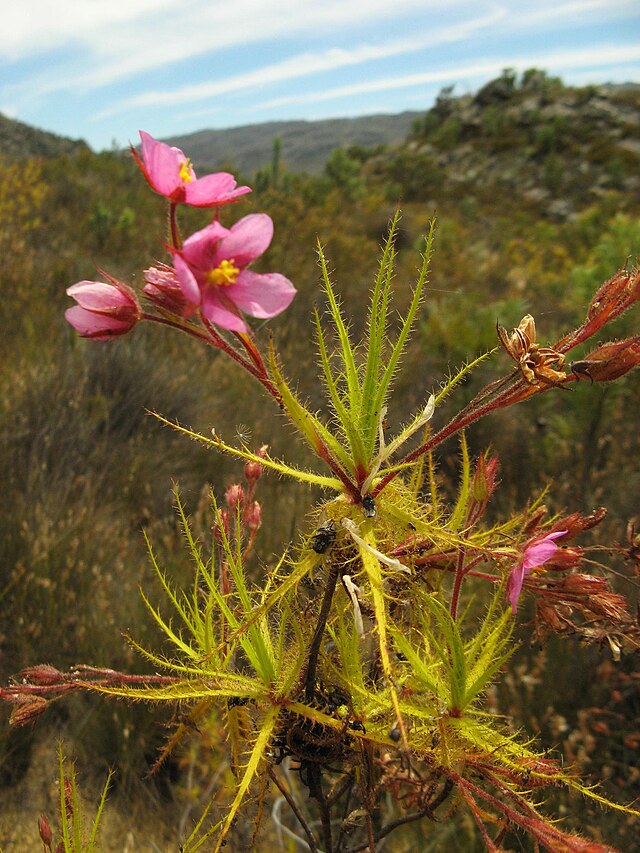
Source: Wikimedia Commons
Roridula Dentata
AdvancedRoridula dentata
A semi-carnivorous plant from South Africa that traps insects with sticky glands but gains nutrients via symbiotic assassin bugs.
About
Roridula dentata is the second of the two species in the genus Roridula, also native to the fynbos heathlands of the Western Cape, South Africa. Like its congener R. gorgonias, it is a protocarnivore that traps insects on sticky glandular leaves but cannot digest them independently, instead relying on mutualistic Pameridea bugs whose nitrogenous excreta fertilize the plant. R. dentata is somewhat larger than R. gorgonias, and its species name ('toothed') refers to the distinctly serrated leaf margins that distinguish it from the species. Both species are subject to CITES regulations. Cultivation requires sharply drained mineral or sandy media, a Mediterranean wet-dry seasonal cycle, strong direct sunlight, and good air movement. It is considered moderately to highly challenging in cultivation.
Lifespan of the Roridula Dentata
The Roridula Dentata lives 10+ years.
Size of the Roridula Dentata
The Roridula Dentata grows to 30-100cm.
Basic Info
Origin
Western Cape, South Africa, fynbos heathland vegetation
Lifespan
10+ years
Size
30-100cm
Temperature
10〜30℃
Humidity
60〜90%
Watering & Fertilizer
Insects (auto-capture)
Growing Tips
Light & Placement
Strong direct sun and good airflow are essential. It weakens quickly in low light or stuffy spots, so a sunny outdoor position is standard.
Soil & Repotting
Use a free-draining, acidic, nutrient-poor sandy medium. Plant in a deep pot and repot as little as possible to spare the roots.
Watering
Mimic a Mediterranean climate with wet-dry cycles. Use pure water, soak thoroughly once the medium dries, and avoid standing water.
Pests & Cautions
It cannot digest prey itself and relies on symbiotic bugs' droppings for nitrogen. That partnership is absent in cultivation, making it fairly difficult.
Pruning & Shaping
Grows as a shrub to 30-100 cm. The woody stems resent hard cutting back, so limit pruning to light shaping.
Roridula Dentata FAQ
QWhat is the growing difficulty level for Roridula Dentata?
Advanced. A variety suitable for advanced growers. Requires advanced cultivation techniques and specialized equipment, with careful environmental adjustments needed.
QWhat is the lifespan of Roridula Dentata?
The average lifespan of Roridula Dentata is 10+ years. With proper cultivation environment and nutrient management, you can keep it healthy for a long time.
QHow large does Roridula Dentata get?
The mature size of Roridula Dentata is 30-100cm. This may vary slightly depending on cultivation environment and individual differences.
QHow should I water and fertilize Roridula Dentata?
Roridula Dentata: watering & fertilizer — Insects (auto-capture). Aim for appropriate frequency and amount.
QWhat is the typical price for Roridula Dentata?
The price of Roridula Dentata varies significantly by variety, characteristics, size, and lineage. Please check GrowerDirect's price guide for the latest market information.
Last updated: September 17, 2026
References & Sources
Edited & verified by: GrowerDirect Editorial Team
The classifications, regulations, and growing data on this page are created and verified based on the primary information database below.
Taxonomy & Authority
Accepted name: Roridula dentata L.
Synonyms: Drosera roridula Thunb., Roridula muscicarpa Gaertn., Roridula brachysepala Gand., Drosera verticillata (Burm.f.) L., Ireon verticillatum Burm.f., Roridula verticillata (Burm.f.) Pers.
Authority databases: GBIF · POWO · ICPS cultivar registration (International Carnivorous Plant Society)
Nomenclature follows global taxonomic authority databases.
Regulations & Conservation Status
This genus is not listed in CITES Appendices (among carnivorous plants, only Nepenthes/Sarracenia/Dionaea are subject to CITES).
Sources: CITES Appendices (carnivorous plants) - ICPS/Barry Rice / CITES & Carnivorous Plant Checklist (RBG Kew)
Regulations may change. Always verify the latest information with the relevant authorities.
Related Species
Find listings for this species
Related Articles
Roridula Care Guide
From Roridula's unique ecology of sticky traps and symbiosis with minute pirate bugs, this guide explains key cultivation points including location, watering, soil, and propagation.
Carnivorous Plant Dormancy Awakening Guide | Correct Timing for Resuming Feeding, Fertilizing, and Watering
A step-by-step guide to the correct timing for resuming watering, restoring humidity, feeding, and fertilizing as your carnivorous plants emerge from dormancy and enter spring growth.
Why Carnivorous Plant Traps Fail and How to Fix Them | Optimizing Humidity, Nutrition, and Prey-Capture Systems
Investigate why carnivorous plant traps fail to capture insects. From humidity management to nutrient balance, gland secretion function, and dormancy, a detailed scientific approach to restoring trap function.
A Guide to Giving Carnivorous Plants as Gifts | How to Choose Unique Presents and Tips for Long-Term Enjoyment
A guide to selecting carnivorous plants as gifts. Covers how to choose varieties based on the recipient's type, and important care tips to communicate before gifting, such as water quality and dormancy periods.
Can't find the plant you're looking for?
Post your wishes for free and growers with matching plants will contact you with introductions.