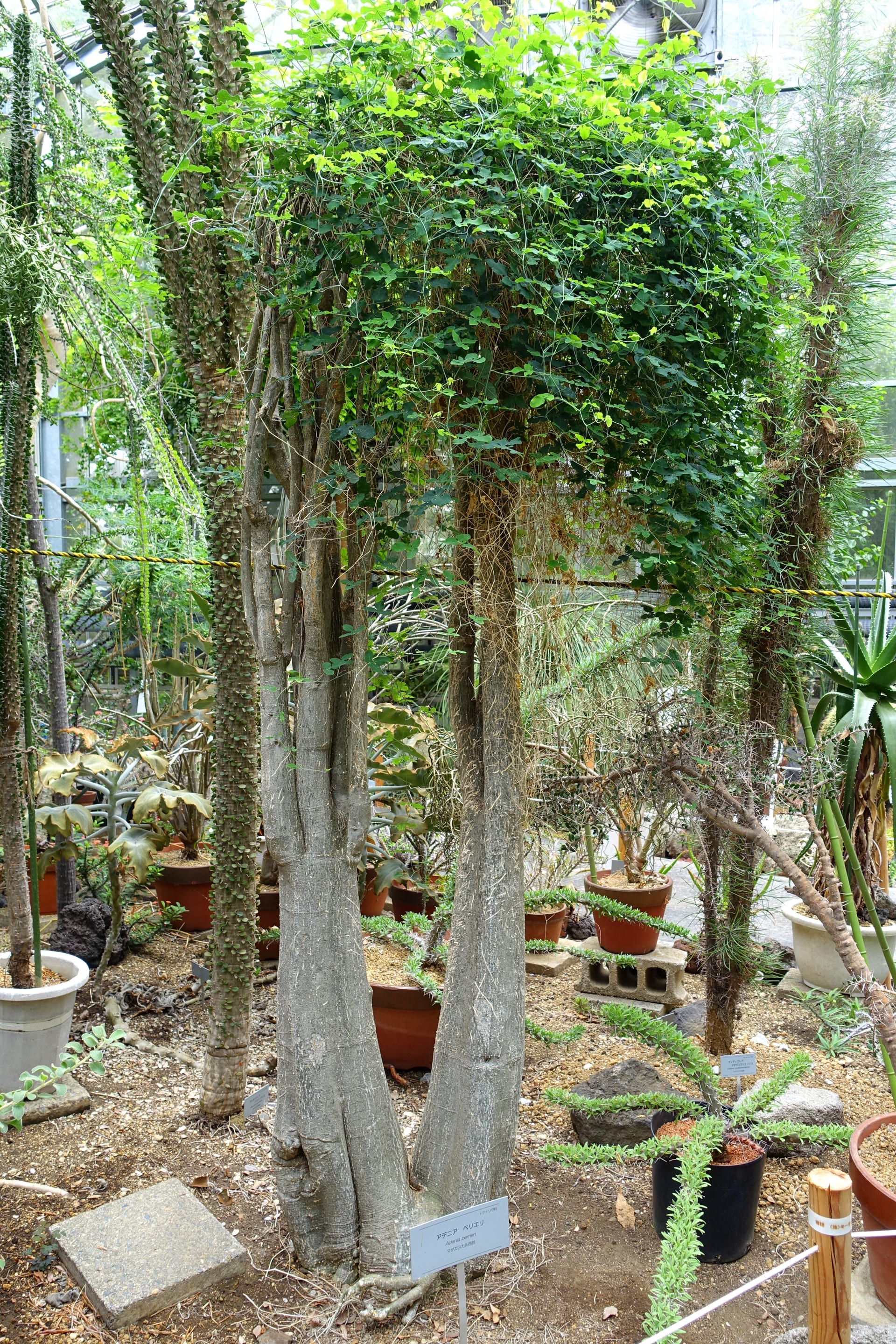
Source: Wikimedia Commons
Adenia perrieri
IntermediateAdenia perrieri
A Madagascan Adenia that sends green vines with lace-like, finely divided leaves from a caudex about 20 cm across. It is grown more for its foliage than its caudex, and a white-spotted "snowflake" form is also known.
About
Adenia perrieri is a climbing caudiciform in the passion-flower family (Passifloraceae) from the Ambongo-Boina region of north-western Madagascar, where it grows in sandy soil, on basalt rocks and on the limestone pinnacles known as tsingy. The caudex, which stores water through drought, swells to about 20 cm across. From it rises a short, thin woody stem that produces one or several annual green vines climbing to 2 m, occasionally 3 m. The whole plant is hairless. The leaves are deeply divided into five palmate segments up to 3.5 cm long and 1.5 cm wide, giving a delicate, lace-like look. Leaf shape varies with location: plants in natural vegetation without bushfires have simple segments, while those where fires recur have deeply dissected lobes. A form with white-spotted leaves, called "snowflake", is also popular; this species is grown for its foliage rather than its caudex. The flowers are small and greenish white. The IUCN Red List category is Vulnerable. In Japan seed-grown plants and variegated rooted cuttings are sold through online auctions.
Size of the Adenia perrieri
The Adenia perrieri grows to Caudex about 20 cm across; vines 2 m (occasionally 3 m) long.
Basic Info
Origin
North-western Madagascar (Ambongo-Boina region)
Lifespan
Very slow-growing and long-lived (little published data)
Size
Caudex about 20 cm across; vines 2 m (occasionally 3 m) long
Temperature
10〜35℃
Watering & Fertilizer
Moderate slow-release feeding in the growing season
Growing Tips
Light & Placement
Grow it in light shade, with the caudex shaded and the leaves getting some sun; avoid harsh midsummer sun. Indoors give it bright light.
Watering
Water frequently while it is in full growth, but it rots if kept too wet, so a free-draining mix is essential.
Dormancy Care
Once the vines die back in winter, stop watering and keep it dry; too much water while leafless causes rot.
Soil & Repotting
Use a very porous mix with plenty of pumice and perlite; it does better in a slightly acidic soil.
Fertilizer
Give moderate doses of a balanced slow-release fertilizer in the growing season; ample water, warmth and feeding can speed its very slow growth somewhat.
Pests & Cautions
Adenia are reported to be highly toxic in all parts: wear gloves when pruning or repotting and keep plants away from children and pets.
Adenia perrieri FAQ
QWhat is the growing difficulty level for Adenia perrieri?
Intermediate. A variety suitable for intermediate growers. Requires some cultivation experience and knowledge of environment management. Pay careful attention to temperature and humidity control.
QHow large does Adenia perrieri get?
The mature size of Adenia perrieri is Caudex about 20 cm across; vines 2 m (occasionally 3 m) long. This may vary slightly depending on cultivation environment and individual differences.
QHow should I water and fertilize Adenia perrieri?
Adenia perrieri: watering & fertilizer — Moderate slow-release feeding in the growing season. Aim for appropriate frequency and amount.
QWhat is the typical price for Adenia perrieri?
The price of Adenia perrieri varies significantly by variety, characteristics, size, and lineage. Please check GrowerDirect's price guide for the latest market information.
Last updated: September 23, 2026
References & Sources
Edited & verified by: GrowerDirect Editorial Team
The classifications, regulations, and growing data on this page are created and verified based on the primary information database below.
Taxonomy & Authority
Regulations & Conservation Status
Not listed in CITES (checked on Species+). No special procedure is needed for transfers within Japan. The IUCN Red List category is Vulnerable.
Sources: Species+ (CITES): Adenia perrieri / IUCN Red List category via GBIF: Adenia perrieri
Regulations may change. Always verify the latest information with the relevant authorities.
Related Species
Find listings for this species
Related Articles
How to Grow Uncarina | Differences Between the Madagascar Endemic Species Grandidieri and Roeoesliana
An explanation of the appeal and cultivation methods of the Madagascar endemic caudex plant Uncarina genus. We introduce the differences between Uncarina grandidieri and roeoesliana, seedling cultivation, and repotting timing.
Complete Guide to Choosing Caudex Plants as Gifts | Recommended Varieties by Occasion and How to Include Care Notes
A guide to choosing caudex plants as gifts organized by occasion. We introduce how to select varieties based on the recipient's cultivation experience and how to include care notes for long-term enjoyment.
Diagnosing and Treating Poor Root Development in Caudex Plants | Causes and Solutions for Roots That Won't Emerge or Won't Grow
A detailed guide to root emergence problems in caudex plants. From diagnosis methods to solutions, practical techniques for promoting healthy root development are introduced.
Complete Guide to Growing Jatropha podagrica (Buddha's Navel) | Cultivation Management to Enjoy Its Distinctive Caudex and Coral-Red Flowers
Characteristics and cultivation methods of the caudex plant Jatropha podagrica. Detailed explanation of watering management during dormancy, soil, and propagation methods.
🩺 Common diseases
Can't find the plant you're looking for?
Post your wishes for free and growers with matching plants will contact you with introductions.