Source: Wikimedia Commons
Ocotillo
IntermediateFouquieria splendens
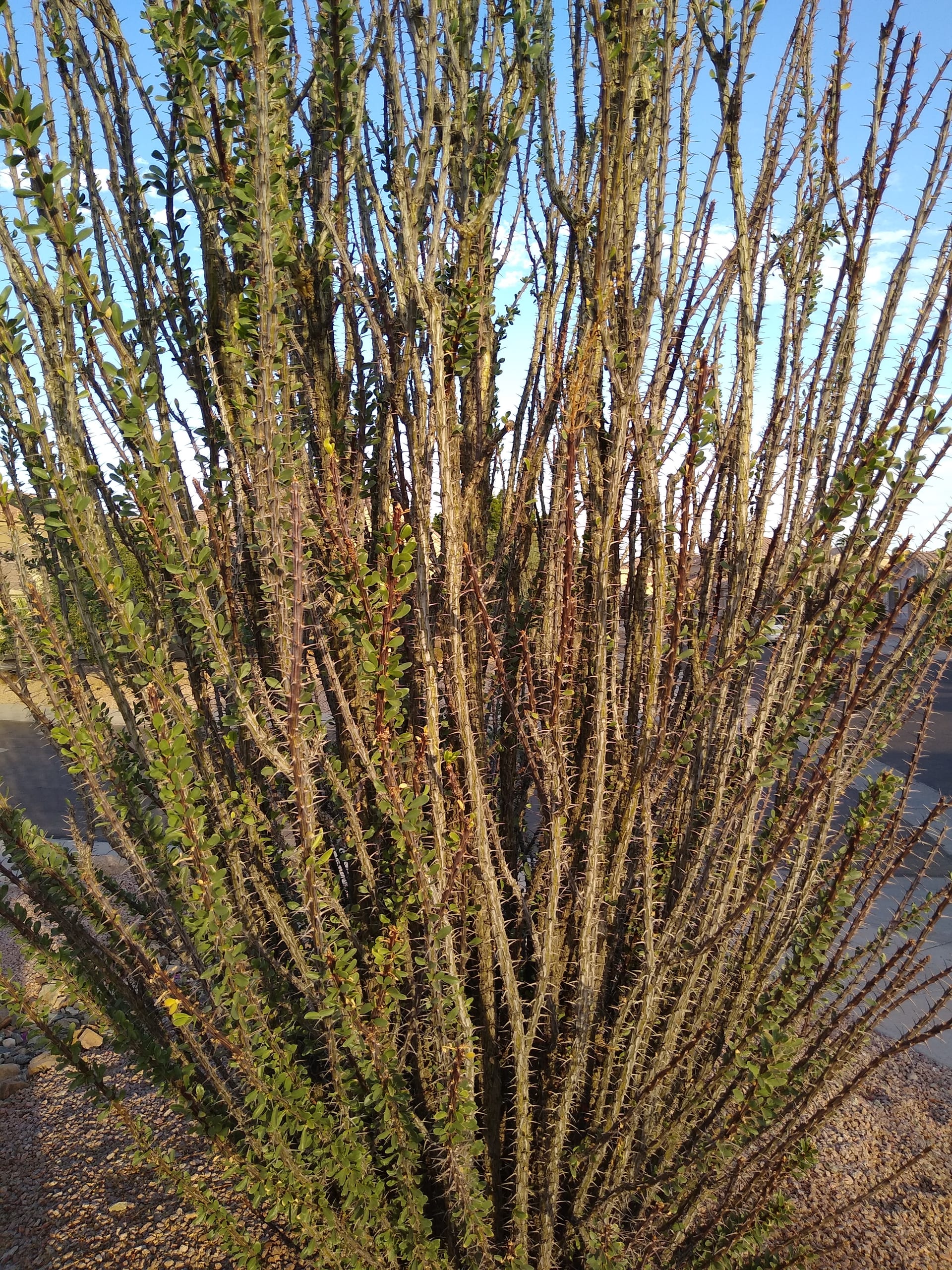
The ocotillo of North American deserts: many spiny, whip-like stems rise from the base, leaf out within days of rain and carry spikes of red tubular flowers at their tips. In Japan subspecies breviflora and campanulata are also sold.
About
Fouquieria splendens, the ocotillo, is a succulent shrub in the Fouquieriaceae and the most widespread species in its genus, native to the Mojave, Sonoran and Chihuahuan deserts of the south-western United States (southern California, southern Nevada, Arizona, New Mexico and Texas) and northern to central Mexico. It grows on dry, rocky hills, slopes and plains from sea level to 1,500 m. It reaches 2.5–6 m (rarely 10 m), with a few to dozens of straight, spiny stems rising from a short, stout base. The stems are about 6 cm thick at the base and have chlorophyll in the bark, so they photosynthesize while leafless. After rain, clusters of leaves appear from short shoots within about 48 hours and fall again as the soil dries, a cycle that can repeat several times a year; on long shoots the leaf stalks harden into spines. Red to orange-red tubular flowers are clustered at the stem tips and pollinated by hummingbirds and carpenter bees. The name ocotillo comes from the Nahuatl for "torch". Subspecies include the typical splendens (flower tube 7–22 mm), breviflora (6–10 mm) and campanulata from Durango, Mexico (5–9 mm, pink to deep purple or creamy white). It closely resembles the Madagascan Alluaudia procera but is unrelated. In Japan plants labelled with subspecies names, and seed, are sold online.
Source: Wikipedia (CC BY-SA 4.0)
Lifespan of the Ocotillo
The Ocotillo lives Long-lived shrub taking 60–100 years to mature.
Size of the Ocotillo
The Ocotillo grows to 2.5–6 m (rarely 10 m) tall; stems about 6 cm thick at the base.
Basic Info
Origin
Deserts of the south-western USA to northern and central Mexico
Lifespan
Long-lived shrub taking 60–100 years to mature
Size
2.5–6 m (rarely 10 m) tall; stems about 6 cm thick at the base
Temperature
10〜35℃
Watering & Fertilizer
Light feeding in the growing season
Growing Tips
Light & Placement
It grows best in full sun to part shade.
Watering
Give moderate water while it is in leaf and keep it dry while it is leafless and dormant.
Soil & Repotting
A plant of dry rocky ground: use a free-draining mix. Seedlings grow fast and need a deep pot for their stout taproot.
Pruning & Shaping
To show off the swollen base, side branches are often pruned away to enlarge the main trunk.
Propagation
Propagate from seed or cuttings; in its native range cut stems used as fencing often take root to form a living fence.
Ocotillo FAQ
QWhat is the growing difficulty level for Ocotillo?
Intermediate. A variety suitable for intermediate growers. Requires some cultivation experience and knowledge of environment management. Pay careful attention to temperature and humidity control.
QWhat is the lifespan of Ocotillo?
The average lifespan of Ocotillo is Long-lived shrub taking 60–100 years to mature. With proper cultivation environment and nutrient management, you can keep it healthy for a long time.
QHow large does Ocotillo get?
The mature size of Ocotillo is 2.5–6 m (rarely 10 m) tall; stems about 6 cm thick at the base. This may vary slightly depending on cultivation environment and individual differences.
QHow should I water and fertilize Ocotillo?
Ocotillo: watering & fertilizer — Light feeding in the growing season. Aim for appropriate frequency and amount.
QWhat is the typical price for Ocotillo?
The price of Ocotillo varies significantly by variety, characteristics, size, and lineage. Please check GrowerDirect's price guide for the latest market information.
Last updated: September 23, 2026
References & Sources
Edited & verified by: GrowerDirect Editorial Team
The classifications, regulations, and growing data on this page are created and verified based on the primary information database below.
Taxonomy & Authority
Regulations & Conservation Status
Not listed in CITES (checked on Species+). No special procedure is needed for transfers within Japan.
Sources: Species+ (CITES): Fouquieria splendens
Regulations may change. Always verify the latest information with the relevant authorities.
Related Species
Find listings for this species
Related Articles
Fouquieria Cultivation Guide
This guide explains the cultivation points for Fouquieria, a caudiciform plant, from its native habitat characteristics to placement, watering, soil, repotting, and propagation methods.
How to Grow Uncarina | Differences Between the Madagascar Endemic Species Grandidieri and Roeoesliana
An explanation of the appeal and cultivation methods of the Madagascar endemic caudex plant Uncarina genus. We introduce the differences between Uncarina grandidieri and roeoesliana, seedling cultivation, and repotting timing.
Complete Guide to Choosing Caudex Plants as Gifts | Recommended Varieties by Occasion and How to Include Care Notes
A guide to choosing caudex plants as gifts organized by occasion. We introduce how to select varieties based on the recipient's cultivation experience and how to include care notes for long-term enjoyment.
Diagnosing and Treating Poor Root Development in Caudex Plants | Causes and Solutions for Roots That Won't Emerge or Won't Grow
A detailed guide to root emergence problems in caudex plants. From diagnosis methods to solutions, practical techniques for promoting healthy root development are introduced.
🩺 Common diseases
Can't find the plant you're looking for?
Post your wishes for free and growers with matching plants will contact you with introductions.