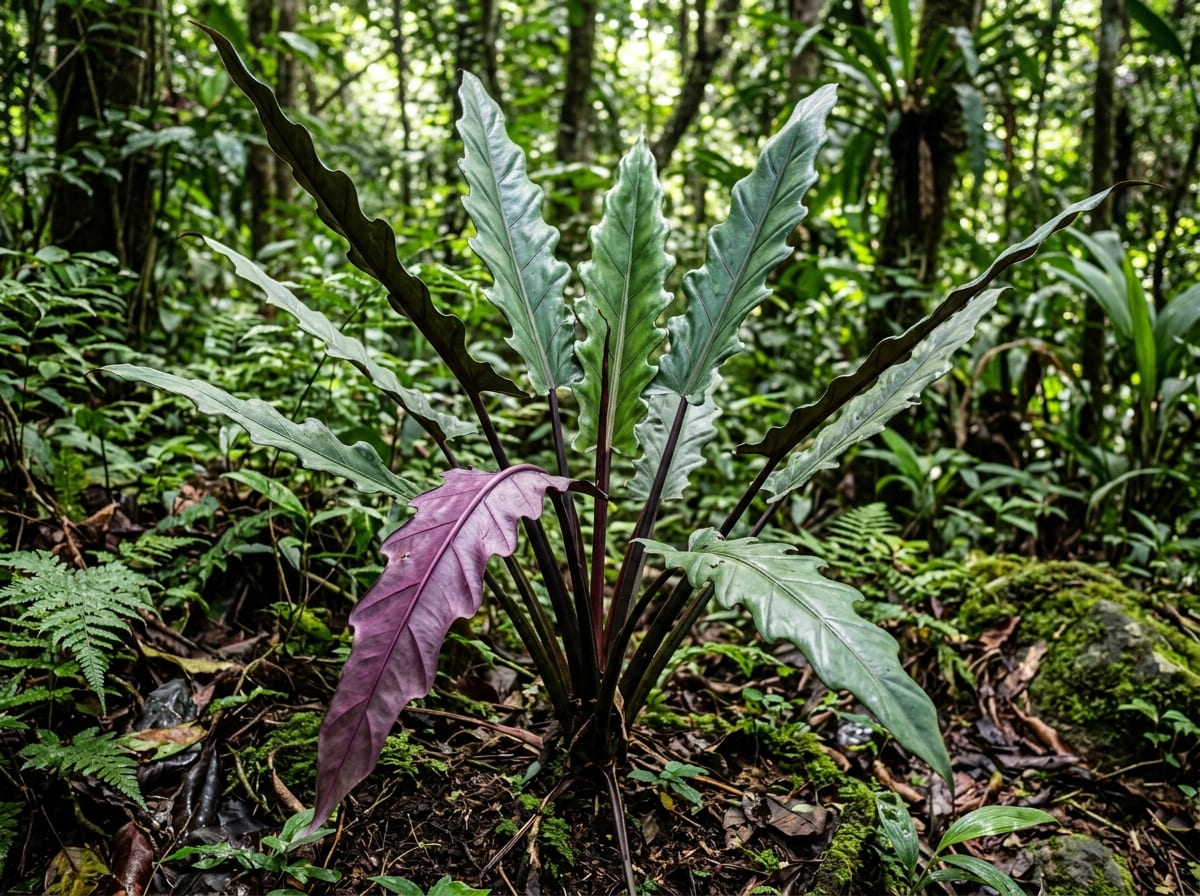
AI-generated image
Purple Sword
IntermediateAlocasia lauterbachiana
A New Guinean Alocasia that holds long, sword-shaped leaves upright. The margins are shallowly scalloped, the upper side metallic green and the underside deep purple. It is sold as 'Purple Sword'.
About
Alocasia lauterbachiana is a perennial aroid from northern New Guinea and the Bismarck Archipelago. It was described in Schizocasia from a sterile plant collected by Lauterbach in montane forest on Mount Sattelberg in 1890, and was transferred to Alocasia by A.Hay in 1990. The original description gives an elongated, spear-shaped blade about 50 cm long with around nine blunt lobes along each margin, metallic green above and dark violet beneath. The upright leaves can reach about 1.5 m, and the plant is sold as 'Purple Sword'. Among mostly round-leaved Alocasias it is easy to recognise by its narrow sword-like blades with scalloped edges. Variegated plants are also offered, with patterns that vary between individuals. Care is as for other Alocasias: bright shade and a free-draining mix. In Japan it is readily available through general houseplant retailers.
Source: Wikipedia (CC BY-SA 4.0)
Size of the Purple Sword
The Purple Sword grows to Upright leaves reach about 1.5 m; blades about 50 cm long.
Temperature & humidity for the Purple Sword
The ideal temperature for the Purple Sword is 20〜25℃. Ideal humidity is 60〜70%.
Basic Info
Origin
Northern New Guinea and the Bismarck Archipelago
Lifespan
Perennial
Size
Upright leaves reach about 1.5 m; blades about 50 cm long
Temperature
20〜25℃
Humidity
60〜70%
Watering & Fertilizer
Dilute liquid feed in the growing season
Growing Tips
Light & Placement
Bright shade or light through a sheer curtain. Too little light makes the petioles stretch and flop.
Watering
Water well when the surface dries in the growing season; water less often and keep drier in winter.
Temperature & Overwintering
Its habitat is humid tropical forest at about 60-70% humidity year-round. Aim for the genus optimum of about 20-25°C and keep it warm indoors in winter.
Soil & Repotting
A free-draining, slightly acidic mix with organic matter. Repot in spring to early summer when root-bound.
Propagation
Propagate from offsets or tubers.
Pests & Cautions
Watch for spider mites, aphids and mealybugs. Contains calcium oxalate; keep away from pets and children.
Purple Sword FAQ
QWhat is the growing difficulty level for Purple Sword?
Intermediate. A variety suitable for intermediate growers. Requires some cultivation experience and knowledge of environment management. Pay careful attention to temperature and humidity control.
QWhat is the ideal temperature for Purple Sword?
The ideal temperature for Purple Sword is 20〜25℃. Recommended humidity is 60〜70%. Avoid sudden temperature changes and maintain a stable environment.
QHow large does Purple Sword get?
The mature size of Purple Sword is Upright leaves reach about 1.5 m; blades about 50 cm long. This may vary slightly depending on cultivation environment and individual differences.
QHow should I water and fertilize Purple Sword?
Purple Sword: watering & fertilizer — Dilute liquid feed in the growing season. Aim for appropriate frequency and amount.
QWhat is the typical price for Purple Sword?
The price of Purple Sword varies significantly by variety, characteristics, size, and lineage. Please check GrowerDirect's price guide for the latest market information.
Last updated: September 23, 2026
References & Sources
Edited & verified by: GrowerDirect Editorial Team
The classifications, regulations, and growing data on this page are created and verified based on the primary information database below.
Taxonomy & Authority
Regulations & Conservation Status
Not listed in the CITES Appendices. Not a designated invasive alien species in Japan, nor a nationally rare species under the Act on Conservation of Endangered Species.
Sources: Species+ (CITES listing check) / Ministry of the Environment: List of Invasive Alien Species
Regulations may change. Always verify the latest information with the relevant authorities.
Related Species
Find listings for this species
Related Articles
Alocasia Care Guide: Choosing Varieties, Watering, Summer Care, and Winter Dormancy
Learn the basics of Alocasia care. We explain the characteristics of popular varieties like Polly and Amazonica, proper watering and lighting conditions, heat management during summer, and overwintering methods.
Why New Leaves on Foliage Plants Are Smaller — Practical Solutions for Light, Humidity, and Nutrition
We analyze the causes behind stunted growth and smaller new leaves on foliage plants. From light environment and humidity management to fertilization strategy and root health, we explain each factor based on empirical data and introduce methods to restore new leaf size.
Spider Mite and Scale Insect Control: Practical Pest Prevention
Learn to identify spider mites and scale insects on houseplants and recognize damage signs, master practical spider mite control methods, discover effective scale insect elimination techniques, create pest-resistant environments with seasonal management, understand pesticide safety precautions, and discover early detection and prevention strategies.
Root Rot Prevention and Root Zone Regeneration Management in Foliage Plants | Soil Selection, Watering, and Early Diagnosis & Recovery Techniques
Root rot is the greatest threat to foliage plants. This article covers practical knowledge from the mechanisms of root rot development to prevention, early-stage diagnosis and treatment methods, and ensuring long-term plant health through soil and watering management.
🩺 Common diseases
Can't find the plant you're looking for?
Post your wishes for free and growers with matching plants will contact you with introductions.