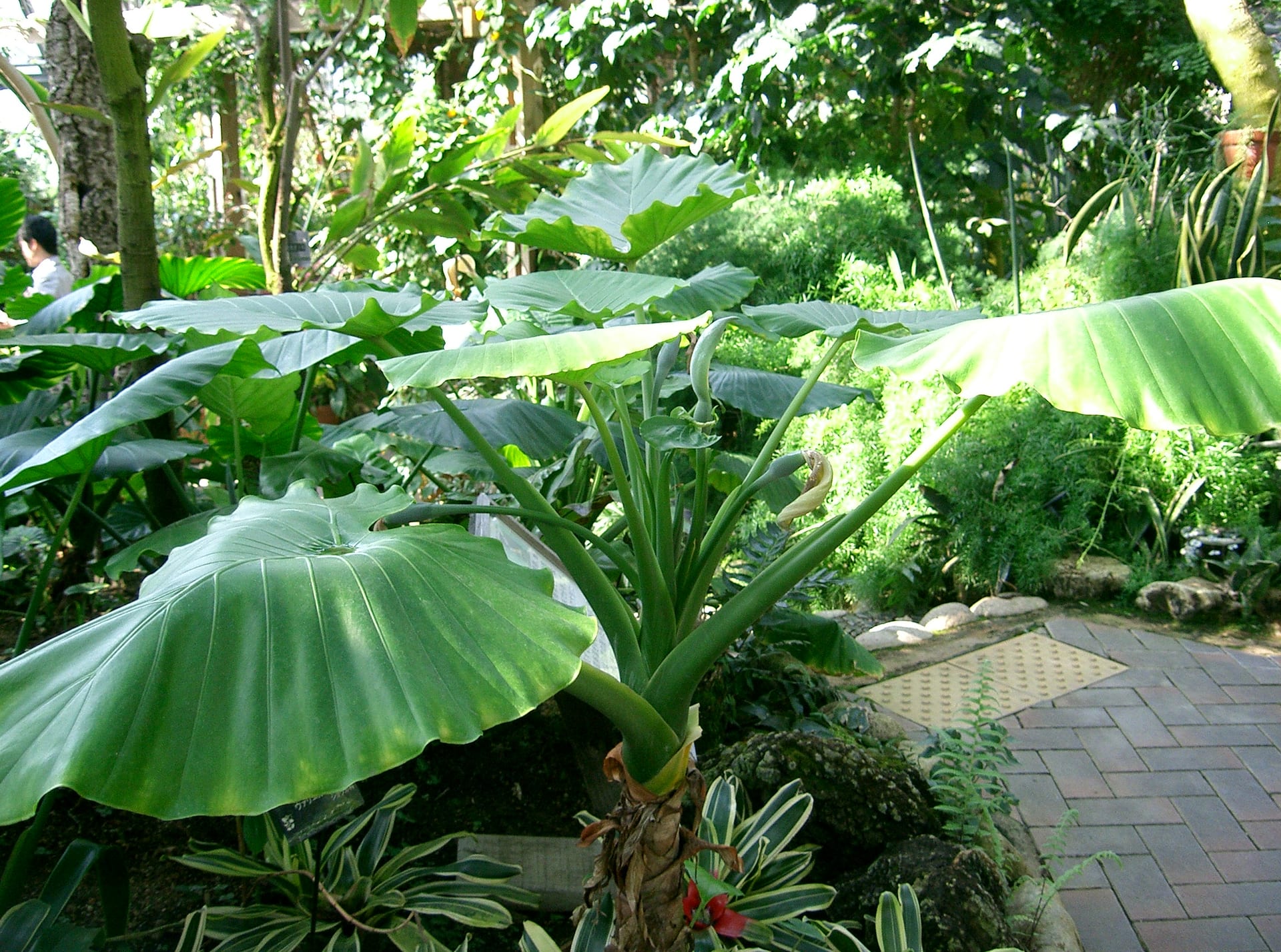
Source: Wikimedia Commons
Night-scented Lily / Giant Upright Elephant Ear
BeginnerAlocasia odora
The most widely grown Alocasia in Japan, holding large oval leaves up on thick petioles. Its rod-like rhizome creeping along the soil surface is the key difference from look-alike taro. The whole plant is poisonous.
About
Alocasia odora is an evergreen perennial in the arum family (Araceae), native from southern China and Taiwan through Indochina to India, and wild in Japan from southern Shikoku and Kyushu to the Ryukyu Islands. Plants reach 1-2 m, with petioles 60-120 cm long and leaf blades that are heart-shaped at the base and pointed at the tip. It closely resembles taro (Colocasia esculenta), but instead of forming a rounded corm it has a thick rod-like rhizome that creeps along the soil surface and turns upward at the tip. The whole plant contains calcium oxalate, and Japan's Ministry of Health, Labour and Welfare records poisonings where it was mistaken for taro or its stems for edible taro petioles. It is tough, tolerating some dryness and shade, and is often sold simply as 'Alocasia'. A population at Hachiman Shrine in Goto, Nagasaki, is designated a natural monument. It is one of the most commonly available houseplants in Japanese garden centres and online shops. Leaves can reach 60 cm long and have wavy margins.
Source: Wikipedia (CC BY-SA 4.0)
Size of the Night-scented Lily / Giant Upright Elephant Ear
The Night-scented Lily / Giant Upright Elephant Ear grows to 1-2 m tall in the wild; petioles 60-120 cm.
Temperature & humidity for the Night-scented Lily / Giant Upright Elephant Ear
The ideal temperature for the Night-scented Lily / Giant Upright Elephant Ear is 20〜25℃.
Basic Info
Origin
Southern China, Taiwan, Indochina, India and southern Japan (southern Shikoku to the Ryukyu Islands)
Lifespan
Perennial
Size
1-2 m tall in the wild; petioles 60-120 cm
Temperature
20〜25℃
Humidity
50〜70%
Watering & Fertilizer
Slow-release or liquid fertiliser in the growing season
Growing Tips
Light & Placement
Prefers bright shade to part shade. Indoors, a spot behind a sheer curtain is ideal; strong midsummer sun scorches the leaves.
Watering
Water well when the surface dries during the growing season. Cut back in winter and keep on the dry side.
Temperature & Overwintering
Alocasias grow best at around 20-25°C by day. Bring indoors in winter and keep away from frost and cold drafts.
Soil & Repotting
Use a free-draining, slightly acidic mix with organic matter. Repot in spring to early summer when the rhizome fills the pot.
Propagation
Divide offsets or cut the rhizome into sections. Wear gloves to avoid contact with the sap.
Pests & Cautions
Prone to spider mites; overwatering causes rot and leaf spots. The whole plant contains calcium oxalate and the sap can irritate skin. Never mistake it for edible taro, and keep it away from pets and children.
Night-scented Lily / Giant Upright Elephant Ear FAQ
QWhat is the growing difficulty level for Night-scented Lily / Giant Upright Elephant Ear?
Beginner. A variety suitable for beginners. No special equipment or experience is required—you can grow it without problems by setting up a basic cultivation environment.
QWhat is the ideal temperature for Night-scented Lily / Giant Upright Elephant Ear?
The ideal temperature for Night-scented Lily / Giant Upright Elephant Ear is 20〜25℃. Avoid sudden temperature changes and maintain a stable environment.
QHow large does Night-scented Lily / Giant Upright Elephant Ear get?
The mature size of Night-scented Lily / Giant Upright Elephant Ear is 1-2 m tall in the wild; petioles 60-120 cm. This may vary slightly depending on cultivation environment and individual differences.
QHow should I water and fertilize Night-scented Lily / Giant Upright Elephant Ear?
Night-scented Lily / Giant Upright Elephant Ear: watering & fertilizer — Slow-release or liquid fertiliser in the growing season. Aim for appropriate frequency and amount.
QWhat is the typical price for Night-scented Lily / Giant Upright Elephant Ear?
The price of Night-scented Lily / Giant Upright Elephant Ear varies significantly by variety, characteristics, size, and lineage. Please check GrowerDirect's price guide for the latest market information.
Last updated: September 23, 2026
References & Sources
Edited & verified by: GrowerDirect Editorial Team
The classifications, regulations, and growing data on this page are created and verified based on the primary information database below.
Taxonomy & Authority
Regulations & Conservation Status
Not listed in the CITES Appendices. Not a designated invasive alien species in Japan, nor a nationally rare species under the Act on Conservation of Endangered Species.
Sources: Species+ (CITES listing check) / Ministry of the Environment: List of Invasive Alien Species
Regulations may change. Always verify the latest information with the relevant authorities.
Related Species
Find listings for this species
Related Articles
Alocasia Care Guide: Choosing Varieties, Watering, Summer Care, and Winter Dormancy
Learn the basics of Alocasia care. We explain the characteristics of popular varieties like Polly and Amazonica, proper watering and lighting conditions, heat management during summer, and overwintering methods.
Why New Leaves on Foliage Plants Are Smaller — Practical Solutions for Light, Humidity, and Nutrition
We analyze the causes behind stunted growth and smaller new leaves on foliage plants. From light environment and humidity management to fertilization strategy and root health, we explain each factor based on empirical data and introduce methods to restore new leaf size.
Spider Mite and Scale Insect Control: Practical Pest Prevention
Learn to identify spider mites and scale insects on houseplants and recognize damage signs, master practical spider mite control methods, discover effective scale insect elimination techniques, create pest-resistant environments with seasonal management, understand pesticide safety precautions, and discover early detection and prevention strategies.
Root Rot Prevention and Root Zone Regeneration Management in Foliage Plants | Soil Selection, Watering, and Early Diagnosis & Recovery Techniques
Root rot is the greatest threat to foliage plants. This article covers practical knowledge from the mechanisms of root rot development to prevention, early-stage diagnosis and treatment methods, and ensuring long-term plant health through soil and watering management.
🩺 Common diseases
Can't find the plant you're looking for?
Post your wishes for free and growers with matching plants will contact you with introductions.