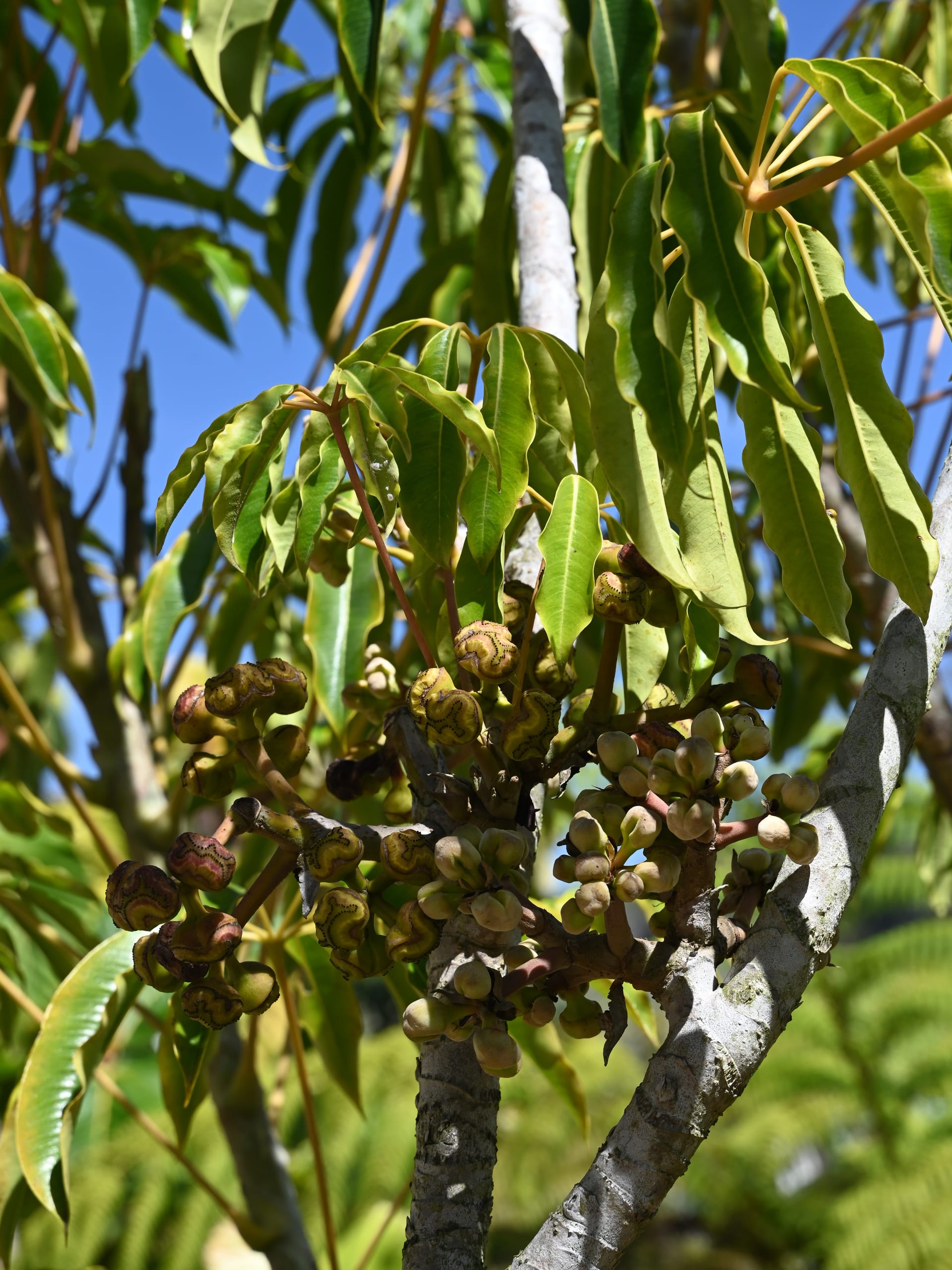
Source: Wikimedia Commons
Tupidanthus (Mallet Flower)
BeginnerHeptapleurum calyptratum
An evergreen in the ivy family whose long petioles carry 7-11 large leaflets in a palmate spread. Sold under its old genus name Tupidanthus, with lush, drooping foliage.
About
Tupidanthus is the trade name for Heptapleurum calyptratum in the ivy family (Araliaceae). It was formerly placed in Tupidanthus (as T. calyptratus) and in Schefflera (as S. pueckleri), and garden centres still often sell it under the old name. It ranges from eastern India and Bangladesh through Tibet and Indochina to southern China, growing in forests at 900-1,700 m. In the wild it is a shrub or small tree 4-10 m tall whose stems eventually scramble up other trees. The palmate leaves have petioles 15-60 cm long bearing 7-11 elliptic leaflets 12-23 cm long. The green, mallet-shaped flowers give it the English name mallet flower. The familiar umbrella tree (Heptapleurum arboricola) is now in the same genus, but Tupidanthus is easy to tell apart by its larger leaflets and drooping, dense foliage. It tolerates shade and is regarded as a good indoor plant. In Japan it is sold as a large pot plant, though by relatively few nurseries.
Source: Wikipedia (CC BY-SA 4.0)
Size of the Tupidanthus (Mallet Flower)
The Tupidanthus (Mallet Flower) grows to 4-10 m tall in the wild; pot plants are kept in check by pruning.
Basic Info
Origin
Eastern India and Bangladesh to Indochina and southern China
Lifespan
Evergreen woody plant (perennial)
Size
4-10 m tall in the wild; pot plants are kept in check by pruning
Temperature
15〜30℃
Humidity
50〜70%
Watering & Fertilizer
Light houseplant feed in the growing season
Growing Tips
Light & Placement
Shade tolerant and suited to indoor use. Growth is fullest in bright light without direct sun.
Watering
Moderate water needs. Water when the surface of the mix dries and do not leave water in the saucer.
Temperature & Overwintering
It is not cold hardy, so keep it in a warm room in winter, away from cold windows.
Soil & Repotting
Use a well-drained mix. It grows large, so move it to a slightly bigger pot when root-bound.
Pruning & Shaping
Prune overlong branches to keep the shape. The branches are weak, so handle the plant carefully when moving it.
Pests & Cautions
Parts of the plant can be mildly toxic if eaten in quantity, so keep it away from pets and small children.
Tupidanthus (Mallet Flower) FAQ
QWhat is the growing difficulty level for Tupidanthus (Mallet Flower)?
Beginner. A variety suitable for beginners. No special equipment or experience is required—you can grow it without problems by setting up a basic cultivation environment.
QHow large does Tupidanthus (Mallet Flower) get?
The mature size of Tupidanthus (Mallet Flower) is 4-10 m tall in the wild; pot plants are kept in check by pruning. This may vary slightly depending on cultivation environment and individual differences.
QHow should I water and fertilize Tupidanthus (Mallet Flower)?
Tupidanthus (Mallet Flower): watering & fertilizer — Light houseplant feed in the growing season. Aim for appropriate frequency and amount.
QWhat is the typical price for Tupidanthus (Mallet Flower)?
The price of Tupidanthus (Mallet Flower) varies significantly by variety, characteristics, size, and lineage. Please check GrowerDirect's price guide for the latest market information.
Last updated: September 23, 2026
References & Sources
Edited & verified by: GrowerDirect Editorial Team
The classifications, regulations, and growing data on this page are created and verified based on the primary information database below.
Taxonomy & Authority
Regulations & Conservation Status
Not listed in the CITES Appendices. Not a designated invasive alien species in Japan, nor a nationally rare species under the Act on Conservation of Endangered Species.
Sources: Species+ (CITES listing check) / Ministry of the Environment: List of Invasive Alien Species
Regulations may change. Always verify the latest information with the relevant authorities.
Related Species

Find listings for this species
Related Articles
Why New Leaves on Foliage Plants Are Smaller — Practical Solutions for Light, Humidity, and Nutrition
We analyze the causes behind stunted growth and smaller new leaves on foliage plants. From light environment and humidity management to fertilization strategy and root health, we explain each factor based on empirical data and introduce methods to restore new leaf size.
Spider Mite and Scale Insect Control: Practical Pest Prevention
Learn to identify spider mites and scale insects on houseplants and recognize damage signs, master practical spider mite control methods, discover effective scale insect elimination techniques, create pest-resistant environments with seasonal management, understand pesticide safety precautions, and discover early detection and prevention strategies.
Root Rot Prevention and Root Zone Regeneration Management in Foliage Plants | Soil Selection, Watering, and Early Diagnosis & Recovery Techniques
Root rot is the greatest threat to foliage plants. This article covers practical knowledge from the mechanisms of root rot development to prevention, early-stage diagnosis and treatment methods, and ensuring long-term plant health through soil and watering management.
Aerial Root Management and Utilization in Houseplants | Cultivation Techniques for Aerial Root-Bearing Plants like Philodendron and Monstera
This guide explains how to understand and manage the characteristics of aerial roots in houseplants. We introduce cultivation techniques that leverage aerial roots, from growth promotion to aesthetic expression.
🩺 Common diseases
Can't find the plant you're looking for?
Post your wishes for free and growers with matching plants will contact you with introductions.