Source: Wikimedia Commons
Habenaria Radiata
IntermediatePecteilis radiata
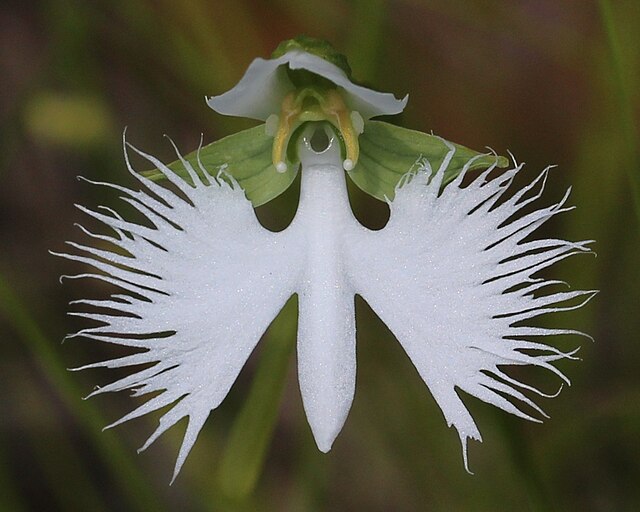
A Japanese terrestrial orchid with flowers resembling white egrets in flight, a summer icon.
Overview
Pecteilis radiata (synonym Habenaria radiata), the White Egret Orchid (sagiuso in Japanese), is a tuberous terrestrial orchid native to wetlands and moist grasslands in Japan, China, and the Korean Peninsula. The common name refers to the striking resemblance of the pure white flowers to a white egret in flight, with the large white lip deeply divided into three lobes, the edges of the two side lobes finely fringed to form wing-like extensions. Plants grow 15–30 cm, bearing one to four flowers per stem in summer (July–August). After the foliage dies in autumn, watering is reduced, but the tubers are not dried out completely; they are rested slightly moist and replanted in spring. A well-draining medium of sphagnum or pumice-based soil and ample water during the growing season are key requirements. It is one of Japan's most beloved summer wildflowers.
Size of the Habenaria Radiata
The Habenaria Radiata grows to 15-30cm.
Temperature & humidity for the Habenaria Radiata
The ideal temperature for the Habenaria Radiata is 10〜28℃.
Basic Info
Origin
Japan, China, and Korean Peninsula, wetlands and moist grasslands
Lifespan
Annual from tubers
Size
15-30cm
Temperature
10〜28℃
Humidity
50〜70%
Growing Tips
Light & Placement
Native to wetlands and damp grassland, it should be grown outdoors in a sunny spot. In poor light the flower stems become thin.
Watering
Water generously in the growing season and keep it constantly moist. Growth stops if it dries out, so never let it go dry.
Temperature & Overwintering
The ideal range is 10-28°C. It overwinters as a tuber, so store the lifted tubers where they will not freeze.
Soil & Repotting
Plant the tubers in a well-draining medium such as sphagnum, kanuma or kiryu sand. Replant them each spring.
Dormancy Care
When the leaves die back in autumn, reduce watering, but do not let the tubers dry out completely; rest them slightly moist, for example with a light misting. Replant them in fresh medium the following spring.
Habenaria Radiata FAQ
QWhat is the growing difficulty level for Habenaria Radiata?
Intermediate. A variety suitable for intermediate growers. Requires some cultivation experience and knowledge of environment management. Pay careful attention to temperature and humidity control.
QWhat is the ideal temperature for Habenaria Radiata?
The ideal temperature for Habenaria Radiata is 10〜28℃. Avoid sudden temperature changes and maintain a stable environment.
QHow large does Habenaria Radiata get?
The mature size of Habenaria Radiata is 15-30cm. This may vary slightly depending on cultivation environment and individual differences.
QWhat is the typical price for Habenaria Radiata?
The price of Habenaria Radiata varies significantly by variety, characteristics, size, and lineage. Please check GrowerDirect's price guide for the latest market information.
Last updated: October 2, 2026
Growing Specifications
- Hardiness (RHS)
- H2
References & Sources
Edited & verified by: GrowerDirect Editorial Team
The classifications, regulations, and growing data on this page are created and verified based on the primary information database below.
Taxonomy & Authority
Accepted name: Pecteilis radiata (Thunb.) Raf.
Synonyms: Hemihabenaria radiata, Habenaria radiata var. dianthoides, Orchis radiata, Platanthera radiata, Plantaginorchis dianthoides, Orchis susannae, Plantaginorchis radiata, Habenaria dianthoides
Authority databases: GBIF · POWO · RHS orchid hybrid registration (International Orchid Register) · AOS (American Orchid Society)
Nomenclature follows global taxonomic authority databases.
Regulations & Conservation Status
The family Orchidaceae is listed entirely in CITES Appendix II (except for the genera Paphiopedilum and Phragmipedium and certain species, which are in Appendix I). Cultivars and hybrids are subject to family-level regulation; however, artificially propagated specimens may benefit from simplified trading procedures under the Appendices.
Sources: CITES Appendices (Orchidaceae spp. = Appendix II) / CITES Appendix I Orchid Checklist (Kew/UNEP-WCMC 2019)
Regulations may change. Always verify the latest information with the relevant authorities.
Related Species
Find listings for this species
Related Articles
Airflow Management Guide for Bulbless Orchids | Understanding the Physiology of Non-Water-Storing Epiphytic Orchids and Their Differences from Dendrobium kingianum
This guide explains the physiology of bulbless epiphytic orchids and key points for airflow management, while comparing water management differences with pseudobulbed Dendrobium kingianum.
Orchid Division and Bulb Propagation to New Plant Development | Complete Roadmap from Seedling to Flowering Stock
Orchid division is an important propagation method for bulb-bearing orchids such as Cymbidiums and Dendrobiums. This article provides a detailed explanation of the complete process from division to bulb propagation and new plant development. It covers the full range of successful techniques, from selecting the optimal timing, separating bulbs, planting new plants with initial care management, to the timeline through flowering.
Coelogyne Genus Seasonal Care Guide | Withholding Water in the Dry Season and Tips for Regulating the Bloom Cycle
A seasonal guide to Coelogyne, a type of epiphytic orchid, from watering during the growing season to dry-season drought management and tips for regulating the bloom cycle.
Post-Bloom Care: The Annual Cycle from New Growth to Flower Formation
Learn the annual care cycle for orchids from the end of flowering to the next bloom. This guide covers post-flower care including flower stem cutting methods, signs to observe during new shoot development, summer growth period considerations, requirements for flower bud formation, and finishing care from bud emergence through blooming.
Can't find the plant you're looking for?
Post your wishes for free and growers with matching plants will contact you with introductions.