Neofinetia falcata 'Tenkei Fukurin'
BeginnerVanda falcata 'Tenkei Fukurin'
A named fukiran listed by the Japan Fukiran Society as a fukurin (margined) variety. Its leaves carry a variegated edge, and the society lists it as derived from 'Gojo Fukurin', with a brown-red stem base and brown-red root tips.
About
Tenkei Fukurin is one of the fukiran cultivars, the traditional cultivated forms of Vanda falcata (formerly Neofinetia falcata), an epiphytic orchid native to Japan. The Japan Fukiran Society's register lists its feature as fukurin (margined variegation), its stem base and root tips as 'doro' (brown-red), its leaf-base junction (tsuke) as the crescent 'tsuki' type, its mother variety as 'Gojo Fukurin', and its status as a pre-existing variety. Fukurin means variegation running along the leaf margin, a pattern shared by many cultivars. In fukiran, the colour of the stem formed by the overlapping leaf bases (brown-red doro or green ao) and the colour of the root tips are key features for telling varieties apart. The society lists 'Gojo Fukurin' with a doro stem but green root tips, so root-tip colour helps separate the two margined varieties. The sources consulted do not record who found or named it, or when. In Japan it is handled by fukiran specialists and wildflower nurseries and is one of the more frequently seen margined varieties.
Source: Wikipedia (CC BY-SA 4.0)
Size of the Neofinetia falcata 'Tenkei Fukurin'
The Neofinetia falcata 'Tenkei Fukurin' grows to The parent species is 8-12 cm tall (little data on this cultivar's size).
Basic Info
Origin
Cultivar derived from 'Gojo Fukurin' (the parent species grows in Japan, Korea and China)
Lifespan
Perennial; individual leaves last four to five years, sometimes eight
Size
The parent species is 8-12 cm tall (little data on this cultivar's size)
Temperature
15〜30℃
Humidity
50〜70%
Watering & Fertilizer
Sparing, very dilute liquid fertilizer while growing
Growing Tips
Light & Placement
Keep it in bright shade in summer and give good light in winter, as in the wild where it sits in summer shade and gets winter sun on bare branches.
Watering
Water thoroughly when the sphagnum dries. The roots are used to good air movement, so avoid keeping them constantly wet.
Temperature & Overwintering
Native to warm parts of Japan, it is fairly tolerant of heat and cold, but protect it from frost and freezing in winter.
Soil & Repotting
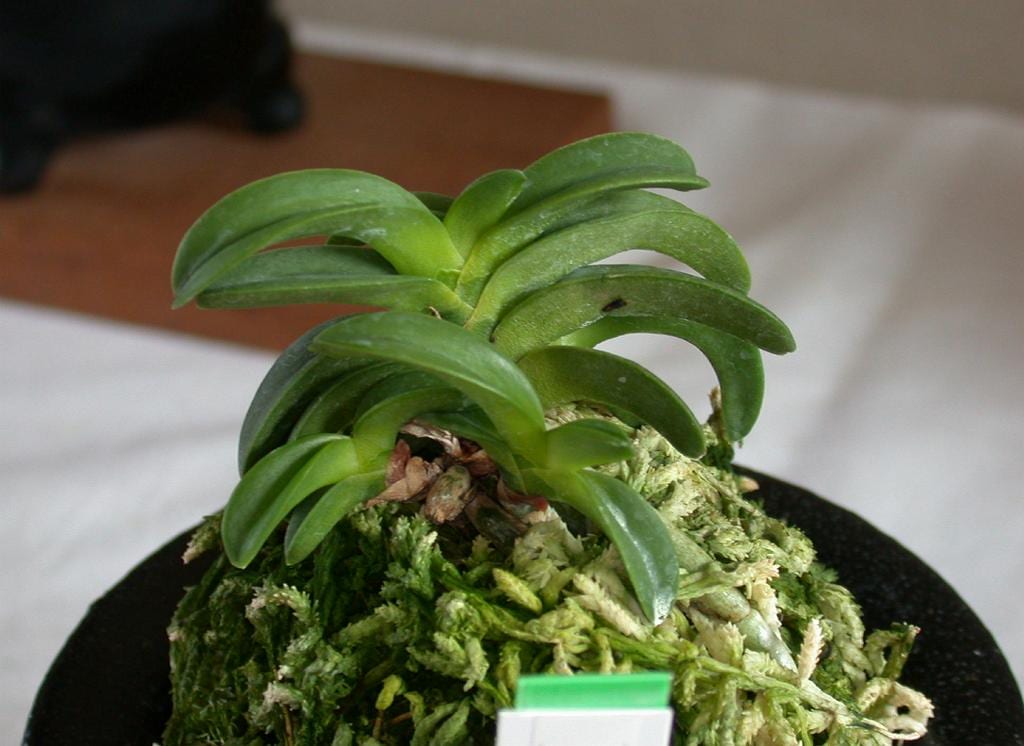
The usual fukiran method is to mound sphagnum into a peak and set the plant on top, leaving the core hollow for air. Divide only once offsets are well grown.
Identifying the Cultivar
Many cultivars are margined, so check the features the Japan Fukiran Society registers for it: a doro stem and doro root tips. Its mother variety 'Gojo Fukurin' is registered with green root tips, so root-tip colour is a useful check. Buy plants with a reliable name.
Pests & Cautions
The parent species is native to Japan; choose propagated plants rather than wild-collected ones.
Neofinetia falcata 'Tenkei Fukurin' FAQ
QWhat is the growing difficulty level for Neofinetia falcata 'Tenkei Fukurin'?
Beginner. A variety suitable for beginners. No special equipment or experience is required—you can grow it without problems by setting up a basic cultivation environment.
QHow large does Neofinetia falcata 'Tenkei Fukurin' get?
The mature size of Neofinetia falcata 'Tenkei Fukurin' is The parent species is 8-12 cm tall (little data on this cultivar's size). This may vary slightly depending on cultivation environment and individual differences.
QHow should I water and fertilize Neofinetia falcata 'Tenkei Fukurin'?
Neofinetia falcata 'Tenkei Fukurin': watering & fertilizer — Sparing, very dilute liquid fertilizer while growing. Aim for appropriate frequency and amount.
QWhat is the typical price for Neofinetia falcata 'Tenkei Fukurin'?
The price of Neofinetia falcata 'Tenkei Fukurin' varies significantly by variety, characteristics, size, and lineage. Please check GrowerDirect's price guide for the latest market information.
Last updated: September 23, 2026
References & Sources
Edited & verified by: GrowerDirect Editorial Team
The classifications, regulations, and growing data on this page are created and verified based on the primary information database below.
Taxonomy & Authority
Regulations & Conservation Status
The whole orchid family is listed in CITES Appendix II (checked on Species+). International trade requires permits such as export permits, but no registration is needed to buy, sell or transfer plants within Japan. Cultivars are covered by Appendix II as Vanda falcata (the exemption for artificially propagated Vanda hybrids does not apply to cultivars within a species). It is not a registered variety under the Plant Variety Protection Act (no match in the MAFF register). The parent species is listed as Vulnerable on the Ministry of the Environment Red List. It is native to Japan and is not designated as a Nationally Rare Species under the Act on Conservation of Endangered Species (checked against the Ministry of the Environment list). Some prefectures restrict collecting wild plants by ordinance, so choose nursery-propagated plants rather than wild-collected ones.
Sources: Species+ (CITES) / Ministry of the Environment, Japan: list of Nationally Rare Species
Regulations may change. Always verify the latest information with the relevant authorities.
Related Species
Find listings for this species
Related Articles
How to Grow Neofinetia falcata (Fuuran) | Cultivating an East Asian Orchid as a Classical Garden Art
Neofinetia falcata (Fuuran) is an East Asian orchid representing classical garden art that has continued since the Edo period. This guide explains the fundamentals of cultivation, from the traditional moss-ball planting method to air circulation and shade management, as well as how to enjoy the foliage arts.
Coelogyne Genus Seasonal Care Guide | Withholding Water in the Dry Season and Tips for Regulating the Bloom Cycle
A seasonal guide to Coelogyne, a type of epiphytic orchid, from watering during the growing season to dry-season drought management and tips for regulating the bloom cycle.
Post-Bloom Care: The Annual Cycle from New Growth to Flower Formation
Learn the annual care cycle for orchids from the end of flowering to the next bloom. This guide covers post-flower care including flower stem cutting methods, signs to observe during new shoot development, summer growth period considerations, requirements for flower bud formation, and finishing care from bud emergence through blooming.
A Complete Guide to Enjoying Orchid Exhibitions and Sales Events | Variety Selection and Post-Purchase Care
A guide to enjoying orchid exhibitions and sales events. Covering practical tips on variety selection, how to identify rare species, and post-purchase environmental acclimatization.
Can't find the plant you're looking for?
Post your wishes for free and growers with matching plants will contact you with introductions.