Source: Wikimedia Commons
Ascocentrum ampullaceum
IntermediateVanda ampullacea
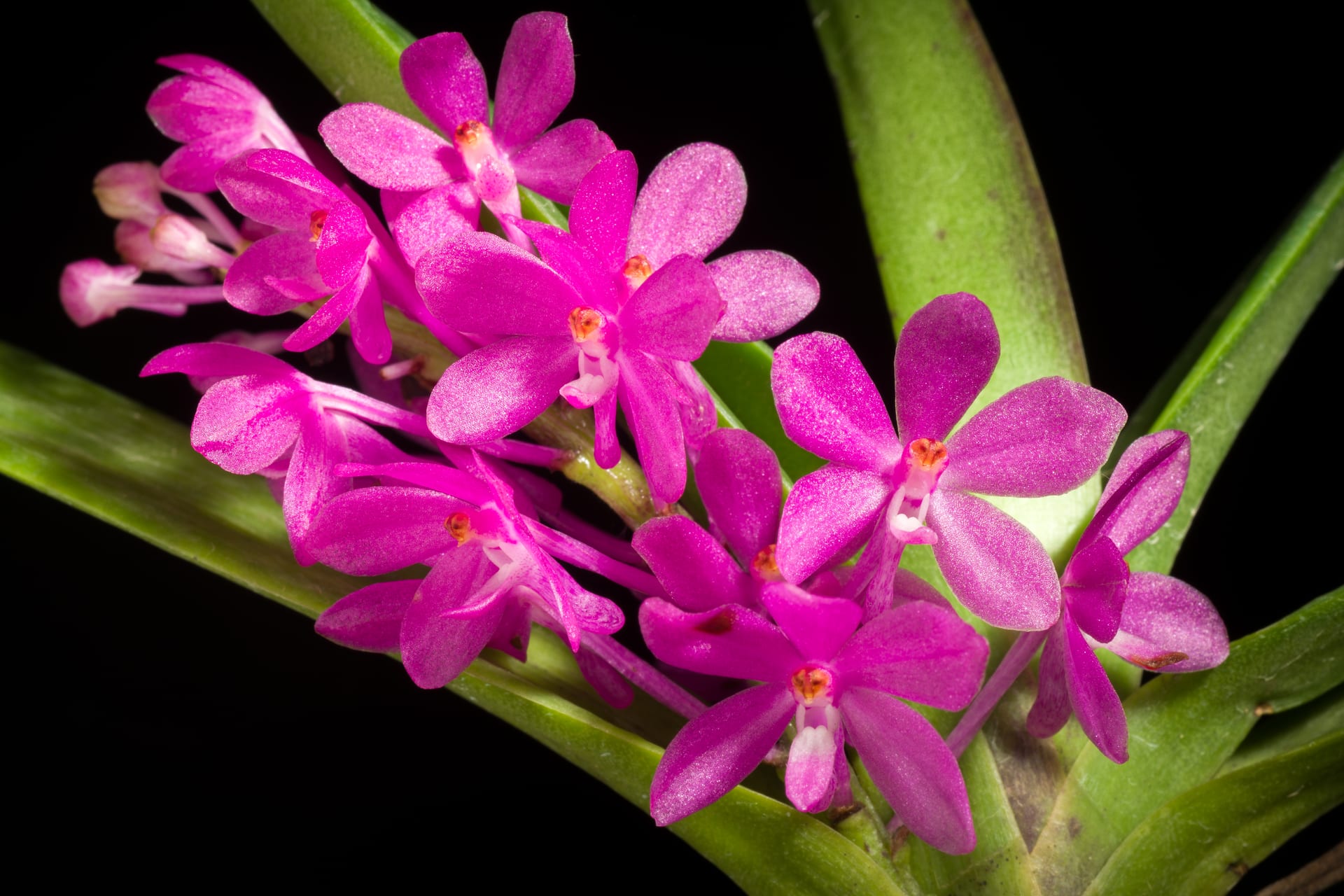
A miniature monopodial orchid ranging from the Himalaya to Indochina. Formerly placed in Ascocentrum, it packs small flowers onto stems shorter than the leaves. It is known as a parent of Ascocenda hybrids and is often still sold under the old genus name.
About
Vanda ampullacea is a miniature epiphytic orchid. Since William Roxburgh described it as Aerides ampullacea in 1814 it has been moved several times and was long known as Ascocentrum ampullaceum; a 2012 revision of Vanda gave it its current name, but the old genus name persists on sale labels. It ranges through Nepal, Bhutan, Sikkim, Assam, Bangladesh, Myanmar, Thailand, Laos, Vietnam and southern Yunnan, growing at 300-1,500 m in subtropical forest near rivers, often on deciduous trees. The short stem carries a few leaves in two ranks; they are strap-shaped with an irregularly toothed tip, keeled beneath and grooved above. From spring to summer it produces stems 8-20 cm long, shorter than the leaves, packed with small flowers about 1.5-2.5 cm across. It has been used as a parent of Ascocenda, the hybrids between Ascocentrum and Vanda. In Japan specialist orchid nurseries sell young plants of the species.
Source: Wikipedia (CC BY-SA 4.0)
Size of the Ascocentrum ampullaceum
The Ascocentrum ampullaceum grows to Miniature; flower stem 8-20 cm, flowers 1.5-2.5 cm across.
Basic Info
Origin
Himalaya (Nepal to Bhutan), NE India, Myanmar, Indochina and southern Yunnan (300-1,500 m)
Lifespan
Perennial that can be kept for many years (little data on lifespan)
Size
Miniature; flower stem 8-20 cm, flowers 1.5-2.5 cm across
Temperature
15〜30℃
Humidity
50〜70%
Watering & Fertilizer
Dilute liquid fertilizer in the growing season
Growing Tips
Light & Placement
It needs bright light; give plenty of light, shading only from harsh midsummer sun.
Watering
Keep humidity high and water during growth, letting it dry out slightly in winter.
Temperature & Overwintering
It is said to tolerate hot to cool conditions but likes a slightly cooler rest in winter; keep it indoors away from hard cold.
Soil & Repotting
It does well in a wooden slat basket that keeps the roots in the air.
Fertilizer
Feed dilute liquid fertilizer regularly in the growing season.
Pests & Cautions
Names are easily mixed with the old genus Ascocentrum and the hybrid Ascocenda, so check the label to confirm it is the species.
Ascocentrum ampullaceum FAQ
QWhat is the growing difficulty level for Ascocentrum ampullaceum?
Intermediate. A variety suitable for intermediate growers. Requires some cultivation experience and knowledge of environment management. Pay careful attention to temperature and humidity control.
QHow large does Ascocentrum ampullaceum get?
The mature size of Ascocentrum ampullaceum is Miniature; flower stem 8-20 cm, flowers 1.5-2.5 cm across. This may vary slightly depending on cultivation environment and individual differences.
QHow should I water and fertilize Ascocentrum ampullaceum?
Ascocentrum ampullaceum: watering & fertilizer — Dilute liquid fertilizer in the growing season. Aim for appropriate frequency and amount.
QWhat is the typical price for Ascocentrum ampullaceum?
The price of Ascocentrum ampullaceum varies significantly by variety, characteristics, size, and lineage. Please check GrowerDirect's price guide for the latest market information.
Last updated: September 23, 2026
References & Sources
Edited & verified by: GrowerDirect Editorial Team
The classifications, regulations, and growing data on this page are created and verified based on the primary information database below.
Taxonomy & Authority
Accepted name: Vanda ampullacea (Roxb.) L.M.Gardiner
Synonyms: Aerides ampullacea Roxb., Ascocentrum ampullaceum (Roxb.) Schltr., Gastrochilus ampullaceus (Roxb.) Kuntze, Oeceoclades ampullacea (Roxb.) Lindl., Oeceoclades ampullacea (Roxb.) Lindl. ex Voigt, Saccolabium ampullaceum (Roxb.) Lindl.
Authority databases: GBIF · GBIF
Nomenclature follows global taxonomic authority databases.
Regulations & Conservation Status
The whole orchid family is listed in CITES Appendix II (checked on Species+). International trade requires permits such as export permits, but no registration is needed to buy, sell or transfer plants within Japan.
Sources: Species+ (CITES) / Ministry of the Environment, Japan: list of Nationally Rare Species
Regulations may change. Always verify the latest information with the relevant authorities.
Related Species
Find listings for this species
Related Articles
Mokara & Vanda Orchid Care Guide | Root Management, Watering & Blooming Tips
A guide to cultivating Mokara and Vanda orchids with their distinctive epiphytic growing style. Detailed practical care methods covering "naked roots" management with exposed aerial roots, watering and drying cycles, creating high-light environments, and temperature management for promoting blooms.
Introduction to Vanda Suspended Cultivation | The Charm of Epiphytic Orchids Grown with Exposed Roots
A guide to Vanda suspended cultivation (basket cultivation). We explain why roots are exposed without a pot, methods for hanging and securing, managing watering and fertilizer, flowering conditions, and tips for overwintering.
Vanda Care Guide | Key Points for Hanging Cultivation and Root Management
Explains the special cultivation methods for Vanda orchids. Introduces hanging basket cultivation, watering methods for exposed roots, creating high temperature and humidity environments, adapting to their preference for strong light, and blooming conditions.
Complete Guide to Growing Aldrovanda | Rare Aquatic Carnivorous Plant That Captures Insects Underwater
Explains the cultivation method for Aldrovanda vesiculosa, a carnivorous plant that floats underwater and captures insects. Tips on water quality management, winter dormancy, and propagation techniques are introduced.
Can't find the plant you're looking for?
Post your wishes for free and growers with matching plants will contact you with introductions.