Aesthetic Appreciation Points of Agave | Understanding Form, Leaf Posture, Spines, and Color Enjoyment
Explanation of appreciation points for enjoying agave from an aesthetic perspective. By deeply understanding plant form, leaf arrangement patterns, spine design, and color variation, your appreciation of agave can expand to an entirely new dimension.
Key Takeaways
Explanation of appreciation points for enjoying agave from an aesthetic perspective. By deeply understanding plant form, leaf arrangement patterns, spine design, and color variation, your appreciation of agave can expand to an entirely new dimension.
Related Species
The Basics of Agave Appreciation: What is Form?
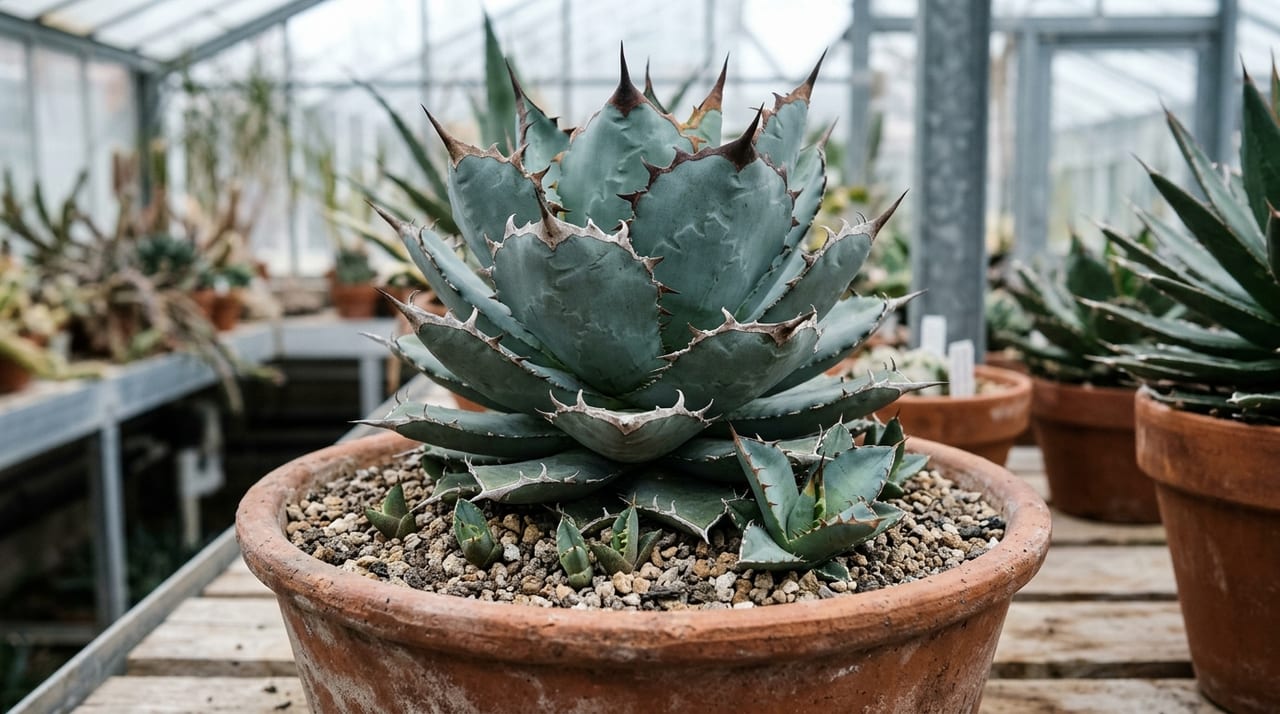
When enthusiasts talk about agave, the first word they mention is "form." Form is not merely simple shape; it refers to a comprehensive three-dimensional evaluation encompassing how the leaves radiate outward from the plant mass, the density of the rosette, the low center of gravity, and the spacing between leaves. A plant with good form is beautiful from all 360 degrees, its outline when viewed from the front describes a neat circle, and when viewed from above, each leaf is arranged in a spiral pattern at equal intervals.
What is particularly emphasized is "compactness." Rather than sprawling leaves, leaves that curve inward with tension as they rise—referred to as a "tight form"—becomes the standard for high evaluation. The compact quality typified by Titanota and Ovatifolia types results from adaptation to harsh arid conditions and intense sunlight in their native habitat; in cultivation, this quality can be maintained and strengthened by recreating those conditions.
Insufficient light and excessive moisture are the primary causes of stretching the plant and ruining its form. When selecting agave, possessing the eye to deduce "under what environmental conditions this plant has been cultivated" rather than judging only by its present appearance is the first step in identifying quality individuals. When origin information and the grower's profile are made public, reading the cultivation environment from there is also a shortcut to developing discerning taste.
What Leaf Shape and Posture Tell Us
The diversity of agave leaves by species is remarkable. It is hardly an exaggeration to say that the uniqueness of a variety is determined by leaf shape alone. Representative leaf forms are as follows:
- Short-leaf type (Ovatifolia, Horrida): broad, stout leaves
- Sword type (Americana, Silvestra): slender, sharp leaves
- Egg type (Titanota, Potatorum): intermediate leaf form
Among fine-leaved species, some like Agave gracilipes possess delicate, supple leaves, offering an entirely different direction of beauty compared to thick, robust types.
In appreciation, what is particularly important is "leaf curvature." Whether the leaf curves slightly upward toward the apex or only the tip curls outward dramatically changes the impression of the entire plant. The V-shaped posture where leaves stand upright and only the tip opens outward is favored by many enthusiasts and is a characteristic seen in superior specimens of Titanota. Conversely, species like Agave chiapensis, where leaves gracefully curve with a soft impression, also make agave appreciation worthwhile through the contrast of strength and gentleness.
The texture of the leaf surface is also a point of interest. Some species possess smooth, lustrous surfaces (Macracantha), others have a chalky white coating (Halberdensis types), and still others have fine horizontal striations (Ovatifolia); textures that invite you to touch them enhance their ornamental value. The micro-serrations along the leaf edge are also elements for identifying species and enjoying individual variation.
The World of Spines: Terminal Spines and Marginal Teeth
The face of agave, so to speak, is the "terminal spine" at the leaf tip and the "marginal teeth" along the leaf margin. These are not merely defense mechanisms but the points most passionately discussed by agave enthusiasts.
The terminal spine of the "exoskeleton" type, exemplified by Titanota and Utahensis, enjoys particular popularity. Spines develop robust and wild, like a skeletal framework, and whitened or cream-colored spines create a dramatic contrast with the green of the leaf. The length, thickness, color, sharpness of the spine tip, and the way it curves—all are points of evaluation. Individuals with long, sharp white terminal spines are called "white spine" and receive particularly high praise. In terms of spine presence, species like Agave lechuguilla, where sharp spines stand out against slender leaves, are also noteworthy.
Marginal teeth are small, tooth-like protrusions arranged along the leaf edge. In Titanota, "compressed shark teeth" are highly prized. Where marginal teeth curve strongly back toward the leaf surface and spread horizontally in a compressed, crushed appearance, this is recognized as a characteristic indicating rarity of the individual. The direction of marginal teeth (inward or outward), density, and color differ by individual, and even within the same variety there is depth to enjoy individual variation. From the viewpoint of spine sculptural beauty, the sequential dragon-fang-like marginal teeth of Agave pygmae dracontis, which inspired its name, are also highly valued among enthusiasts.
Wild-collected individuals often display a rawness and spine development not seen in cultivated specimens, but today CITES regulations strictly limit their distribution. Most superior individuals on the market are seedlings from carefully selected parent plants, where spine traits have been intentionally enhanced.
Color and Variation: Diversity Beyond Green
Agave may seem synonymous with silvery-green or blue-tinged green, but in reality its color palette is remarkably diverse. From variegated varieties with yellow vertical stripes to individuals with an overall golden tone, and types bearing reddish purple tints, the world of agave color is profound.
Among variegations, varieties called "brocade" with striped patterning have particularly high ornamental value. The impression of the entire plant differs completely between the "center variegation" type with yellow stripes running down the center of the leaf and the "edge variegation" type with yellow along the leaf margin. Variegated varieties have reduced photosynthetic capacity and grow more slowly, but due to their rarity command high prices.
Another fascination of agave is that the same plant changes color depending on light conditions. Under intense light, a phenomenon called "sun stress" occurs where leaves take on red or purple tints. Some individuals, like Titanota's Red Cat Whiskers, are even named for becoming red under strong light. This color change is a phenomenon where the plant produces anthocyanins for UV defense—a sign of healthy stress, so to speak.
Furthermore, the "bloom"—the waxy white powder coating the leaf surface—is an element collectors observe closely. This thin waxy powder serves to protect the leaf from intense light and desiccation, and fingerprints remain when touched. Individuals where the coating is thick and uniform evoke cleanliness and refinement, elevating their ornamental value.
Enjoying Growth and Temporal Change
One of the greatest pleasures of agave appreciation is the ability to enjoy change over a long time scale. The transformation from the innocent appearance of a young seedling to increasingly robust leaves and developed spines over the years brings a unique joy found in no other plant.
During the juvenile stage, leaves are soft and spines underdeveloped, but maturation brings changes called "trait expression." The true spine thickness and leaf compactness characteristic of the species typically take three to five years or more to appear. Because evaluating quality individuals requires time, enthusiasts use the term "transform" when speaking of expectation for potentially superior individuals with future potential.
Another source of pleasure is the emergence of offsets. Offsets sprouting from the base of the parent plant genetically carry the same traits as the parent and are valued as a means of propagating superior specimens. When multiple offsets develop and the plant becomes a cluster, the appearance itself is like a work of art.
Flowering is a once-in-a-lifetime phenomenon. As if expending all the energy accumulated over decades at once, the plant sends up a stem, flowers, and then the parent plant dies. Understanding this monocarpic characteristic naturally deepens the perspective with which you observe daily growth.
Cultivating Discerning Appreciation
To truly understand the beauty of agave, there is no substitute for seeing many living specimens. Handling specimens in person at exhibitions and nurseries, examining them from all 360 degrees, and experiencing how their appearance changes with different lighting is the fastest path to developing keen appreciation.
The three-dimensionality, leaf firmness, and sharpness of spines difficult to convey through photographs become apparent only through daily observation of plants in hand. When acquiring specimens, there is also the pleasure of imagining "how this plant will transform in the future" rather than judging by its present state alone. Quality growers possess information about specimen provenance and parent plant details, and the volume of information available to learn from is substantial.
Form, leaf posture, spines, and color—individuals where these four elements achieve harmony at a high level are called "good plants." However, what each person finds beautiful in each of these elements ultimately comes down to personal preference, and therein lies the freedom and depth of agave appreciation. Develop your own aesthetic sense and enjoy the dialogue with each plant.