Agave Container Arrangement Durability Strategy | Root Compaction Checklist and Division Timing
Agave container arrangements experience progressive root compaction due to competition for root zone, with the difficulty being that it is hard to notice in appearance. This article explains early detection checklists for root compaction, timing judgments for division and repotting, and post-division recovery management.
Key Takeaways
Agave container arrangements experience progressive root compaction due to competition for root zone, with the difficulty being that it is hard to notice in appearance. This article explains early detection checklists for root compaction, timing judgments for division and repotting, and post-division recovery management.
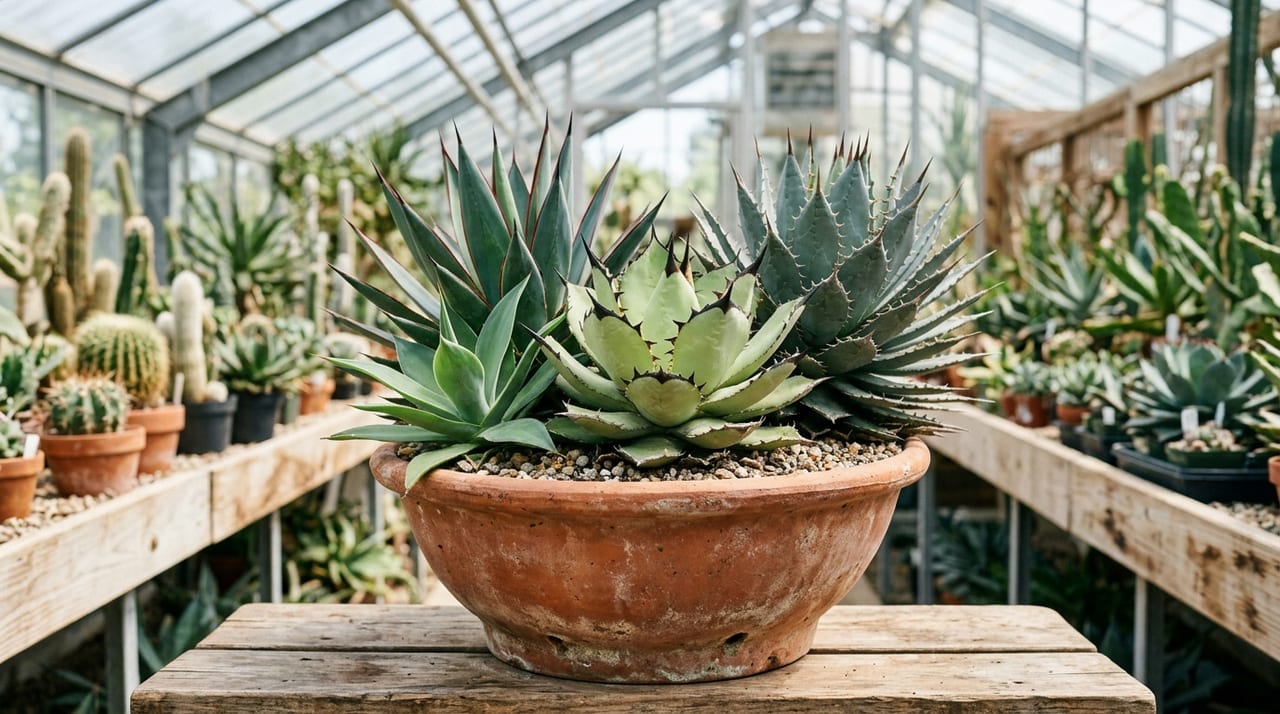
Agave container arrangements with multiple specimens planted in a single container offer high visual completion and excellent space efficiency. Mixing 3–5 small to medium agaves creates three-dimensional, dynamic arrangements and allows enjoying a collection in limited space, which is a major advantage. However, cultivation in a shared pot creates challenges different from individual management. Root compaction in particular, though difficult to discern visually, has serious impacts on the overall health of each specimen. In an environment where multiple specimens compete for root zone, smaller species can lose nutrient competition to larger species and decline, making unbalanced growth common. This article explains the practical steps needed for long-term maintenance of agave container arrangements, from early detection of root compaction to division and repotting.
Early Detection Checklist for Container Root Compaction
To determine whether an agave container arrangement is experiencing root compaction, it is important to observe by combining several indicators.
- The most reliable sign is when the soil surface remains damp even a full day or more after watering: Normally, fast-draining soil formulated for agaves is designed to dry on the surface in about one day during summer, but when roots are compacted, water penetration speed decreases and drying is delayed. Specifically, if you water in the morning and the soil is still moist the next day, it is a warning sign.
- Also pay attention if overall growth rate of the specimen noticeably slows: If new leaf emergence is clearly slower compared to the previous year, or if leaf size becomes smaller, it is a sign that root zone is restricted. Normally agaves produce 1–2 new leaves per month from spring through summer, but in a root-compacted state, new leaves appear once per month or less, or sometimes not at all.
- Despite spring being the growth season, new shoots emerge with difficulty, and existing leaves become yellowed: These indicate worsening nutrient uptake.
- If roots begin to emerge from the bottom of the container, it can be judged as moderate root compaction: Root protrusion from drainage holes is evidence that roots are actively continuing to extend, meaning space inside the pot is nearly full. At this stage, there is also a high likelihood that mild root rot has already begun, requiring swift action.
- Damp areas constantly exist on the soil surface, or moss-like deposits are visible: This too is a result of root compaction and excessive moisture.
Timing Judgment for Division and Repotting
The success rate of dividing agave container arrangements changes significantly depending on choosing the right timing.
| Timing | Suitability | Reason |
|---|---|---|
| Mid-March–mid-April (Spring) | Optimal timing | This is the season when root activity intensifies, and recovery from damage occurs most efficiently. The subsequent 3-month growth period provides the optimal window for establishing new root systems |
| September–October (Autumn) | Division possible, but recovery time is limited | Winter dormancy approaches. Two months are needed for new roots to form, but winter arrives immediately after, causing newly emerged roots to halt activity, resulting in recovery being delayed until the following spring |
| Late May–July (Rainy season) | Work should be avoided | High humidity and rising temperatures sharply increase the risk of root rot after repotting. High temperatures and humidity tend to coincide, making cut and exposed roots prone to damage |
After division, each specimen is planted in new soil. At this time, it is important to choose soil that is identical to (or has equivalent drainage properties as) the existing soil. Standard formulation for agave-specific fast-draining soil is small-grain red volcanic ash : Kanuma soil : pumice = approximately 3:3:4, though some formulations add slight organic matter (roughly 5% leaf mold). When preparing new soil, precisely measuring the soil mixture ratio is directly linked to success in subsequent water management.
Post-Division Recovery Management Steps
Each specimen after division requires staged care appropriate to the timing.
- First Two Weeks (Cooling Period): Immediately after division, each newly planted specimen requires special attention for the first two weeks. Before resuming normal watering routine, allow 5–7 days of drying. During this "cooling period," callus tissue forms on cut roots and rot risk decreases significantly. During cooling, it is ideal to place the container in a completely shaded location and maintain temperatures of 15–20°C. Rapid temperature or light changes stress the plant and delay root callus formation.
- First Month: Water at approximately 50% of normal frequency. While waiting for new roots to develop, excess moisture can cause root rot. This means reducing normal weekly watering to approximately twice per month.
- Second Month: The new root system begins to function, and you can gradually transition to normal watering schedule. It is important to progress gradually through this transition; suddenly returning to normal watering frequency will cause the adapted root system to return to stress.
- Additional Care for Summer-Divided Specimens: By avoiding direct sunlight during high-temperature periods and providing approximately 30% shade for 3 weeks, adaptation stress can be reduced. Shading not only prevents sunscald, but also reduces water loss from plant transpiration and lessens strain on the root system. Gradually reduce shading, returning to normal light conditions after 6 weeks.
Through regular observation and staged environmental adjustments, agave container arrangements can maintain good condition for years.