Fundamentals of Agave Flowering and Monocarpy (Monocarpic)|What to Do When Flower Buds Appear?
Agave is a monocarpic plant that flowers only once in its lifetime and then dies. This article provides detailed explanations of what to do when flower buds (flower stems) begin to emerge, how to secure offshoots, the flowering process, and the final fate of the plant.
Key Takeaways
Agave is a monocarpic plant that flowers only once in its lifetime and then dies. This article provides detailed explanations of what to do when flower buds (flower stems) begin to emerge, how to secure offshoots, the flowering process, and the final fate of the plant.
Related Species
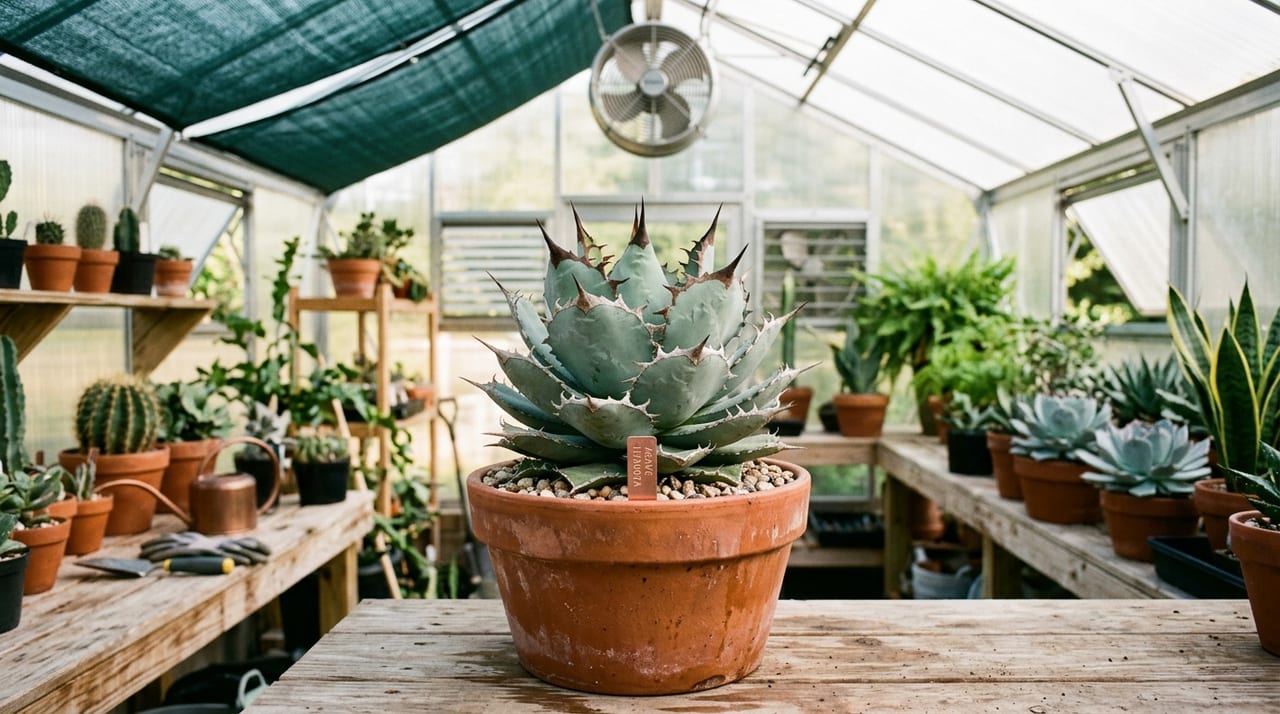
If you have been growing Agave for many years, you may one day notice a slender stem beginning to emerge from the center of the plant. This is called a "flower stem," and it is one of the most dramatic events in the lifetime of an Agave. However, Agave flowering is not something you can simply celebrate with "congratulations." Agave is a monocarpic plant, meaning the parent plant will inevitably die after flowering. This article provides a detailed explanation of how Agave flowering works, what to do when flower buds appear, how to secure offshoots, and more.
What is Monocarpy (Monocarpic)?
"Monocarpy" or in English "monocarpic" refers to the characteristic of plants that reproduce (flower and set fruit) only once during their lifetime and then die. Agave is the archetypal example of a monocarpic plant, accumulating energy over many decades before finally producing one magnificent bloom.
Agave americana and similar species are sometimes called "Century Plants" (100-year plants), but in reality, the number of years until flowering varies depending on the plant's condition and environment.
- Small varieties may flower in 10-15 years
- Large species can take decades to flower, which is not uncommon
Don't Miss the Signs of Flower Bud (Flower Stem) Emergence
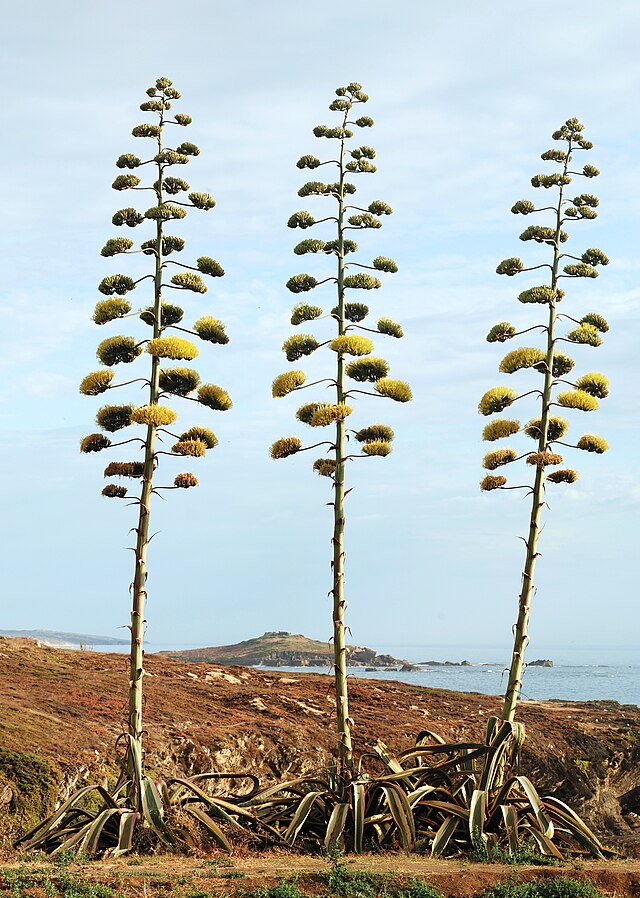
The signs of flowering can be surprisingly easy to miss. At first, the leaves at the center of the plant appear to open gradually, and eventually a thin, pointed bud begins to emerge from the center. This bud is the "flower stem," which can reach several meters in height depending on conditions.
The time between when the flower stem begins to emerge and when flowering occurs varies by variety and environment, but typically takes several weeks to several months. If you are growing it indoors, you will need to move it to an outdoor or spacious location as early as possible to prevent the flower stem from hitting the ceiling.
The Fate of the Plant After Flowering
Once the flowers bloom and fruit sets (produces seeds), the Agave exhausts all its energy, and the parent plant gradually dies. This death cannot be prevented. Some may think, "Could cutting the flower stem early save the plant?" However, the trigger for flowering is set at a stage before the flower stem appears, and cutting it is nearly impossible to prevent the plant's death.
It is difficult to watch the parent plant as it withers, but that is the way of life for Agave. Expending in a single burst the energy accumulated over many decades is, in a sense, the final accounting of the plant's lifetime.
Securing Offshoots (Pups) is the Top Priority
Once flowering is confirmed, the first thing to do is to secure offshoots (pups). Most Agaves produce offshoots from the base of the plant before or after flowering. These offshoots are clones that inherit the genetic information of the parent plant, and they are the only way to pass the same variety on to the next generation.
Offshoots should be detached after their roots have developed to a certain extent. The procedure is as follows.
- When roots have grown to about 2-5 cm, cut them off with a clean knife or scissors
- Apply a disinfectant (sulfur powder or horticultural fungicide, etc.) to the cut surface
- Dry for 1-2 days before planting in fresh soil
If there are no offshoots, bulbils may form on the flower stem. Bulbils are small buds that emerge from the nodes of the flower stem, and they can also be planted and allowed to root. However, since rooting takes time, careful management is necessary.
The Option of Collecting Seeds
If the flowering plant produces fruit, another method is to grow new plants from seeds. Agave is not easily self-pollinated, so hand-pollinating using pollen from the same or a related variety will increase the likelihood of fruit set.
Seeds should be collected when fully mature, sown shallowly in clean seed-starting soil, and managed in a bright, warm location. The germination rate varies depending on the variety and freshness of the seeds, but freshly collected seeds tend to germinate relatively easily. However, depending on the cross, individuals that differ from the parent plant may be born, so if you want to maintain specific variety characteristics, propagation using offshoots or bulbils is more reliable.
The Joy of "Flowering Plants"
Flowering plants are also special in terms of ornamental value. The sight of countless flowers blooming on a flower stem that reaches several meters in height is spectacular, and if you are growing it in a garden or field planted in the ground, it can become the talk of the neighborhood. Growing the flower stem to its full height without cutting it and watching the flowering to its end is one of the pleasures of Agave cultivation.
During flowering, adequate water is required, so increasing watering compared to normal helps the flower stem and flowers last longer. Displaying part of the flower stem indoors as a cut flower is another way to enjoy it.
Environments Where Agave is More or Less Likely to Flower
A prerequisite for Agave flowering is that the plant is sufficiently mature, but it is also known that environmental stress can trigger flowering. In particular, there is a theory that sudden temperature changes (especially cold in winter) or drought stress can induce flowering.
Many experienced growers hold the empirical rule that plants grown outdoors and exposed to natural seasonal changes are more likely to flower than plants maintained at constant temperatures indoors or in greenhouses. However, this is merely a tendency, and there are plants that flower in the same environment and plants that do not.
Reusing Pots and Soil After Flowering
What should be done with the pot and soil after the parent plant dies?
- Pots can be reused after washing and disinfection
- Soil often becomes old and poses risks of root rot and pests or diseases, so it is recommended to replace it with fresh soil
Remove any root remnants carefully, and clean the bottom holes and insides of the pot with a brush. Expose to sunlight for disinfection before using for the next plant to minimize risk.
Find Your Next Agave at GrowerDirect
After losing the parent plant to flowering, finding the next plant is also an important issue. At GrowerDirect, you can purchase Agave directly from growers who carefully provide information about flowering history and offset availability. Since you can confirm the background and cultivation history of the variety, you can confidently select the next plant for your collection.