Agave Soil Selection Guide | Water Drainage-First Substrate Formula
This guide explains the ideal substrate composition for Agave. Learn drainage-first mixing ratios centered on Hyuga soil, pumice, and Akadama clay, pot material compatibility, and how to coordinate watering to prevent root rot.
Key Takeaways
This guide explains the ideal substrate composition for Agave. Learn drainage-first mixing ratios centered on Hyuga soil, pumice, and Akadama clay, pot material compatibility, and how to coordinate watering to prevent root rot.
The primary cause of failure in Agave cultivation is poor substrate selection. "I didn't realize until the roots had rotted" or "The plant was thriving when I bought it, but died within 1–2 months"—most of these problems stem from poorly draining soil. Agave is a plant that survives harsh, arid climates, and replicating an environment suited to its nature is key to successful cultivation. This article provides a systematic explanation of substrate selection fundamentals, material characteristics, specific mixing formulas, and pot selection.
Learning from Agave's Native Habitat: The Right Approach to Substrate
Agave originates from the vast, arid regions spanning central and southwestern Mexico to the southwestern United States. Whether the soil is weathered granite sand and gravel, limestone rock faces, or desert slopes, what they share is an environment with "extremely well-draining soil with minimal organic matter."
In these environments, rain either quickly permeates into the ground or flows away, and after roots absorb water rapidly, they are left in a dry state. While Agave roots tolerate extended dryness, prolonged moist conditions lead to oxygen deficiency and microbial proliferation, causing rapid, severe damage.
The ideal substrate conditions can be summarized as follows:
- High drainage and aeration so the entire pot dries within days after watering
- Minimal water retention to prevent excessive dryness
- Low organic content to reduce rot and microbial risks
- Weakly acidic to neutral pH (approximately 5.5–7.0)
- Appropriately granular structure for healthy root development
The assumption that "any succulent mix will do" is dangerous. Most commercial succulent soils contain high levels of organic matter and fine particles to increase water retention, which often leads to excess moisture for Agave. It is essential to understand mixing materials correctly and adjust as needed.
Understanding Substrate Materials: Types and Characteristics
To create the right Agave substrate, it is important to understand the role of each material.
Inorganic Materials (Core Components)
Pumice (Small Grade, 2–5mm) A volcanic, porous material with the best drainage and aeration properties. The countless air pores within the particles promote water drainage while providing modest water retention. Pumice forms the backbone of Agave substrate and increasing its proportion accelerates drying. It resists breakdown and maintains consistent properties over extended use.
Akadama Clay (Hard Grade, Small Particles) Volcanic soil from the Kanto loam layer, dried and processed. It offers water retention and nutrient retention while maintaining adequate aeration, making it a standard base material for most potting soils. Always select the "hard" grade. Standard Akadama absorbs water and breaks down, losing its granular structure and significantly reducing drainage.
Kanuma Soil (Small Particles) Volcanic soil sourced from the Kanuma area in Tochigi Prefecture. With a weakly acidic pH (4.5–6.0), it excels in drainage and, when combined with Akadama, lowers the overall pH to an appropriate level. Its light weight and fine-root-binding properties support fine root development in Agave.
Hyuga Soil A pumice-based material from Miyazaki Prefecture with exceptionally high aeration and drainage. The high porosity of its internal pores is particularly effective at preventing root suffocation. Despite resembling pumice, Hyuga soil tends to have lower water retention.
Perlite Expanded pearl stone—a white, porous material created through high-temperature expansion. Extremely lightweight, it enhances drainage and reduces overall substrate weight. However, its light particles float easily during watering, making it impractical in large quantities. Use 10–20% of total substrate.
Organic Materials (Use with Caution)
Organic materials such as leaf mold, peat moss, and bark compost retain water excessively and increase root rot risk for Agave. Especially during Japan's hot, humid summers, organic matter becomes a breeding ground for harmful microbes. If used at all, keep organic content below 10% of total substrate. Beginners are safer starting with no organic materials.
Base Formulas by Environment
The optimal substrate composition varies depending on where your Agave is placed and growing conditions. Refer to the following three patterns and adjust to match your environment.
Standard Formula (Outdoor, Well-Lit Environment)
| Material | Ratio |
|---|---|
| Akadama Clay (Hard Grade, Small) | 30% |
| Pumice (Small) | 30% |
| Kanuma Soil (Small) | 20% |
| Hyuga Soil | 20% |
A well-balanced, foundational formula. When grown outdoors in direct sunlight, adequate water retention allows for a comfortable watering cycle.
Drainage-Focused Formula (Indoors, High-Humidity Environments)
| Material | Ratio |
|---|---|
| Pumice (Small) | 40% |
| Akadama Clay (Hard Grade, Small) | 20% |
| Kanuma Soil (Small) | 20% |
| Hyuga Soil | 20% |
For indoor cultivation or seasons with poor drying conditions (rainy season, winter), increase pumice proportion to enhance drainage. While faster drying requires more frequent watering, root rot risk drops significantly.
Quick Formula Based on Commercial Succulent Mix
To modify off-the-shelf succulent soil, add 30–50% pumice or perlite by volume to substantially improve drainage. However, since the quality of base soils varies, choose a trusted brand.
Pot Selection and Drainage Preparation
Like substrate composition, pot material, size, and drainage preparation significantly affect drainage performance.
Choosing Pot Material
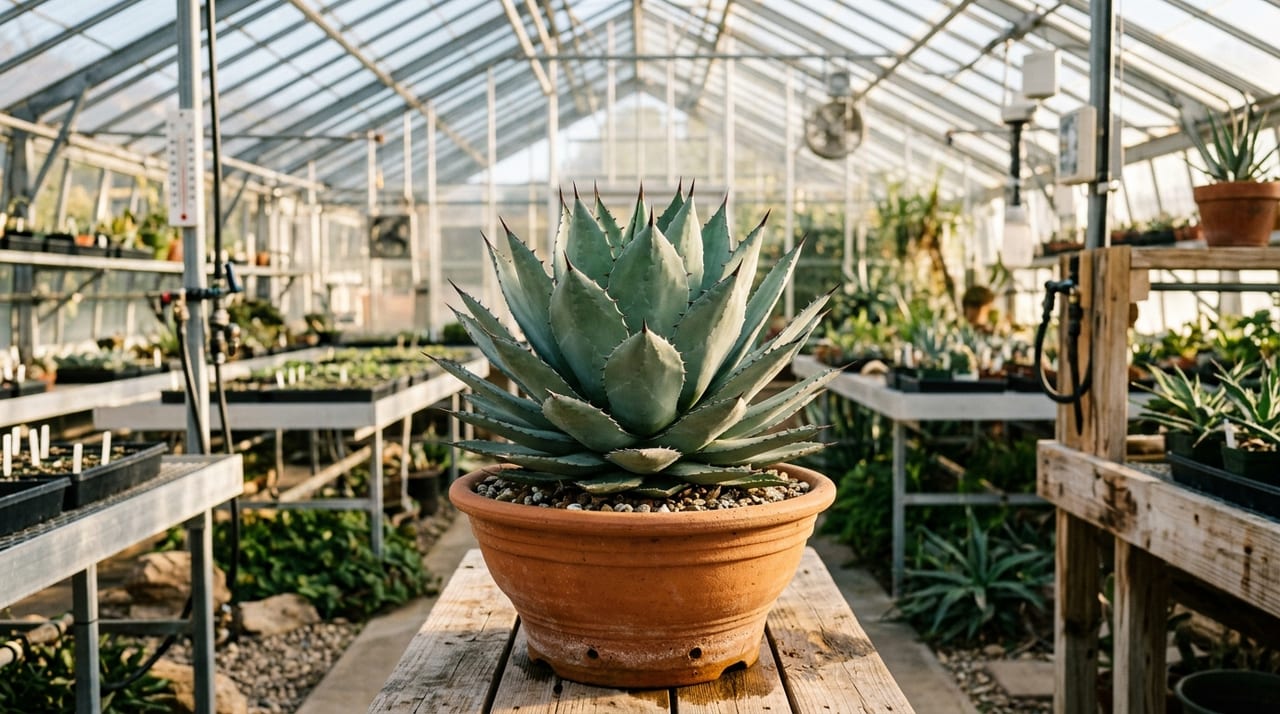
Terracotta pots are most suitable for Agave. Water and air exchange through the pot wall provides excellent aeration and minimizes root rot risk. However, they are heavy and can become very hot in summer.
Slitted pots are plastic pots with excellent aeration and drainage, with the added benefit of affordability. Roots grow straight without circling, and they cause minimal root damage during repotting. They are widely used by Agave growers.
Standard plastic pots require either higher-drainage substrate or reduced watering frequency.
Sizing Your Pot
Choose a pot about one size larger than the plant's diameter. Oversized pots retain water the roots cannot absorb, creating persistent moisture. Since Agave dislikes excess moisture more than root congestion, right-sizing matters more than extra room.
Drainage Layer at Pot Bottom
Place 2–3cm of pumice or coarse gravel at the pot bottom to ensure a drainage layer. A pot mesh alone may not provide sufficient drainage. This layer is especially critical for pots with small or few drainage holes.
Repotting Timing and Precautions
Regardless of substrate quality, drainage declines over time due to organic decomposition and particle breakdown. Repot every 2–3 years to refresh the substrate.
The best times to repot are spring (March–May) or fall (September–October). Avoid repotting in peak summer, as it stresses the plant. After repotting, withhold water for about a week to allow roots to dry and recover.
Repotting is also an excellent opportunity to inspect roots. Remove any blackened or rotting portions with clean scissors.
GrowerDirect's Reassuring Safe Practices
Sustaining healthy Agave begins with acquiring quality stock. Most growers listing on GrowerDirect are dedicated specialists who manage Agave with care. Many share their cultivation expertise—substrate composition, watering frequency—in profiles and product pages, and you can ask questions directly before purchase, such as "What substrate did you use to grow this?"
By recreating the same growing environment after purchase, the plant adapts more easily. Plants from substrate-conscious growers typically have robust root systems and stable condition, making them easier to manage for beginners.
GrowerDirect provides a platform where buyers and growers can share cultivation information before and after purchase, ensuring peace of mind for your Agave care.