Agave Water Stress Techniques for Creating Compact, Well-Formed Plants | Healthy Stock Through Contrasting Watering
Explains watering control techniques for growing beautifully compact Agave plants. Covers the principles of water stress, seasonal watering schedules, how to assess soil dryness, and risks of excessive drought stress.
Key Takeaways
Explains watering control techniques for growing beautifully compact Agave plants. Covers the principles of water stress, seasonal watering schedules, how to assess soil dryness, and risks of excessive drought stress.
How Water Stress Transforms Agave Appearance
In Agave cultivation, "water stress" is one of the most important techniques for creating beautiful, well-formed plants. By restricting moisture appropriately, leaves become firm and compact, spines develop sharp and powerfully, and plants achieve a dense, wild appearance. Conversely, overwatering causes leaves to elongate, become soft, and lose their characteristic sharp form.
However, water stress does not mean "not watering at all." It is important to provide the necessary amount at the right timing while intentionally maintaining a dry state. Through proper water stress management, roots develop deeply and leaves become thick and full, resulting in healthy, vigorous stock. The act of "tightening" is not mistreating the plant but rather reproducing the cultivation principles of the plant's native habitat.
The effects of water stress vary by variety. Management must be based on understanding the characteristics of each variety.
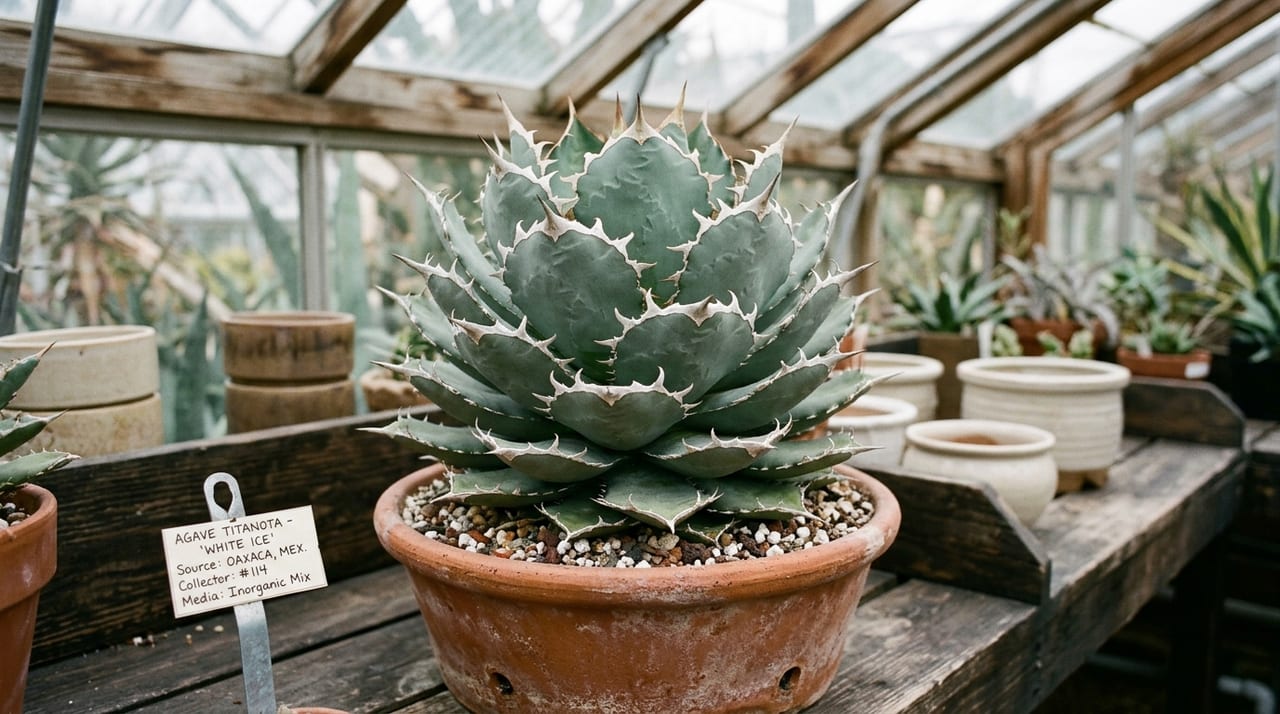
- Titanota and Holida types, which naturally originate from arid regions: show marked responses to water stress, with spines tending to grow thicker and sharper as dryness increases
- Varieties with thin leaves like Attenata: susceptible to extreme drought
Seasonal Watering Strategies
| Season | Timing | Watering Approach |
|---|---|---|
| Spring | March–May | Begin with minimal watering, gradually return to normal pace over 2–3 weeks. Water when soil surface is completely dry and 2–3 more days have passed |
| Summer | June–August | Increase watering frequency, but during humid rainy seasons consider moving to sheltered locations away from rain. Evening to nighttime watering is ideal |
| Fall | September–November | Gradually reduce frequency from September onward; observe for about 1 week after soil dries before the next watering. Repeat the "dry→minimal water→dry" cycle |
| Winter | December–February | In environments where room temperature continuously drops below 10°C, maintain water-free management. Aim for 2–3 months of complete drought; beyond that, give minimal water about once monthly |
Spring (March–May): Growth Season Begins and Roots Awaken
Spring is when active growth resumes. Gradually restart watering after winter dormancy, but giving large amounts of water all at once can damage roots that have been dormant for long periods. Begin with minimal watering that barely moistens the pot base, then gradually return to normal pace over 2–3 weeks.
During this period, it is important to actively expose plants to sunlight. Combining direct sunlight with appropriate dryness produces tightly formed new leaves. Water when the soil surface is completely dry and 2–3 more days have passed; a frequency that feels "slightly insufficient" is just right.
Summer (June–August): Flexible Management During Hot Months
Summer is when most Agave reach their growth peak. In high-temperature environments, soil dries faster, so increasing watering frequency compared to other seasons is no problem. However, during the humid rainy season, the risk of root rot from excess moisture increases, so consider moving plants to sheltered locations away from rain.
Watering during peak summer is ideally done during evening to nighttime hours when temperatures drop. Applying cold water during daytime heat can shock roots and damage fine root hairs. Even during high temperatures, ensure good airflow after watering to prevent heat buildup in the pot.
Fall (September–November): Prime Season for Applying Water Stress
Fall is an excellent opportunity to intentionally apply water stress and tighten plant form. From September onward, gradually reduce watering frequency and observe for about 1 week after soil dries before the next watering. Repeating this "dry→minimal water→dry" cycle firms up leaves and builds vigorous, mature stock for the coming spring.
As temperatures drop, plant metabolism also slows, making autumn dryness a natural stress for the plant. The large temperature swings between day and night in fall deepen coloration, making this an ideal season for developing beautiful plant color.
Winter (December–February): Setting Drought Periods and Winter Survival
Winter is a dormant period for most Agave. In environments where room temperature continuously drops below 10°C, maintain water-free management as a rule. Aim for 2–3 months of complete drought; if this extends longer, provide minimal water about once monthly to maintain roots.
During complete drought, leaves may become slightly soft—this is a normal state as the plant gradually consumes stored internal moisture. When watering resumes in spring, recovery is rapid. During drought, place plants in the brightest location possible; maintaining root health is key to successful winter survival.
Three Methods for Timing Watering
Judging by Leaf Condition
Agave has the ability to store water in leaves. When water becomes insufficient, the center of the leaf becomes subtly concave or the leaf tip wilts slightly—a "watering signal" appears. Confirming this condition and then watering achieves optimal water stress effects.
Conversely, if leaves are firm and glossy, moisture is adequate. Continuing to water at this stage causes overwatering. Developing the ability to read these daily changes through observation is central to mastering Agave cultivation.
Judging by Pot Weight
There is an obvious difference in pot weight between completely dry and moist soil. This difference is especially apparent with unglazed clay pots or lightweight plastic pots—when the pot feels "light" when lifted, it is time to water. When acquiring a new plant, memorizing the weight difference between right after watering and complete dryness as a sensory reference makes management significantly easier.
Confirming Pot Base and Soil Dryness
Touch the pot base to confirm complete dryness before watering. If the pot base is even slightly moist, no watering is needed yet. Another practical method is inserting a wooden stick or bamboo skewer into the soil, withdrawing it, and assessing internal moisture by how the soil adheres to it.
Soil and Pot Selection Determine Water Stress Management Success
Success in water stress management depends not only on watering frequency but also on soil and pot selection. Agave requires highly draining specialty soil mixtures. General-purpose houseplant soil has poor drainage for Agave; the basic formula uses red ball clay, pumice, and Kanuma soil as a base with a small amount of organic matter mixed in. Grain size should be adjusted for pot size; larger pots use larger-grain soil to ensure airflow.
Unglazed clay pots excel in airflow and drainage, making them ideal for water stress management. Plastic pots dry more slowly, requiring longer intervals between waterings. Pot size should not be too large relative to the plant's root mass—excess moisture tends to remain, raising root rot risk. A pot only one size larger than the plant is the basic rule.
Overwatering Failures and Solutions
Early Detection and Treatment of Root Rot
Overwatering causes root rot. Early symptoms are leaf discoloration (yellowing or browning) and softening. If the base shows browning or blackening, root rot is advancing. Early detection gives the best chance of recovery—do not hesitate to remove the plant and inspect when noticing leaf changes.
Treatment involves removing rotted roots with clean scissors and drying cut surfaces thoroughly before repotting into clean, dry soil. After repotting, refrain from watering for about 1 week while wound sites heal. Even plants with almost no roots can often recover through dormancy management if leaves remain firm.
Addressing Leaf Elongation (Etiolation)
When too much water combines with insufficient light, leaves elongate and the plant appears loose and undefined. Once-elongated leaves do not return to their original form, but with proper water stress management and adequate light afterward, newly expanding leaves become tightly formed. Continuing management with the mindset of developing the next generation of leaves, rather than rushing, is essential.
Selecting Healthy Stock at GrowerDirect
At GrowerDirect, you can purchase plants directly from growers. You can send questions like "What soil and watering management do you use?" directly to the grower, so you can use their answers as a reference for your management approach after purchase.
In Agave cultivation especially, the plant's condition at purchase greatly influences subsequent management. Stock with healthy roots, developed under appropriate water stress, has strong adaptability to environmental change and quickly establishes roots in new growing conditions. Meeting the right plant is the first step to enjoying water stress management.