Substrate Selection Guide for Planted Aquariums | Nutrient-Rich vs. Absorbent Soil: Differences and Uses
Learn how to select the ideal substrate for aquatic plant cultivation. Explains the differences between nutrient-rich and absorbent soils, and substrate lifespan.
Key Takeaways
Learn how to select the ideal substrate for aquatic plant cultivation. Explains the differences between nutrient-rich and absorbent soils, and substrate lifespan.
Related Species
The success of a planted aquarium is said to depend 80% on substrate selection. The substrate is fundamental to aquatic plant cultivation—it is the foundation where plant roots establish, the source of nutrient supply, and a habitat for beneficial bacteria. Choosing the right substrate is the first step toward a beautiful aquascape. This article explains, taking 2026 product trends into account, the types of soil that confuse beginners, how to choose particle size, the characteristics of substrates other than soil, and practical tips for long-term maintenance.
Two Major Types of Soil: Understanding Nutrient-Rich and Absorbent Differences
The most commonly used substrate in planted aquariums is "soil." This is a granular material made by firing and hardening dark soil, and it has the property of promoting good root establishment in aquatic plants and maintaining slightly acidic water pH. Soil is broadly divided into two types: "nutrient-rich" and "absorbent," each with distinct characteristics.
Nutrient-Rich Soil
Nutrient-rich soil is abundantly filled with nutrients that plants need, such as nitrogen, phosphorus, and potassium. Because aquatic plants can absorb nutrients directly through their roots, when combined with CO₂ supplementation, you can expect remarkably vigorous growth.
- Advantages: Aquatic plants grow very rapidly, and stable long-term cultivation is possible without additional fertilization
- Disadvantages: Water tends to become cloudy and ammonia is likely to be produced in large quantities during the initial setup phase. A period of frequent water changes is necessary
- Representative products: ADA Amazonia, Platinum Soil (nutrient type)
For first-time users, it is important to perform water changes of about 1/3 daily for 2 to 4 weeks after setup, and to refrain from introducing fish until the water quality stabilizes.
Absorbent Soil
Absorbent soil excels at adsorbing ammonia, organic matter, and turbidity, clearing the water quickly and transparently. Since it contains almost no nutrients, aquatic plant cultivation requires supplementation with liquid fertilizers or granular fertilizers added at the plant base. However, the advantage is that it establishes quickly and has less impact on fish and shrimp.
- Advantages: Water becomes clear quickly, ideal for shrimp tanks or aquariums prioritizing livestock. High safety for aquatic animals
- Disadvantages: In aquariums focused solely on aquatic plant cultivation, regular fertilizer management is essential
- Representative products: Master Soil, Control Soil
If prioritizing aquatic plants, nutrient-rich soil is best; if you want to keep shrimp or small fish alongside aquatic plants, absorbent soil or a hybrid combination of both is a practical choice.
Choosing Particle Size: Match It to the Type of Aquatic Plant and Layout
Soil particle size significantly affects how easily aquatic plants can be planted, how their roots establish, and water permeability. There are mainly three sizes available on the market, and it is important to use them according to your purpose.
| Size | Particle Size | Primary Use |
|---|---|---|
| Powder | 1mm or less | Planting foreground plants and finishing |
| Normal | 2–4mm | Standard size. Compatible with almost all aquatic plants |
| Large | 5mm or more | Prioritizing water permeability, lower layer of large tanks |
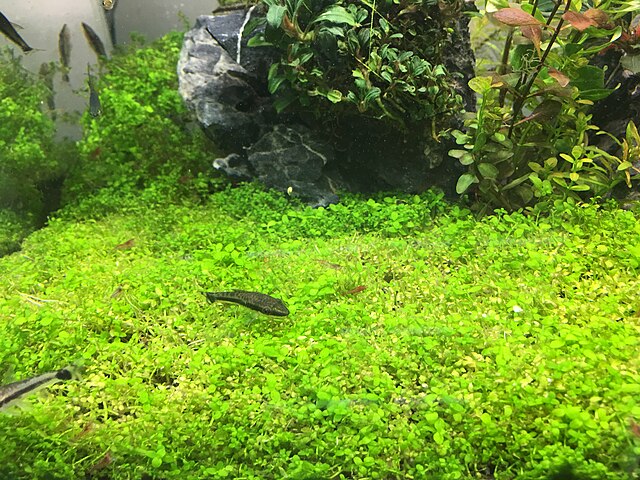
A particularly practical approach is the "two-layer method." By laying normal-sized particles 6–8cm deep on the bottom and finishing the surface with powder, you create an environment that ensures good root establishment while making it easy to plant foreground plants. For foreground plants with fine roots such as Glossostigma elatinoides (Glosso) and Hemianthus callitrichoides 'Cuba' (Dwarf Pearl Grass), powder is considered essential.
Also, the total thickness of soil is recommended to be at least 5cm or more. If too thin, roots cannot establish sufficiently, and plants become prone to uprooting.
Substrates Other Than Soil: Characteristics of Silica Sand, Decorative Sand, and Lava Rock Gravel
Beyond soil, there are multiple substrate options to choose from depending on your purpose and design. Understanding each substrate's characteristics expands the possibilities for your aquascape.
Silica Sand
This ocean-derived gravel has semi-permanent durability as its greatest advantage. However, the shell components it contains slightly raise pH, so when using it in a planted aquarium, acid treatment (soaking in vinegar or hydrochloric acid to dissolve components) is standard practice. Since it contains virtually no nutrients, you must bury granular fertilizer at the plant base to supplement nutrition.
Because it does not degrade even with long-term use, it is suitable for those wanting to minimize running costs or aquariums that are reset infrequently.
Decorative Sand (White Sand, River Sand)
White sand and river sand are popular as accents in aquascapes. They are difficult to use in areas where plants are planted, but are very effective for creating "open spaces" that resemble small paths or rivers. They contain no nutrients, and pH impact varies by product, so check the material before introducing them. The contrast with soil is beautiful, and they are often adopted in nature aquarium-style layouts.
Lava Rock Gravel
Fine fragments of porous lava rock, which has a large bacterial colonization surface area and excels as a biological filtration aid. High water permeability is another advantage, meaning anaerobic layers are unlikely to form. Since it contains no nutrients, fertilization is necessary for aquatic plant cultivation. Rather than mixing it with soil, combining it with an undergravel filter is more effective.
Substrate Lifespan and Replacement Timing: Keys to Long-Term Maintenance
Substrates have a "lifespan." Generally, after 1 to 2 years, particles begin to break down and turn muddy, which worsens water permeability. When oxygen fails to reach the substrate bed, an "anaerobic layer" forms. In anaerobic layers, harmful substances like hydrogen sulfide are produced, adversely affecting fish and aquatic plants, so timely replacement is necessary.
Signs not to miss for replacement
- Aquatic plant roots clearly establish poorly
- Bubbles form when you gently disturb the substrate (anaerobic layer gas)
- Algae on the glass suddenly increases (nutrient imbalance)
- Water becomes turbid more easily even with water changes
Complete substrate replacement causes large water quality fluctuations and essentially resets the bacterial environment, creating significant stress for fish and plants. The "partial replacement" method of replacing 1/3 at a time is gentler on livestock. Also, remember that after replacement, you will again need the initial setup-phase management.
Summary: Starting with Substrate Selection Toward Your Ideal Planted Aquarium
The choice of substrate for a planted aquarium depends on the type of aquatic plants you wish to grow, the livestock you plan to introduce, the direction of your layout, and the time you can dedicate to maintenance. First, understand soil characteristics correctly, and choose a substrate that matches your style.
- Want to enjoy vigorous aquatic plant growth → Nutrient-rich soil + CO₂ supplementation
- Want shrimp or small fish as the main focus while growing plants too → Absorbent soil + liquid fertilizer management
- Prioritizing long-term maintenance cost → Silica sand + granular fertilizer
- Creating a distinctive aquascape → Combination of soil and decorative sand
If you're interested in trying foreground plant cultivation, see the foreground plants guide as well.
GrowerDirect allows you to purchase aquatic plants directly from growers who are actually cultivating them in soil. A major strength of a direct sales platform is that you can easily ask questions like "What substrate do you use for cultivation?" and "How thick is your soil layer?" You can purchase after learning about the growing environment, making it easier to select aquatic plants that match your tank conditions. Even beginners can confidently start their 2026 aquatic plant hobby.