Introduction to Displaying Small Specimen Bonsai | Basics of Shelf and Seat Displays
This article explains the basic rules for displaying small specimen bonsai, methods for composing shelf and seat displays, how to choose accent plants and display stands, and techniques for expressing seasonal aesthetics.
Key Takeaways
This article explains the basic rules for displaying small specimen bonsai, methods for composing shelf and seat displays, how to choose accent plants and display stands, and techniques for expressing seasonal aesthetics.
Small specimen bonsai are beautiful on their own, but by giving thought to how you display them, their appeal can be magnified many times over. In Japanese bonsai culture, "display" is an important element for appreciating bonsai, and the compositional beauty created by combining multiple bonsai with accent plants is one of the pinnacles of bonsai art. Here we explain the fundamentals of displaying small specimen bonsai.
Basic Principles of Display
There are two display formats: "seat display" and "shelf display."
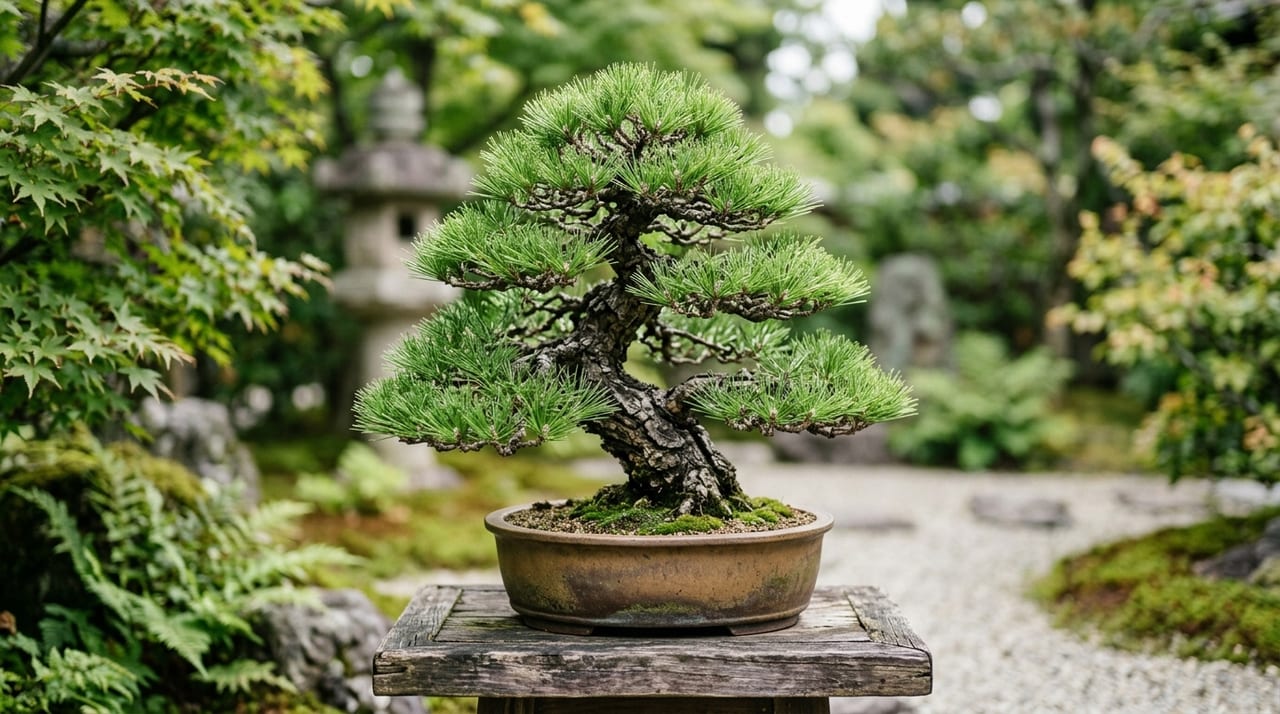
Seat display is a traditional form in which the principal tree (the main bonsai) is combined with accent plants (herbaceous plants, auxiliary plantings) and displayed in an alcove or exhibition space. It is the most formal display method and is the mainstream format at bonsai exhibitions.
Shelf display is a format in which multiple small specimen bonsai are arranged on a tiered display shelf (also called a small specimen shelf). Bonsai are balanced across the upper, middle, and lower tiers, creating a unified composition for appreciation. This is a display method unique to small specimen bonsai, offering the advantage of enjoying many trees in limited space.
In either format, the fundamentals of display are "harmony" and "seasonal feeling." Compose by considering the combination of tree species, the pairing of pot and stand, and the overall balance. It is important to approach this with the awareness that you are expressing a landscape or narrative, rather than simply arranging bonsai side by side.
Composition of Seat Displays
The basic composition of a seat display is a three-point set of "principal tree," "accent plant," and "(hanging scroll)." When displaying in an alcove, a hanging scroll is added, but general exhibitions typically feature a two-point composition of principal tree and accent plant.
The principal tree is the star of the display, and you should select the most visually impressive specimen. Medium to large pots of conifers or deciduous trees are commonly used, but for small specimens, choose a particularly well-developed tree as the principal. Position the principal tree slightly to the left or right of the display space, not in the center.
The accent plant is the supporting role that sets off the principal tree. Herbaceous plants (small potted alpine plants) are most common, and using seasonal flowering or fruiting plants expresses the feeling of the season. When the principal tree is a conifer, the contrast with herbaceous plants is beautiful; when the principal is a flowering bonsai, choose more modest herbaceous plants.
The height difference between the principal tree and accent plant is also important. If the principal tree is tall, place the accent plant lower; if the principal is in a cascade form or otherwise low, position the accent plant somewhat higher. Overall, aim for a triangular silhouette.
Composition of Shelf Displays
In shelf display, three to seven small specimen bonsai are arranged on a tiered display shelf. There are compositional rules; trees are selected strategically rather than arranged arbitrarily.
The basic rules for shelf display are as follows.
- Do not repeat the same tree species: arrange different types such as conifers, deciduous trees, flowering bonsai, and herbaceous plants in balanced proportions
- Vary the pot shapes: combine round, rectangular, oval, and other forms to avoid monotony
Place the most visually impressive bonsai, equivalent to a principal tree, on the upper tier. On the middle and lower tiers, arrange complementary bonsai and herbaceous plants to create overall harmony. The left-right distribution on each tier is also important; create a zigzag rhythm by placing trees shifted right below trees shifted left, and so on.
In shelf display, also consider the balance of "visual weight." Place delicate herbaceous plants near robust conifers, or austere deciduous trees near showy flowering bonsai, using contrast to enhance each.
Choosing Display Stands and Pots
The stand is the base on which the bonsai rests and plays an important role in display. The choice of stand can greatly alter the impression of the bonsai. Representative stands have the following characteristics.
| Stand Type | Characteristics | Suitable Bonsai |
|---|---|---|
| Flat Stand (Base Board) | The most basic stand. Natural wood with beautiful grain is preferred, and prized woods such as rosewood, padauk, and ebony are used | Any bonsai |
| Elevated Stand | A stand that raises the bonsai to a higher position | Bonsai with pendulous forms such as cascade and semi-cascade styles |
It is also important to coordinate the colors of pot and stand. Generally, pair a darker-toned pot with a more subdued stand, and a bright-glazed pot with a slightly lighter-impression stand. Be mindful of balance to avoid the overall display becoming too heavy or too light.
Display shelf designs are diverse, ranging from simple wooden versions to luxurious lacquer-finished ones. Matching the shelf design with the aesthetic of the bonsai creates a cohesive display.
Expressing Seasonal Aesthetics
Expressing seasonal aesthetics in display is extremely important. Since bonsai are living plants, strive to create displays that fully showcase their appearance at each time of year.
| Season | Featured Bonsai | Accent Plant |
|---|---|---|
| Spring | New-growth deciduous bonsai or flowering varieties (plum, cherry, forsythia, etc.) | Combine with spring alpine plants (violet, trillium, etc.) to express the arrival of spring |
| Summer | Conifers displaying strong, deep-green growth | Use ferns or summer herbaceous plants (false hellebore, etc.) to create a cool impression. Adding a viewing stone is also effective in summer displays |
| Autumn | Bonsai with autumn color and fruit-bearing varieties | Pairing with autumn wildflowers such as gentian and toad lily enhances seasonal feeling |
| Winter | Cold-hardy deciduous bonsai or evergreen conifers | Select winter herbaceous plants (adonis, hardy chrysanthemum, etc.) and aim for a display that conveys vitality within the severity of winter |
Common Beginner Mistakes and How to Avoid Them
- Mistake 1: Displaying too many trees Because small specimens are compact, you may be tempted to display many. However, seat display is a world of subtraction, and as the number of pieces increases, the principal tree fades. Start with the basic three-point composition of principal tree, accent plant, and accent feature.
- Mistake 2: Mismatching pot and stand quality Placing a light pot on a heavy stand looks unstable, and the reverse is equally problematic. Avoid failure by first choosing the pot, then selecting a stand to match.
- Mistake 3: Clashing seasons When seasons are mismatched—such as pairing autumn foliage with spring grasses—the overall display loses cohesion. The basic rule is to choose the accent plant from the same season as the principal tree.
Find Bonsai to Enjoy Display with GrowerDirect
At GrowerDirect, you can purchase small specimen bonsai suitable for display directly from specialty growers. If you consult about your display composition, you may receive suggestions for tree species and accent plants that complement your existing collection. Experience the joy of not just "growing" bonsai but also "displaying" them with bonsai found at GrowerDirect.