Outdoor Environment Setup for Large Agave Species and In-Ground Installation Strategies for Oversized Varieties
Challenges in Large Agave Cultivation and the Importance of Outdoor Environments Among Agave species, large varieties that exceed one meter at maturity (such as Agave titanota and Agave parry) captivate many plant enthusiasts with their imposing presence and visual impact. However, as size increases, indoor management becomes increasingly difficult, making the transition to outdoor cultivation essential. Outdoor environments require more than simply "securing land"—they demand a complex system encompassing wind-resistant anchoring methods, efficient drainage, and seasonal adaptation strategies. This article explains practical, concrete methods for setting up outdoor environments to safely and healthily cultivate large Agaves.
Key Takeaways
Challenges in Large Agave Cultivation and the Importance of Outdoor Environments Among Agave species, large varieties that exceed one meter at maturity (such as Agave titanota and Agave parry) captivate many plant enthusiasts with their imposing presence and visual impact. However, as size increases, indoor management becomes increasingly difficult, making the transition to outdoor cultivation essential. Outdoor environments require more than simply "securing land"—they demand a complex system encompassing wind-resistant anchoring methods, efficient drainage, and seasonal adaptation strategies. This article explains practical, concrete methods for setting up outdoor environments to safely and healthily cultivate large Agaves.
Related Species
Challenges in Large Agave Cultivation and the Importance of Outdoor Environments
Among Agave species, large varieties that exceed one meter at maturity (such as Agave titanota and Agave parry) captivate many plant enthusiasts with their imposing presence and visual impact. However, as size increases, indoor management becomes increasingly difficult, making the transition to outdoor cultivation essential. Outdoor environments require more than simply "securing land"—they demand a complex system encompassing wind-resistant anchoring methods, efficient drainage, and seasonal adaptation strategies. This article explains practical, concrete methods for setting up outdoor environments to safely and healthily cultivate large Agaves.
Soil Selection and Drainage Assurance — Foundation for Preventing Root Rot
Because the root systems of large varieties spread deep and wide, soil selection determines success or failure in cultivation. Agaves are naturally plants that grow in deserts and semi-arid regions, and they are prone to root rot in high-humidity environments.
For outdoor cultivation of large Agaves, a standard mixture of red clay soil (medium grain) 40%, Kanuma soil 30%, pumice 15%, leaf mold 10%, sand 5% is recommended. However, adjustments may be necessary depending on regional rainfall. In high-rainfall areas, increase the ratio of Kanuma soil and pumice; in arid regions, add a little more leaf mold—fine-tune based on your local climate.
The selection of pots is also important. Normally, caudiciform species like Agave gracilipes are managed in terracotta pots, but for large varieties, considering weight and wind protection, deep plastic containers with multiple drainage holes are recommended. They are lighter than terracotta pots, making relocation and securing easier. Layer coarse gravel about 5 centimeters deep at the pot bottom and ensure thorough drainage.
During the rainy season and autumn rains, rainwater easily accumulates in outdoor placements. When necessary, consider temporary rain protection measures such as placement under eaves or coverage with vinyl sheets.
Wind Protection and Plant Anchoring — Prevention of Toppling and Root Damage
The greatest threat to outdoor cultivation of large Agaves is "wind." Species like Agave titanota and Agave parry have broad leaves, making them easily affected by wind, and the risk of toppling increases significantly during typhoons or strong winds.
Anchoring methods vary depending on container size and plant size. The following methods are practical:
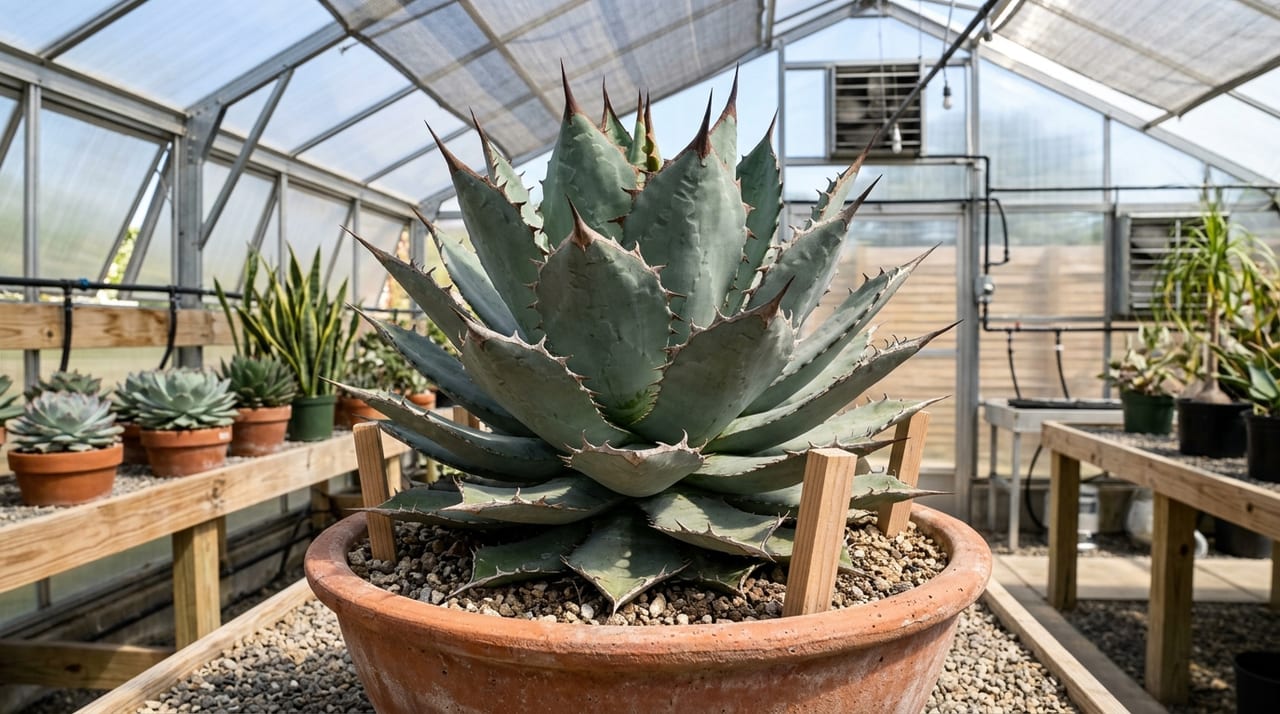
In-ground Anchoring Method: When planting in large containers (60 centimeters or taller in height) and placing directly on the ground, drive a stake (timber approximately 2 centimeters in diameter) deep into the soil, and loosely tie it with garden twine or netting at a position 30 centimeters above the base of the plant. Create spacing with bamboo sticks or ties so the twine does not directly contact the leaves.
Weight Balance Method: Arrange three or more large containers side by side so they support each other. In areas with strong winds, attaching anchor bolts to the sides of large containers and connecting them to concrete pins buried in the ground is also effective.
Net and Frame Utilization: Create a structure supporting the plant using sturdy, coarse-mesh netting (20 millimeters or larger) supported by a wooden frame around the plant. This frame is also effective in preventing feeding damage and theft by animals.
Important points when anchoring: avoid applying excessive force directly to the plant body. Agave leaves are delicate and can split or be damaged at the base if pulled forcefully. Always use distributed support at multiple points.
Light Management and Seasonal Adjustment
Large species including Agave filifera require more than 12 hours of direct sunlight daily. When setting up outdoors, placement along a south-facing wall or in an open area is fundamental.
However, intense sunlight in early summer carries the risk of leaf burn. Particularly for plants freshly moved outdoors in spring or immediately after winter dormancy, it is important to gradually acclimate them to light using 30–50% shade cloth (mid-April through mid-July).
Winter management also differs by season. - Autumn (September–October): As temperatures begin to drop, reduce watering and prepare the plant for "winter readiness." - Winter (November–February): Agaves enter dormancy. In the Kanto region and southward, outdoor overwintering is entirely feasible, but in areas where temperatures drop below 0°C, protection under eaves or a frost-protection vinyl tunnel guaranteeing 0°C or above is essential. - Spring (March–April): Gradually resume watering as temperatures rise.
Pest and Disease Management and Sanitation
Outdoor cultivation increases exposure to pests and diseases. The primary pests that affect large varieties such as Agave titanota include scale insects, spider mites, and thrips.
Regular observation is the first line of defense. Check both the upper and lower surfaces of leaves once or twice weekly for black spots or white cottony deposits. At early stages, gently wiping with a damp cloth is sufficient.
Regarding diseases, concerns include "soft rot" and "gray mold" in high-humidity environments. To prevent these, ensure adequate air circulation around the plant, and perform preventive fungicide applications (such as triflumizole-type fungicides) approximately once per month during the rainy season.
Additionally, in outdoor cultivation, fallen and dead leaves tend to accumulate around pots. These become breeding grounds for pests, so regular cleaning and maintaining cleanliness around the pot is important.
Summary
Outdoor cultivation of large Agaves is not simply "planting in a large pot and placing it outside"—it is the construction of an "ecosystem" integrating drainage, wind protection, light management, and pest control. Popular large varieties such as Agave parry and Agave gracilipes can fully display their appeal only with proper environmental setup based on these fundamentals.
It may initially seem labor-intensive, but once the system is in place, the natural outdoor environment provides dynamic growth that is difficult to achieve with indoor management. Please refer to the guidance in this article and work toward establishing an outdoor environment suited to your garden or cultivation space for large Agaves.