Lady Bank's Rose | Complete Guide to Cultivating Thornless Large Climbing Roses
A guide to the key points of planting, pruning, and training Lady Bank's rose, a thornless climbing rose that is easy to handle even for beginners.
Key Takeaways
A guide to the key points of planting, pruning, and training Lady Bank's rose, a thornless climbing rose that is easy to handle even for beginners.
Related Species
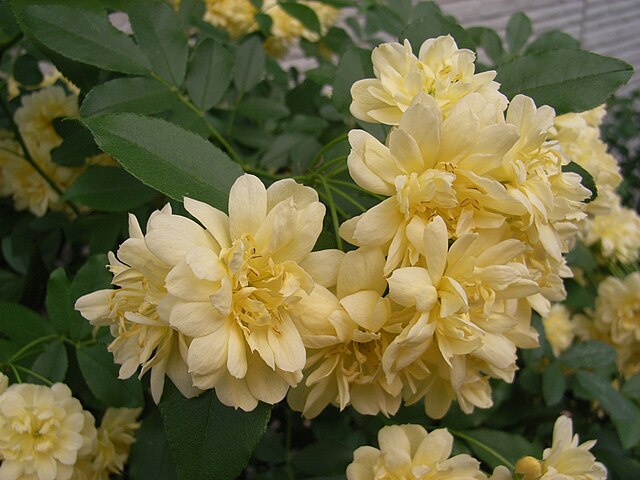
Lady Bank's rose is a climbing plant classified in the Rosaceae family and Rosa genus, native to China. Its most distinctive feature, setting it apart from typical roses, is the near-absence of thorns on the stems. This means there is little risk of pricking your hands during pruning or training, making it a popular choice for those attempting to grow climbing roses for the first time. It has a vigorous growth habit and grows quite large, and its impressive ability to quickly cover structures like fences, arches, and pergolas with lush foliage and blooms is another reason for its enduring popularity.
Varieties and Flowering Characteristics
Lady Bank's rose is broadly divided into two types: white flowers and yellow flowers. Each has its own distinct character, so choosing based on the atmosphere and purpose of your planting location will increase your satisfaction.
- Double Yellow-Flowered (Lady Hillingdon): The most widely available type, with densely packed small, double flowers in vivid pale yellow. It has a subtle fragrance and robust constitution.
- Double White-Flowered: Small double white flowers with a strong, sweet vanilla-like fragrance.
- Single White-Flowered: A type closer to the species, with single white flowers. It has fragrance and a wild, natural charm.
Flowering typically occurs from late April through May, blooming earlier than most roses. It is not repeat-flowering; instead, it blooms once a year all at once. However, the flower set is exceptionally abundant, and at full bloom, branches are completely covered with small flowers, creating a striking display. It is fairly cold and heat tolerant, and in warm regions west of the Kanto area, it overwinters easily when planted in the ground.
Planting and Location Selection
The best time to plant is from November to March, when the plant is dormant. Choosing a location with good sunlight and air circulation is the first step to healthy growth. While it can flower even in partial shade, insufficient light may reduce flowering, so prioritize securing a sunny location as much as possible.
For ground planting, dig a hole about 2 to 3 times the size of the root ball and mix leaf mold and compost into the soil before planting, which will facilitate good root establishment. In poorly drained soil, there is an increased risk of root rot, so if the area is heavy clay, it's wise to amend it by mixing in sand or light stone.
It's easy to overlook imagining the plant's size in a few years. Lady Bank's rose can spread several meters in both width and height if conditions are favorable. Choosing a location with adequate distance from adjacent building walls, neighboring plantings, and power lines will make future management significantly easier.
Watering and Fertilizing
Once established in the ground with well-developed roots, Lady Bank's rose can be grown primarily on natural rainfall alone. Only during periods of extreme drought after the rainy season ends should you water generously at the base. For container-grown plants, water thoroughly when the surface soil is dry, and be careful not to allow water to sit in the saucer.
There are two main times to apply fertilizer.
- Post-flowering fertilizer (May–June): Apply slow-release compound fertilizer or organic solid fertilizer at the base to help the plant recover from the exertion of flowering.
- Winter fertilizer (December–February): During dormancy, lightly work organic fertilizer (oil cake, bone meal, etc.) into the soil around the plant.
Excessive nitrogen-rich fertilizer will cause excessive leaf and branch growth at the expense of flowers. Choosing a fertilizer that also contains balanced phosphorus and potassium will support flower bud formation for the following year.
Pruning and Training Basics
The most important aspect of pruning Lady Bank's rose is timing. Since flower buds for the following spring form on branches that grew the previous year, heavy pruning in winter will remove flower buds and result in dramatically fewer flowers the next year. The golden rule is to prune immediately after flowering, during early summer.
The main purposes of pruning are these two points:
- Branch thinning: Remove dead wood, thin branches, and branches that are congested toward the interior of the plant at the base, to ensure good air circulation.
- Length adjustment: Cut back branches that extend beyond fences or arches to the appropriate length and maintain the overall shape.
The key to training is to guide the main branches at as close to a horizontal angle as possible. When branches are fixed horizontally, new shoots tend to grow upward from those points, resulting in increased flowering. Use twine or training clips to secure branches with sufficient slack to avoid damaging them. Since there are almost no thorns, this task is safer compared to working with other climbing roses.
Pest and Disease Management and Daily Care
Lady Bank's rose is relatively resistant to pests and diseases, but the following problems may arise depending on environmental conditions:
- Powdery mildew and black spot: These become more likely when the interior of the plant becomes congested and air circulation is poor. Ensuring good air flow within the plant through pruning and training is the fundamental preventive measure.
- Aphids: They readily appear when new spring growth is developing. Remove them by hand as soon as you spot them, or treat with a pesticide registered for use on flowering and foliage plants. Always check the label's application chart when using pesticides.
What you must especially avoid in daily care is "neglect." Because Lady Bank's rose grows vigorously, if you skip pruning for many years, the plant can become so tangled that you won't know where to begin untangling it. Maintaining a simple annual cycle of post-flowering pruning and winter fertilizing is the best way to keep beautiful flowering year after year.
Container vs. Ground Planting: Which Should You Choose?
If you want to grow Lady Bank's rose on a balcony or in a small entryway, container planting is an option. However, because the roots are very vigorous, plan on repotting into a larger container every 1 to 2 years. Ultimately, a pot of size 10 (about 30 cm in diameter) or larger is the target. By training it on small structures like obelisks or trellises, you can enjoy the full, abundant flowering characteristic of Lady Bank's rose even in limited space.
On the other hand, if you have sufficient garden space and want it to grow large in the coming years, ground planting from the start will allow roots to spread freely and will require less maintenance effort in the long term. When planting along a fence or near an arch support, deciding the planting location after first visualizing the training direction and the plant's spread will make subsequent work significantly easier.
With few thorns and easy handling, Lady Bank's rose is an extremely practical variety for both those attempting to grow climbing roses for the first time and those already cultivating roses who want to add verdant color to garden structures. As long as you carefully time post-flowering pruning and ensure adequate space for planting, it will reward you each spring with an overwhelming abundance of flowers. On GrowerDirect, you can search for seedlings offered by growers (availability varies by season).