Source: Wikimedia Commons
Whorled pennywort
BeginnerHydrocotyle verticillata
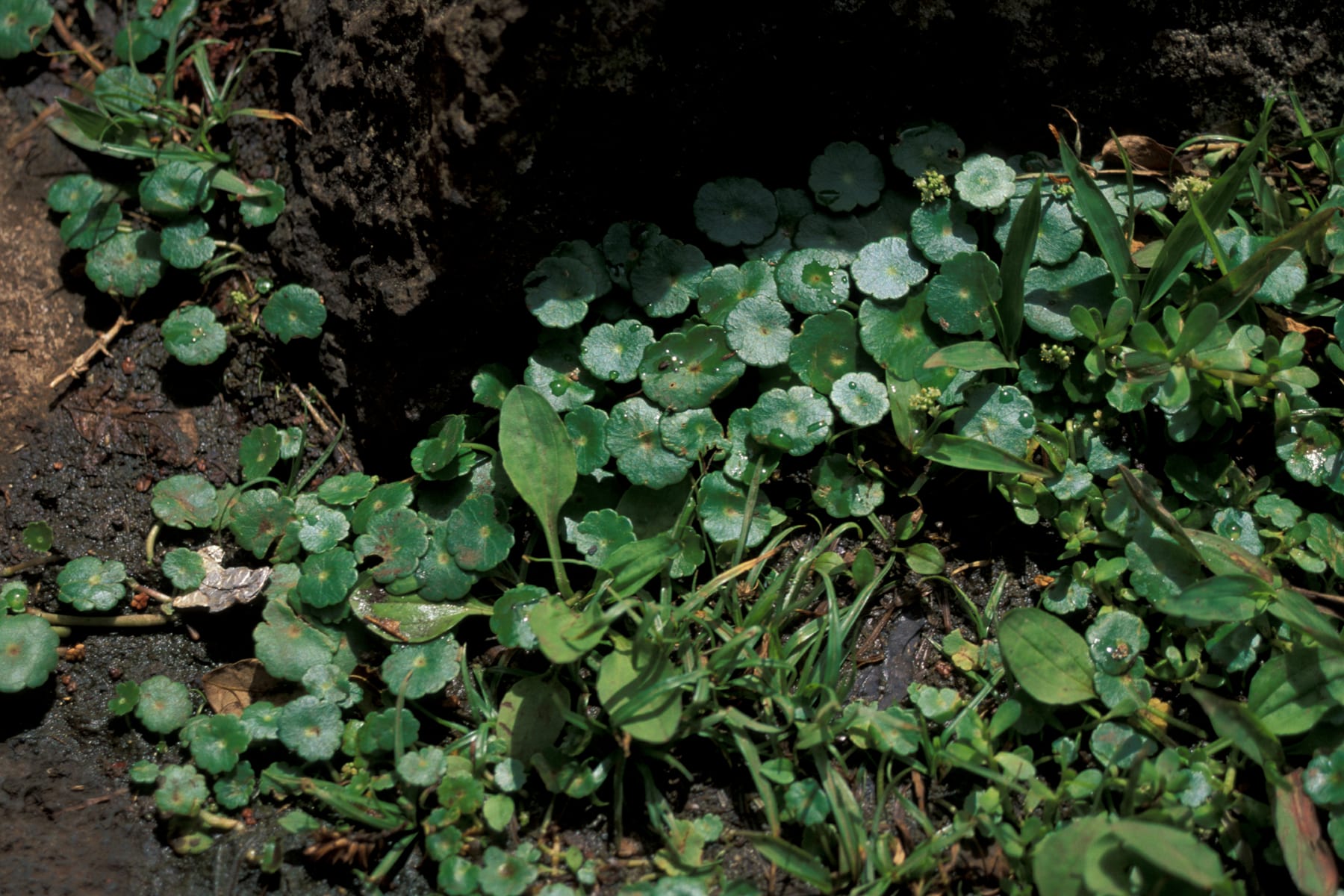
A creeping marsh plant (Japanese name Uchiwazenikusa) with round, shield-shaped leaves on slender stalks. A biotope staple, but naturalised in Japan and listed as a Priority Control Alien Species. It is distinct from the Specified Invasive Hydrocotyle ranunculoides.
About
Water mushroom (Hydrocotyle verticillata, Araliaceae) is a perennial; the form sold in Japan is treated by the Ministry of the Environment as Uchiwazenikusa, H. verticillata var. triradiata, and is also called water coin. The species occurs in North and South America, and the traded plant is said to originate from the southern United States. Its rhizome branches and creeps, sending up slender stalks from the nodes that carry round, shield-shaped leaves attached at the centre. Small white flowers appear in whorls from June to October. It grows in marshes and along water, both emersed and submersed. In aquaria it is a foreground plant that does best in strong light and soft, slightly acidic water; it can also float unrooted or be grown in a pot of moist soil. It arrived in Japan around 1960 and is naturalised on Honshu, Shikoku, Kyushu and the Nansei Islands. The Ministry of the Environment's list (2nd ed., September 2026) designates it a Priority Control Alien Species and asks that it not be taken into natural waters, as water spreads it easily. The similar H. ranunculoides is a Specified Invasive Alien Species banned from sale and cultivation; this species is smaller and rarely forms floating leaves, and it is not a Specified Invasive Alien Species. It is widely sold in Japan as a marginal plant for biotopes.
Source: Wikipedia (CC BY-SA 4.0)
Size of the Whorled pennywort
The Whorled pennywort grows to About 3–10 cm tall in aquaria; up to about 40 cm outdoors.
Basic Info
Origin
The Americas (traded plants said to originate from the southern USA)
Lifespan
Perennial; keeps spreading by rhizomes
Size
About 3–10 cm tall in aquaria; up to about 40 cm outdoors
Temperature
20〜28℃
Watering & Fertilizer
Benefits from moderate CO2; grows without fertiliser outdoors
Growing Tips
Lighting
Likes strong light; outdoors, give it a sunny spot.
CO2 & Fertilizer
In aquaria moderate CO2 helps; outdoors it grows without fertiliser.
Water Temperature & Quality
Does best in soft, slightly acidic water; also grows in pots of moist soil.
Substrate & Attachment
Plant in the substrate or let it float; outdoors it suits marginal pots and biotopes.
Trimming & Propagation
Its rhizomes run freely; cut back excess growth. Pieces of rhizome root readily.
Cautions
Listed as a Priority Control Alien Species. Never dump or plant it in rivers, ponds or rice fields, prevent overflow from containers in heavy rain, and dry cuttings before binning them.
Whorled pennywort FAQ
QWhat is the growing difficulty level for Whorled pennywort?
Beginner. A variety suitable for beginners. No special equipment or experience is required—you can grow it without problems by setting up a basic cultivation environment.
QHow large does Whorled pennywort get?
The mature size of Whorled pennywort is About 3–10 cm tall in aquaria; up to about 40 cm outdoors. This may vary slightly depending on cultivation environment and individual differences.
QHow should I water and fertilize Whorled pennywort?
Whorled pennywort: watering & fertilizer — Benefits from moderate CO2; grows without fertiliser outdoors. Aim for appropriate frequency and amount.
QWhat is the typical price for Whorled pennywort?
The price of Whorled pennywort varies significantly by variety, characteristics, size, and lineage. Please check GrowerDirect's price guide for the latest market information.
Last updated: September 23, 2026
References & Sources
Edited & verified by: GrowerDirect Editorial Team
The classifications, regulations, and growing data on this page are created and verified based on the primary information database below.
Primary sources
- Wikipedia
- Species+ (CITES listing check)
- Ministry of the Environment: list of Invasive Alien Species (Invasive Alien Species Act)
- Ministry of the Environment: List of Alien Species that may Damage Ecosystems
- Ministry of the Environment: alien species list, plants (2nd ed.)
- Tropica plant profile (Hydrocotyle verticillata)
- Wikipedia (Hydrocotyle verticillata)
- GBIF
Taxonomy & Authority
Regulations & Conservation Status
Not listed in CITES (no match in Species+). Designated a Priority Control Alien Species (Uchiwazenikusa) in the Ministry of the Environment's alien species list (2nd ed., September 2026). Imports of any Hydrocotyle need a species-name certificate under the Invasive Alien Species Act, but growing and selling within Japan is not restricted. The Specified Invasive Alien Species is H. ranunculoides, not this plant. Do not introduce it to natural waters, and never dump it in rivers, ponds or ditches.
Sources: Species+ (CITES listing check) / Ministry of the Environment: list of Invasive Alien Species (Invasive Alien Species Act) / Ministry of the Environment: List of Alien Species that may Damage Ecosystems / Ministry of the Environment: alien species list, plants (2nd ed.)
Regulations may change. Always verify the latest information with the relevant authorities.
Related Species
Find listings for this species
Related Articles
Aquatic Plant Tank Used Soil and Substrate Disposal and Recycling Methods | Correct Disposal Methods and Reuse Tips
Explains the correct disposal methods for used substrate in aquatic plant tanks. Introduces the proper disposal procedures according to local municipal rules and the concept of reuse for short-term usage.
Beginner-Friendly Aquatic Plants Without CO2 Supplementation | Cultivation Conditions and Tank Layout Strategies
You can create a beautiful aquarium without expensive CO2 equipment. This guide explains practical methods for selecting CO2-free aquatic plants that beginners can successfully grow, from cultivation conditions to tank layout strategies.
How to Cultivate Rotala and Bring Out Beautiful Red Color | Lighting, CO2, and Trimming Techniques to Achieve Vibrant Red
This guide explains the Rotala genus, popular in aquatic plant layouts, covering light intensity, CO2, and fertilizer management to bring out red coloration, as well as trimming techniques for maintaining beautiful, dense growth.
Rare Attachment-Type Aquatic Plants Beyond Anubias, Bucephalandra, and Willow Moss | The Charm of Distinctive Varieties like Bolbitis
Beyond the standard attachment-type aquatic plants—Anubias, Bucephalandra, and Willow Moss—there are distinctive attachment-type aquatic plants like Bolbitis. This article introduces their charm, cultivation tips, and how to incorporate them into aquascaping layouts.
🩺 Common diseases
Can't find the plant you're looking for?
Post your wishes for free and growers with matching plants will contact you with introductions.