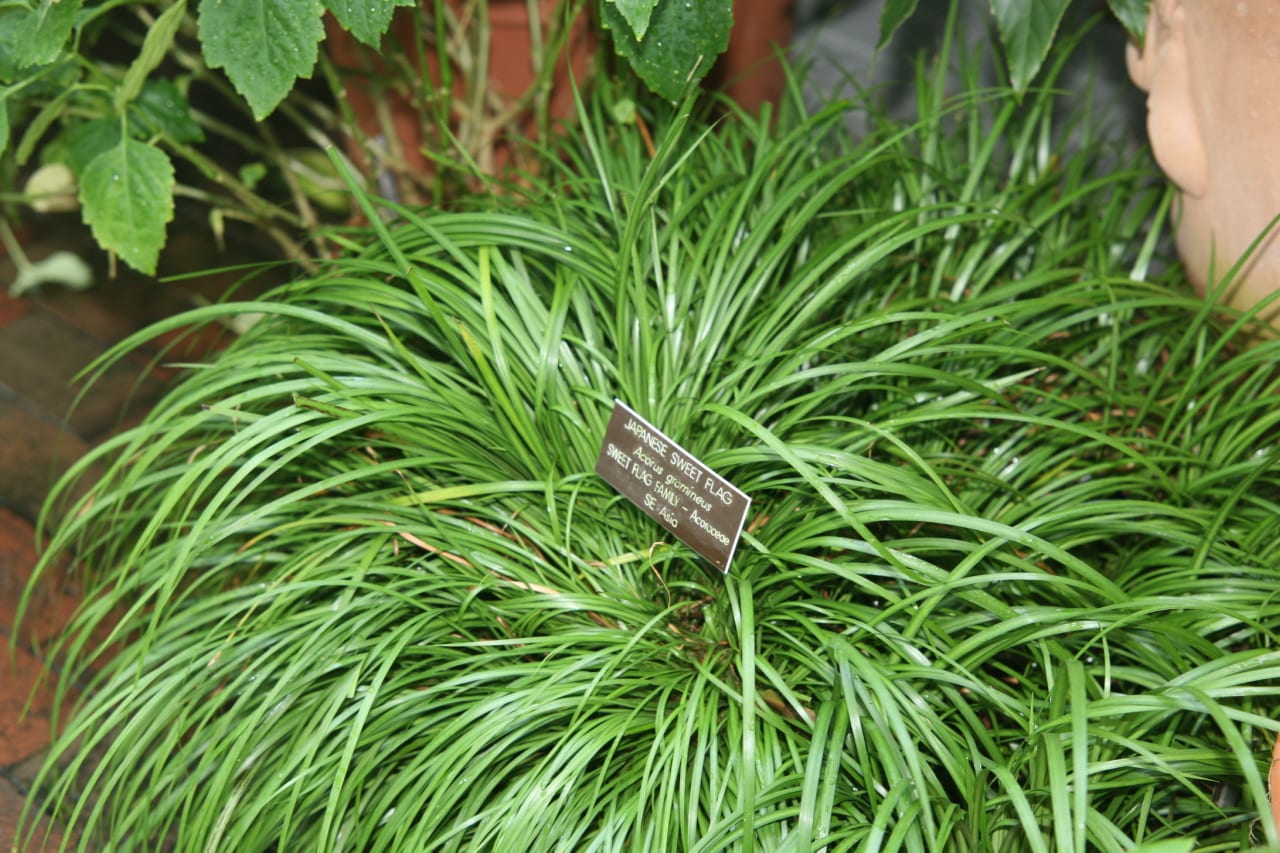
Source: Wikimedia Commons
Japanese sweet flag
BeginnerAcorus gramineus
A Japanese native marsh plant that fans out narrow, sword-like leaves and forms colonies on rocky stream banks. Tough at the water's edge or in terrariums, but most forms decline when fully submerged; only dwarf cultivars cope under water.
About
Japanese sweet flag (Acorus gramineus, Acoraceae) is a perennial ranging from Honshu, Shikoku and Kyushu through China, South-East Asia and north-east India to Korea. Its Japanese name refers to its rocky habitat and resemblance to sweet flag. It is a rheophyte of fast streams and waterfall splash zones, submerged in strong currents when water rises. The rhizome creeps and branches, fanning out pointed linear leaves up to about 30 cm long to form colonies, with pale yellow spadices in spring and early summer. The related A. calamus is larger with a prominent midrib. Acorus was once placed in the arum family but now forms its own family, regarded as the earliest-diverging lineage of monocots. Long used in Japanese gardens and aquaria, it has variegated cultivars and dwarf ones such as 'Pusillus'. In aquaria note that most plants barely grow and eventually die when kept submerged for long; long-term underwater culture is reported only for dwarf forms fixed to stone or wood with the rhizome unburied. Taller forms suit open-topped tanks with leaves above water, paludariums or moist pots. It is widely sold by garden centres and aquatic plant shops in Japan.
Source: Wikipedia (CC BY-SA 4.0)
Size of the Japanese sweet flag
The Japanese sweet flag grows to Leaves up to about 30 cm (dwarf cultivars shorter).
Temperature & humidity for the Japanese sweet flag
The ideal temperature for the Japanese sweet flag is 18〜23℃.
Basic Info
Origin
Japan (Honshu, Shikoku, Kyushu), China, South-East Asia, north-east India, Korea
Lifespan
Perennial; maintained indefinitely by division
Size
Leaves up to about 30 cm (dwarf cultivars shorter)
Temperature
18〜23℃
Watering & Fertilizer
Needs little fertiliser
Growing Tips
Lighting
Grows at the waterside, in indoor pots or in terrariums; little is documented about its light needs.
CO2 & Fertilizer
No CO2 needed and little fertiliser.
Water Temperature & Quality
Prefers cool conditions, about 18–23°C; not suited to submerged culture in warm tropical tanks.
Substrate & Attachment
Grow it emersed with leaves above water. Dwarf forms used under water should be fixed to stone or wood with the rhizome unburied. In pots, ordinary potting soil kept moist is fine.
Trimming & Propagation
Very slow-growing; propagate by division.
Cautions
Taller forms weaken and die when fully submerged; choose dwarf cultivars for underwater use. Never release plants into the wild.
Japanese sweet flag FAQ
QWhat is the growing difficulty level for Japanese sweet flag?
Beginner. A variety suitable for beginners. No special equipment or experience is required—you can grow it without problems by setting up a basic cultivation environment.
QWhat is the ideal temperature for Japanese sweet flag?
The ideal temperature for Japanese sweet flag is 18〜23℃. Avoid sudden temperature changes and maintain a stable environment.
QHow large does Japanese sweet flag get?
The mature size of Japanese sweet flag is Leaves up to about 30 cm (dwarf cultivars shorter). This may vary slightly depending on cultivation environment and individual differences.
QHow should I water and fertilize Japanese sweet flag?
Japanese sweet flag: watering & fertilizer — Needs little fertiliser. Aim for appropriate frequency and amount.
QWhat is the typical price for Japanese sweet flag?
The price of Japanese sweet flag varies significantly by variety, characteristics, size, and lineage. Please check GrowerDirect's price guide for the latest market information.
Last updated: September 23, 2026
References & Sources
Edited & verified by: GrowerDirect Editorial Team
The classifications, regulations, and growing data on this page are created and verified based on the primary information database below.
Taxonomy & Authority
Regulations & Conservation Status
Not listed in CITES (no match in Species+). Not regulated under Japan's Invasive Alien Species Act or Species Conservation Act. Never dump aquatic plants into rivers, ponds or ditches, or flush them away with tank water. Drain unwanted plants and trimmings and dispose of them as household waste.
Sources: Species+ (CITES listing check) / Ministry of the Environment: list of Invasive Alien Species (Invasive Alien Species Act)
Regulations may change. Always verify the latest information with the relevant authorities.
Related Species
Find listings for this species
Related Articles
Aquatic Plant Tank Used Soil and Substrate Disposal and Recycling Methods | Correct Disposal Methods and Reuse Tips
Explains the correct disposal methods for used substrate in aquatic plant tanks. Introduces the proper disposal procedures according to local municipal rules and the concept of reuse for short-term usage.
Beginner-Friendly Aquatic Plants Without CO2 Supplementation | Cultivation Conditions and Tank Layout Strategies
You can create a beautiful aquarium without expensive CO2 equipment. This guide explains practical methods for selecting CO2-free aquatic plants that beginners can successfully grow, from cultivation conditions to tank layout strategies.
How to Cultivate Rotala and Bring Out Beautiful Red Color | Lighting, CO2, and Trimming Techniques to Achieve Vibrant Red
This guide explains the Rotala genus, popular in aquatic plant layouts, covering light intensity, CO2, and fertilizer management to bring out red coloration, as well as trimming techniques for maintaining beautiful, dense growth.
Rare Attachment-Type Aquatic Plants Beyond Anubias, Bucephalandra, and Willow Moss | The Charm of Distinctive Varieties like Bolbitis
Beyond the standard attachment-type aquatic plants—Anubias, Bucephalandra, and Willow Moss—there are distinctive attachment-type aquatic plants like Bolbitis. This article introduces their charm, cultivation tips, and how to incorporate them into aquascaping layouts.
🩺 Common diseases
Can't find the plant you're looking for?
Post your wishes for free and growers with matching plants will contact you with introductions.