Source: Wikimedia Commons
Japanese pond lily
IntermediateNuphar japonica
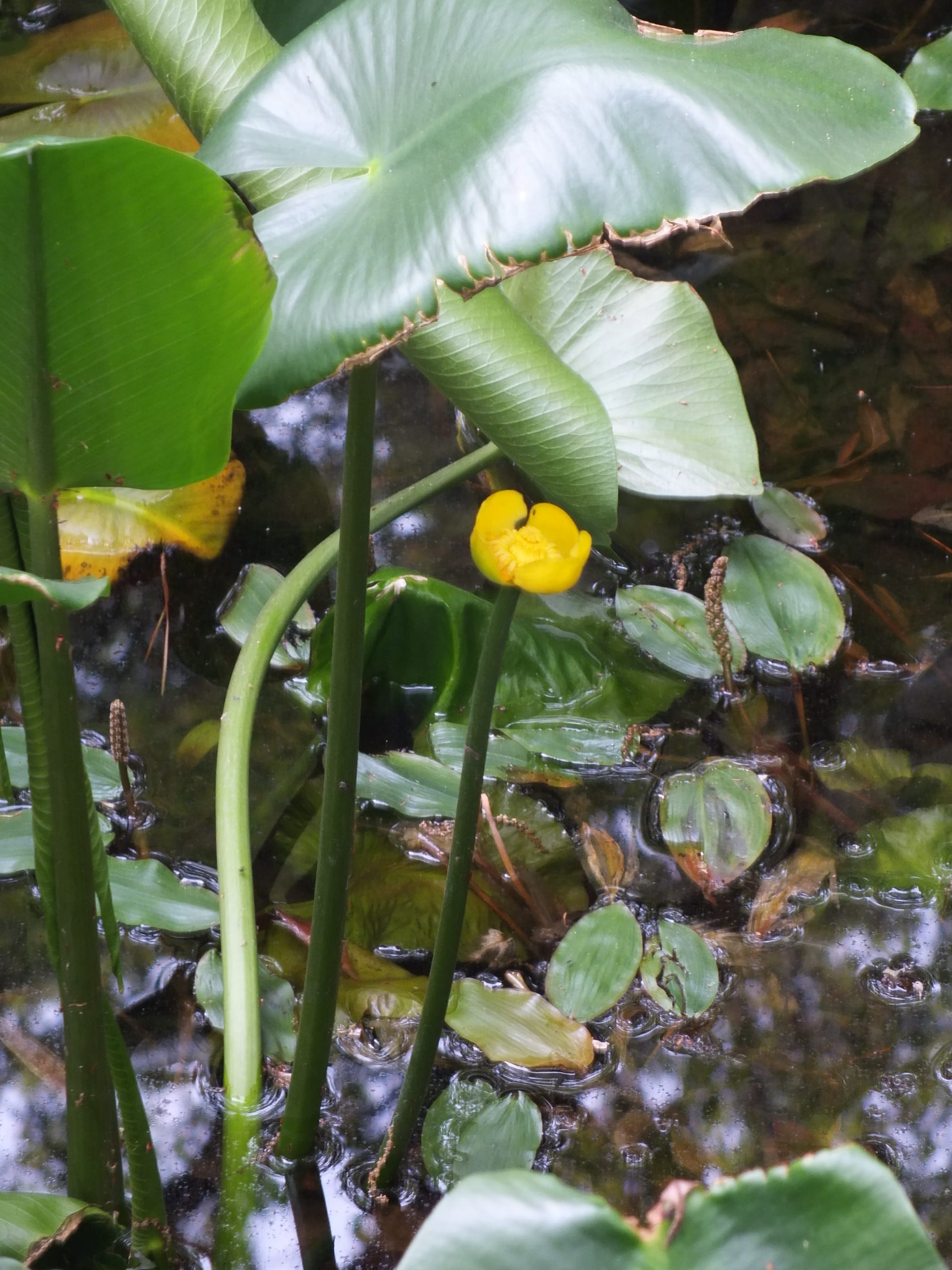
A Japanese aquatic plant that raises thick, arrow-shaped leaves above the water and bears yellow cup-shaped flowers in summer. Its name ('river bone') comes from the thick white rhizome. It has declined widely and is red-listed in many prefectures.
About
Japanese pond lily (Nuphar japonica, Nymphaeaceae) is a perennial of shallow ponds, marshes, rivers and ditches from south-western Hokkaido through Honshu, Shikoku and Kyushu, and is sometimes regarded as endemic to Japan. Its Japanese name, 'river bone', comes from the thick white rhizome creeping through the mud. It has submerged leaves and aerial leaves: the aerial leaves are oblong with arrow-shaped bases, 20–50 cm long, leathery and glossy dark green, standing above shallow water or floating in deeper water. Submerged leaves are thin and wavy, and in flowing water only these may form. In winter the aerial leaves die back, leaving the submerged ones. From June to October single yellow cup-shaped flowers 3–5 cm across open upward on long stalks; the petal-like parts are five sepals. Forms with reddish flowers and variegated forms are cultivated. River works and farmland consolidation have made it scarce, and it is red-listed in many prefectures, so buy cultivated plants rather than collecting from the wild. The related Nuphar submersa is a separate species whose collection and transfer are generally banned under the Species Conservation Act, so do not confuse them. It suits biotopes and ponds, and its submerged leaves can be enjoyed in aquaria. It is sold by garden centres that handle aquatic plants in Japan.
Source: Wikipedia (CC BY-SA 4.0)
Size of the Japanese pond lily
The Japanese pond lily grows to Aerial leaves 20–50 cm long; flowers 3–5 cm across.
Temperature & humidity for the Japanese pond lily
The ideal temperature for the Japanese pond lily is 20〜28℃.
Basic Info
Origin
Japan (south-western Hokkaido to Kyushu)
Lifespan
Perennial; long-lived from its rhizome
Size
Aerial leaves 20–50 cm long; flowers 3–5 cm across
Temperature
20〜28℃
Watering & Fertilizer
Grow in rich mud or paddy soil
Growing Tips
Lighting
Grows in medium to strong light; outdoors, keep it in a sunny pond or container.
CO2 & Fertilizer
No CO2 needed; plant in rich, muddy soil.
Water Temperature & Quality
Grows best at 20–28°C and is cold-hardy outdoors; in winter the aerial leaves die back to the submerged ones.
Substrate & Attachment
Lay the rhizome horizontally in deep mud; depending on water depth the leaves stand up or float.
Trimming & Propagation
Propagate by dividing the rhizome.
Cautions
Red-listed in many prefectures, so choose cultivated plants and never collect from the wild. The related Nuphar submersa is protected under the Species Conservation Act. Do not plant or dump it in natural waters.
Japanese pond lily FAQ
QWhat is the growing difficulty level for Japanese pond lily?
Intermediate. A variety suitable for intermediate growers. Requires some cultivation experience and knowledge of environment management. Pay careful attention to temperature and humidity control.
QWhat is the ideal temperature for Japanese pond lily?
The ideal temperature for Japanese pond lily is 20〜28℃. Avoid sudden temperature changes and maintain a stable environment.
QHow large does Japanese pond lily get?
The mature size of Japanese pond lily is Aerial leaves 20–50 cm long; flowers 3–5 cm across. This may vary slightly depending on cultivation environment and individual differences.
QHow should I water and fertilize Japanese pond lily?
Japanese pond lily: watering & fertilizer — Grow in rich mud or paddy soil. Aim for appropriate frequency and amount.
QWhat is the typical price for Japanese pond lily?
The price of Japanese pond lily varies significantly by variety, characteristics, size, and lineage. Please check GrowerDirect's price guide for the latest market information.
Last updated: September 23, 2026
References & Sources
Edited & verified by: GrowerDirect Editorial Team
The classifications, regulations, and growing data on this page are created and verified based on the primary information database below.
Taxonomy & Authority
Regulations & Conservation Status
Not listed in CITES (no match in Species+). Nuphar japonica itself is not regulated under the Invasive Alien Species Act or Species Conservation Act, but it is red-listed in many prefectures. The related Nuphar submersa is a National Endangered Species of Wild Fauna and Flora under the Species Conservation Act, whose collection, sale and transfer are generally banned, so take care not to confuse the species. Do not collect from the wild. Do not plant or dump it in ponds, rivers or ditches; dry unwanted plants before disposing of them as household waste.
Sources: Species+ (CITES listing check) / Ministry of the Environment: list of National Endangered Species
Regulations may change. Always verify the latest information with the relevant authorities.
Related Species
Find listings for this species
Related Articles
Camellia Bonsai Growing Guide — Enjoying Flowering Bonsai
From the appeal of Camellia (Camellia japonica) bonsai to placement, watering, soil and repotting, fertilizing, pruning and flower bud formation, pest control, and tree shaping, this guide explains the practical management points unique to flowering bonsai.
Aquatic Plant Tank Used Soil and Substrate Disposal and Recycling Methods | Correct Disposal Methods and Reuse Tips
Explains the correct disposal methods for used substrate in aquatic plant tanks. Introduces the proper disposal procedures according to local municipal rules and the concept of reuse for short-term usage.
Beginner-Friendly Aquatic Plants Without CO2 Supplementation | Cultivation Conditions and Tank Layout Strategies
You can create a beautiful aquarium without expensive CO2 equipment. This guide explains practical methods for selecting CO2-free aquatic plants that beginners can successfully grow, from cultivation conditions to tank layout strategies.
How to Cultivate Rotala and Bring Out Beautiful Red Color | Lighting, CO2, and Trimming Techniques to Achieve Vibrant Red
This guide explains the Rotala genus, popular in aquatic plant layouts, covering light intensity, CO2, and fertilizer management to bring out red coloration, as well as trimming techniques for maintaining beautiful, dense growth.
🩺 Common diseases
Can't find the plant you're looking for?
Post your wishes for free and growers with matching plants will contact you with introductions.