Source: Wikimedia Commons
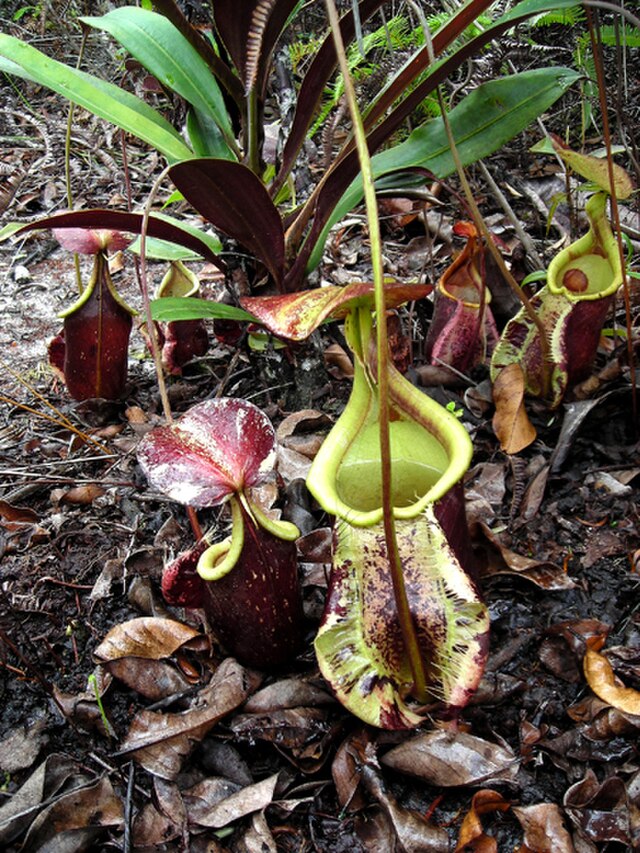
Nepenthes Rafflesiana
IntermediateNepenthes rafflesiana
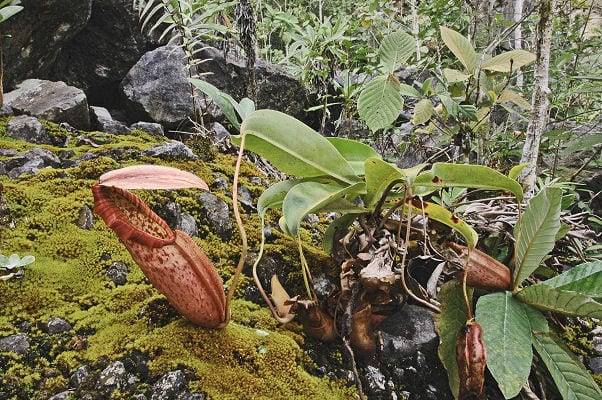
A large Nepenthes widely distributed in SE Asia with huge pitchers and varied coloring.
Overview
Nepenthes rafflesiana is a large lowland species widely distributed across the Malay Peninsula, Borneo, Sumatra, and parts of the southern Philippines. Named in honor of Sir Stamford Raffles, it is among the most morphologically variable Nepenthes, exhibiting pitchers that range from white with purple mottling to entirely deep red. Upper pitchers of mature plants can exceed 50 cm in length and are documented to occasionally trap frogs and other small vertebrates in addition to insects. The species grows very large, necessitating ample space, but is otherwise a robust and rewarding subject in tropical collections.
Lifespan of the Nepenthes Rafflesiana
The Nepenthes Rafflesiana lives 10+ years.
Size of the Nepenthes Rafflesiana
The Nepenthes Rafflesiana grows to Vine 50-300cm.
Temperature & humidity for the Nepenthes Rafflesiana
The ideal temperature for the Nepenthes Rafflesiana is 22〜35℃.
As a lowland species, it requires warm temperatures (22–35°C) and high humidity (70%+), with sphagnum or equivalent media kept consistently moist.
Basic Info
Origin
Malay Peninsula, Borneo, Sumatra, and southern Philippines, lowland tropical rainforests
Lifespan
10+ years
Size
Vine 50-300cm
Temperature
22〜35℃
Humidity
60〜90%
Watering & Fertilizer
Insects
Growing Tips
Light & Placement
A large species whose vines reach 300 cm, so it needs plenty of space. A greenhouse where humidity can be maintained suits it.
Watering
Keep the medium moist with purified water or rainwater. Maintain humidity at 70% or more.
Temperature & Overwintering
It prefers warm, humid conditions at 22-35°C. As a lowland species, keep it warm through winter without letting temperatures drop.
Soil & Repotting
Use sphagnum moss alone or a similar moisture-retentive material. It grows large, so repot into a generously sized pot.
Pruning & Shaping
Because it grows so large, cut back overgrown vines to keep it compact. Otherwise it is fairly easy to grow.
Nepenthes Rafflesiana FAQ
QWhat is the growing difficulty level for Nepenthes Rafflesiana?
Intermediate. A variety suitable for intermediate growers. Requires some cultivation experience and knowledge of environment management. Pay careful attention to temperature and humidity control.
QWhat is the ideal temperature for Nepenthes Rafflesiana?
The ideal temperature for Nepenthes Rafflesiana is 22〜35℃. Avoid sudden temperature changes and maintain a stable environment.
QWhat is the lifespan of Nepenthes Rafflesiana?
The average lifespan of Nepenthes Rafflesiana is 10+ years. With proper cultivation environment and nutrient management, you can keep it healthy for a long time.
QHow large does Nepenthes Rafflesiana get?
The mature size of Nepenthes Rafflesiana is Vine 50-300cm. This may vary slightly depending on cultivation environment and individual differences.
QHow should I water and fertilize Nepenthes Rafflesiana?
Nepenthes Rafflesiana: watering & fertilizer — Insects. Aim for appropriate frequency and amount.
QWhat is the typical price for Nepenthes Rafflesiana?
The price of Nepenthes Rafflesiana varies significantly by variety, characteristics, size, and lineage. Please check GrowerDirect's price guide for the latest market information.
Last updated: August 31, 2026
References & Sources
Edited & verified by: GrowerDirect Editorial Team
The classifications, regulations, and growing data on this page are created and verified based on the primary information database below.
Taxonomy & Authority
Accepted name: Nepenthes rafflesiana Jack
Synonyms: Nepenthes rafflesiana var. minor Becc., Nepenthes rafflesiana var. ambigua Beck, Nepenthes sanderiana Burb., Nepenthes rafflesiana var. nigropurpurea Mast., Nepenthes rafflesiana var. alata J.H.Adam & Wilcock, Nepenthes rafflesiana var. glaberrima Hook.f., Nepenthes rafflesiana var. elongata Anon., Nepenthes rafflesiana var. insignis Mast., Nepenthes rafflesiana var. nivea Hook.f., Nepenthes nigropurpurea T.Moore & Mast., Nepenthes rafflesiana var. longicirrhosa Tamin & M.Hotta, Nepenthes rafflesiana var. zabawiana M.N.Faizal, Latiff & Besi
Authority databases: GBIF · POWO · ICPS cultivar registration (International Carnivorous Plant Society)
Nomenclature follows global taxonomic authority databases.
Regulations & Conservation Status
The genus Nepenthes, except for rajah/khasiana, is CITES Appendix II at the genus level. International trade requires permits.
Sources: CITES Appendices (carnivorous plants) - ICPS/Barry Rice / CITES & Carnivorous Plant Checklist (RBG Kew)
Regulations may change. Always verify the latest information with the relevant authorities.
Related Species
Find listings for this species
Related Articles
Developing Nepenthes Pitcher Traps Completely: Cultivation Secrets Through Environmental Management and Physiological Approaches
The carnivorous leaves of Nepenthes represent the masterpiece of an insect-trapping mechanism that arose over a long course of evolution. This article explains how to mature the carnivorous leaves completely and develop healthy plants with actual predatory function through humidity, light, and nutrient management.
Growing Pitcher Plants Without a Greenhouse: How to Get Pitchers to Form Indoors
Explains how to grow carnivorous pitcher plants (Nepenthes) indoors without a greenhouse. Covers reasons why pitchers fail to form and solutions, methods for maintaining humidity, variety selection, and tips for winter care.
Highland Nepenthes Growing Guide | Cool Management for High-Altitude Pitcher Plants
An introduction to growing highland nepenthes. Covers the key points of managing summer temperatures with air conditioning at about 25–27°C during the day and 20°C at night while maintaining the ideal humidity of 70–90%, a potting mix of 6 parts sphagnum moss, 2 parts perlite, and 2 parts kanuma soil, and a guideline of keeping temperatures at 10°C or above in winter.
How to Grow Nepenthes | Cultivation Techniques to Grow Larger Pitchers
We cover how to grow Nepenthes, including the difference in ideal temperatures between lowland and highland species, how to maintain 70–80% humidity, and a 7:3 sphagnum moss and perlite potting mix, and we also explain the light, ventilation, and fertilizer needed to grow larger pitchers and why you shouldn't cut the growing point.
Can't find the plant you're looking for?
Post your wishes for free and growers with matching plants will contact you with introductions.