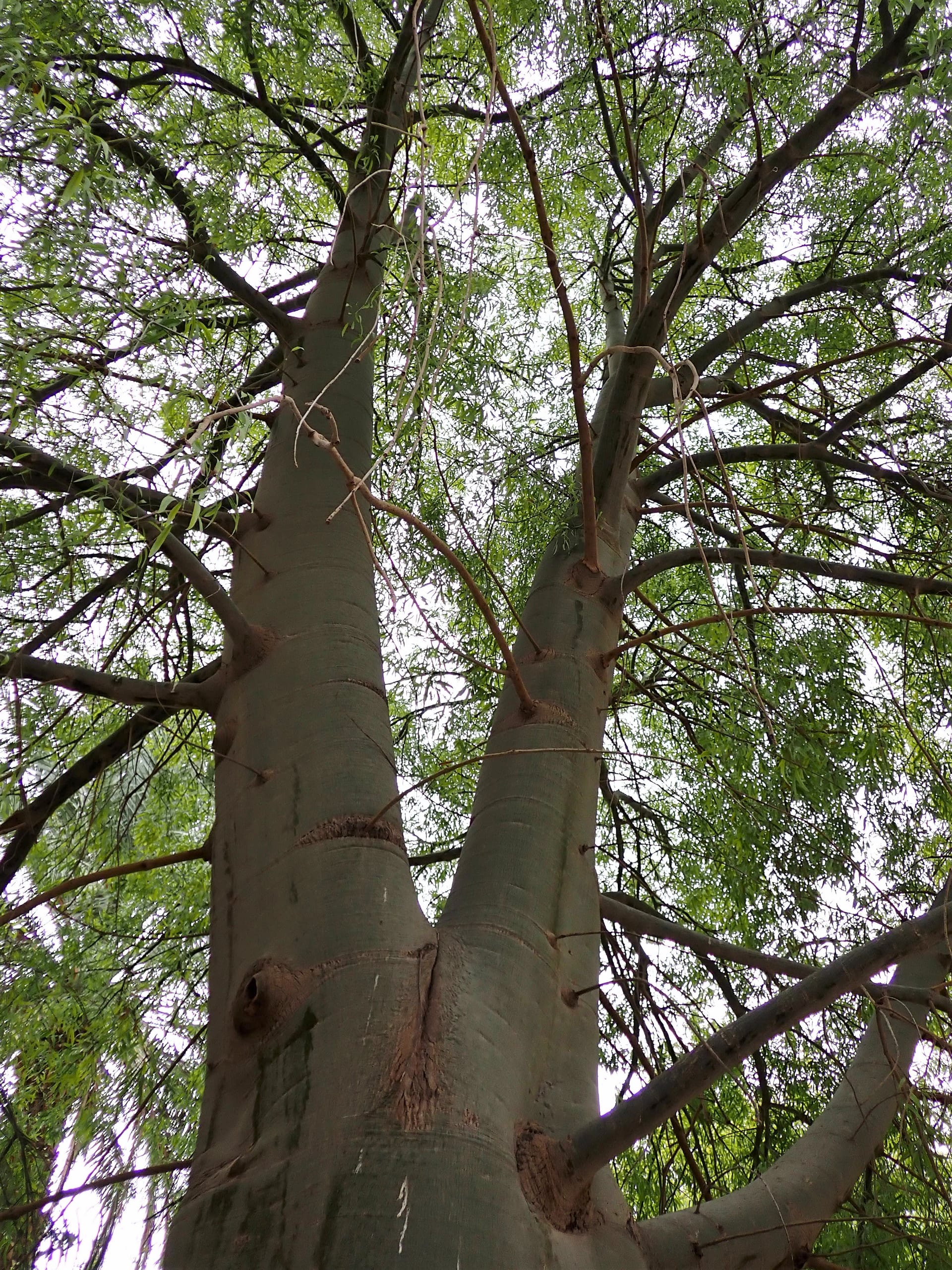
Source: Wikimedia Commons
Queensland bottle tree
BeginnerBrachychiton rupestris
The Queensland bottle tree, endemic to Queensland, Australia, with a swollen bottle-shaped trunk and narrow leaves. Juvenile leaves are deeply divided and look quite different from the narrow adult leaves.
About
Brachychiton rupestris is a deciduous tree in the Malvaceae (formerly Sterculiaceae), endemic to Queensland, Australia. It grows on hilltops and slopes on clay, shale or basalt soils and, as a drought-deciduous succulent tree, is a key emergent species of the semi-evergreen vine thickets of the Brigalow Belt. It reaches 10–20 m, rarely 25 m, and the trunk swells into a bottle shape up to 1–3.5 m across at breast height, hence the name Queensland bottle tree. Adult leaves are narrow-elliptic to deeply divided, 4–11 cm long and 0.8–2 cm wide with a glossy upper surface; juvenile leaves are compound with three or more lobes. It drops its leaves in the dry season, and the cream flowers are followed by woody, boat-shaped follicles lined with irritating hairs. It adapts readily to cultivation, tolerates a wide range of soils and temperatures, and is grown as an indoor plant and a bonsai subject. Young plants grow very slowly: the bottle shape becomes visible only after about 5–8 years, and seed-grown trees may take up to 20 years to flower. The IUCN Red List category is Least Concern. In Japan potted plants are widely sold online and in garden centres as "bottle tree".
Source: Wikipedia (CC BY-SA 4.0)
Size of the Queensland bottle tree
The Queensland bottle tree grows to 10–20 m (rarely 25 m) tall in the wild, trunk 1–3.5 m across; stays small in a pot.
Basic Info
Origin
Australia (Queensland)
Lifespan
Long-lived woody plant (little published data)
Size
10–20 m (rarely 25 m) tall in the wild, trunk 1–3.5 m across; stays small in a pot
Temperature
10〜35℃
Watering & Fertilizer
Regular feeding in the growing season
Growing Tips
Light & Placement
It grows best in full sun; indoors keep it at a bright window.
Watering
A drought-deciduous tree that tolerates dry spells; water when the mix has dried, as soggy soil harms the roots.
Temperature & Overwintering
It tolerates a range of temperatures, but it suits climates equivalent to USDA zones 9–12; bring it indoors for winter in cold areas.
Soil & Repotting
It prefers well-drained, slightly acidic soil. Mature plants transplant easily.
Propagation
Easily raised from seed; wear gloves when extracting it, as the hairs inside the pod irritate skin. Semi-mature cuttings can be taken in late summer with rooting hormone and bottom heat.
Pests & Cautions
Young plants grow very slowly; the bottle-shaped trunk appears only after about 5–8 years.
Queensland bottle tree FAQ
QWhat is the growing difficulty level for Queensland bottle tree?
Beginner. A variety suitable for beginners. No special equipment or experience is required—you can grow it without problems by setting up a basic cultivation environment.
QHow large does Queensland bottle tree get?
The mature size of Queensland bottle tree is 10–20 m (rarely 25 m) tall in the wild, trunk 1–3.5 m across; stays small in a pot. This may vary slightly depending on cultivation environment and individual differences.
QHow should I water and fertilize Queensland bottle tree?
Queensland bottle tree: watering & fertilizer — Regular feeding in the growing season. Aim for appropriate frequency and amount.
QWhat is the typical price for Queensland bottle tree?
The price of Queensland bottle tree varies significantly by variety, characteristics, size, and lineage. Please check GrowerDirect's price guide for the latest market information.
Last updated: September 23, 2026
References & Sources
Edited & verified by: GrowerDirect Editorial Team
The classifications, regulations, and growing data on this page are created and verified based on the primary information database below.
Taxonomy & Authority
Regulations & Conservation Status
Not listed in CITES (checked on Species+). No special procedure is needed for transfers within Japan.
Sources: Species+ (CITES): Brachychiton rupestris / IUCN Red List category via GBIF: Brachychiton rupestris
Regulations may change. Always verify the latest information with the relevant authorities.
Related Species
Find listings for this species
Related Articles
How to Grow Uncarina | Differences Between the Madagascar Endemic Species Grandidieri and Roeoesliana
An explanation of the appeal and cultivation methods of the Madagascar endemic caudex plant Uncarina genus. We introduce the differences between Uncarina grandidieri and roeoesliana, seedling cultivation, and repotting timing.
Complete Guide to Choosing Caudex Plants as Gifts | Recommended Varieties by Occasion and How to Include Care Notes
A guide to choosing caudex plants as gifts organized by occasion. We introduce how to select varieties based on the recipient's cultivation experience and how to include care notes for long-term enjoyment.
Diagnosing and Treating Poor Root Development in Caudex Plants | Causes and Solutions for Roots That Won't Emerge or Won't Grow
A detailed guide to root emergence problems in caudex plants. From diagnosis methods to solutions, practical techniques for promoting healthy root development are introduced.
Complete Guide to Growing Jatropha podagrica (Buddha's Navel) | Cultivation Management to Enjoy Its Distinctive Caudex and Coral-Red Flowers
Characteristics and cultivation methods of the caudex plant Jatropha podagrica. Detailed explanation of watering management during dormancy, soil, and propagation methods.
🩺 Common diseases
Can't find the plant you're looking for?
Post your wishes for free and growers with matching plants will contact you with introductions.