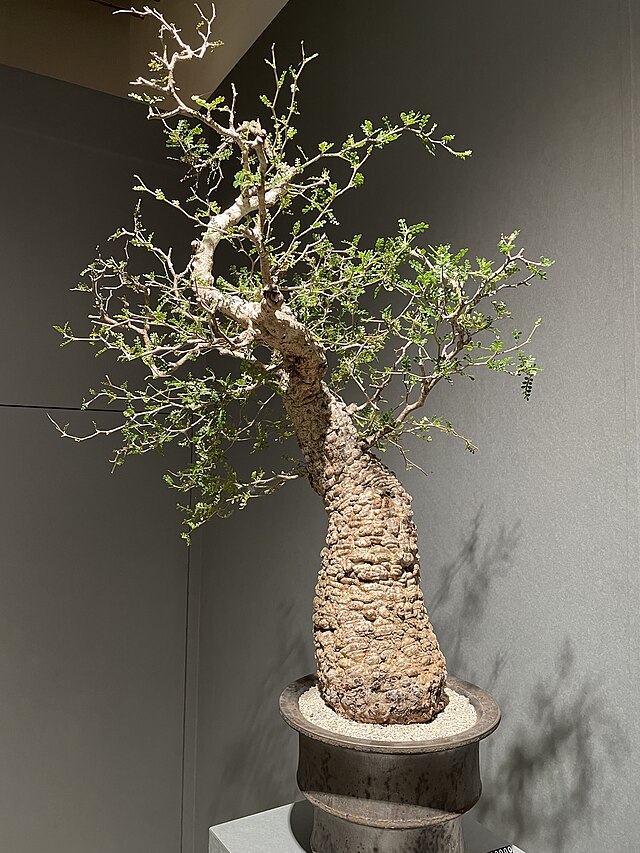
Source: Wikimedia Commons
Operculicarya Pachypus
AdvancedOperculicarya pachypus
The pinnacle of caudex collecting from Madagascar. Bonsai-like intricate branching and massive caudex. Wild specimens trade for thousands of dollars. Root initiation is extremely challenging.
Overview
Operculicarya pachypus is a member of the Anacardiaceae family native only to the area around Toliara in southwestern Madagascar, where it grows in the dry forests of limestone hills and plateaus. It is prized for its dramatically exposed root system and thick, textured gray-brown trunk that evokes the aesthetic of fine bonsai. The compound leaves are small and delicate, creating a striking contrast with the powerful trunk. Growth is slow, and even in habitat it is a low shrub with zigzag branching, only about 1 m (rarely 2 m) tall, and pot-grown specimens are typically maintained at modest sizes. Full sun, extremely fast-draining soil, generous summer watering, and complete winter drought are essential. Its difficulty and rarity place it firmly in the realm of advanced collectors.
Source: Wikipedia (CC BY-SA 4.0)
Lifespan of the Operculicarya Pachypus
The Operculicarya Pachypus lives 100+ years (in habitat).
Size of the Operculicarya Pachypus
The Operculicarya Pachypus grows to 30-100cm (total height incl. caudex).
Temperature & humidity for the Operculicarya Pachypus
The ideal temperature for the Operculicarya Pachypus is 25〜35℃.
Rooting bare-root specimens is notoriously challenging, often requiring a combination of hydroponics, high humidity, and bottom heat of 25–30°C sustained over several months.
Basic Info
Origin
Madagascar
Lifespan
100+ years (in habitat)
Size
30-100cm (total height incl. caudex)
Temperature
15〜40℃
Watering & Fertilizer
Water: when topsoil dries in growth season / complete withhold in dormancy
Growing Tips
Light & Placement
Loves strong direct sun. Ideally grow it outdoors in full sun during the summer growing season, and avoid insufficient light.
Watering
In the growing season, water thoroughly once the surface soil dries. During dormancy withhold water completely to prevent root rot.
Temperature & Overwintering
The ideal range is 25-35°C, within an overall range of 15-40°C. Stop watering after leaf drop in winter; in Japan, overwintering indoors is safest.
Soil & Repotting
Use an ultra-fast-draining mix based on hyuga pumice and pumice with minimal organic matter. Repot in the growing season, taking care not to damage the roots.
Pests & Cautions
Rooting bare-root plants is the hardest part, often needing a combination of hydroponics, sealed humidity, and heat (25-30°C) for months. Starting with an already-rooted plant is safer.
Operculicarya Pachypus FAQ
QWhat is the growing difficulty level for Operculicarya Pachypus?
Advanced. A variety suitable for advanced growers. Requires advanced cultivation techniques and specialized equipment, with careful environmental adjustments needed.
QWhat is the ideal temperature for Operculicarya Pachypus?
The ideal temperature for Operculicarya Pachypus is 25〜35℃. Avoid sudden temperature changes and maintain a stable environment.
QWhat is the lifespan of Operculicarya Pachypus?
The average lifespan of Operculicarya Pachypus is 100+ years (in habitat). With proper cultivation environment and nutrient management, you can keep it healthy for a long time.
QHow large does Operculicarya Pachypus get?
The mature size of Operculicarya Pachypus is 30-100cm (total height incl. caudex). This may vary slightly depending on cultivation environment and individual differences.
QHow should I water and fertilize Operculicarya Pachypus?
Operculicarya Pachypus: watering & fertilizer — Water: when topsoil dries in growth season / complete withhold in dormancy. Aim for appropriate frequency and amount.
QWhat is the typical price for Operculicarya Pachypus?
The price of Operculicarya Pachypus varies significantly by variety, characteristics, size, and lineage. Please check GrowerDirect's price guide for the latest market information.
Last updated: October 2, 2026
References & Sources
Edited & verified by: GrowerDirect Editorial Team
The classifications, regulations, and growing data on this page are created and verified based on the primary information database below.
Taxonomy & Authority
Regulations & Conservation Status
Operculicarya pachypus is individually listed in CITES Appendix II.
Sources: CITES Appendix II species list / CITES Appendices (valid from 2023)
Regulations may change. Always verify the latest information with the relevant authorities.
Related Species
Find listings for this species
Related Articles
How to Care for Operculicarya pachypus | Pruning Time, Watering, and Root Development Management
A complete guide to caring for Operculicarya pachypus, the king of caudiciform plants. Covering pruning timing (May–July), use of wound sealant, root development management and distinguishing between rot and callus formation, watering, differences between wild-collected and seed-grown specimens, and winter dormancy.
Complete Operculicarya Species Guide | Characteristics and Care Methods for Pachypus, Decaryi, Borealis, and Paucifolia
Comprehensive guide to all major Operculicarya species (Pachypus, Decaryi, Borealis, and Paucifolia). Compares each species' morphological characteristics, growth rate, difficulty level, cultivation methods in Japan, and price ranges, providing systematic information to help with variety selection.
How to Grow Uncarina | Differences Between the Madagascar Endemic Species Grandidieri and Roeoesliana
An explanation of the appeal and cultivation methods of the Madagascar endemic caudex plant Uncarina genus. We introduce the differences between Uncarina grandidieri and roeoesliana, seedling cultivation, and repotting timing.
Complete Guide to Choosing Caudex Plants as Gifts | Recommended Varieties by Occasion and How to Add Care Notes
A scene-by-scene guide to choosing caudex plants as gifts. We introduce variety selection tailored to the recipient's growing experience and how to add care notes so they can enjoy them long-term.
🩺 Common diseases
Can't find the plant you're looking for?
Post your wishes for free and growers with matching plants will contact you with introductions.