Source: Wikimedia Commons
Othonna retrorsa
IntermediateOthonna retrorsa
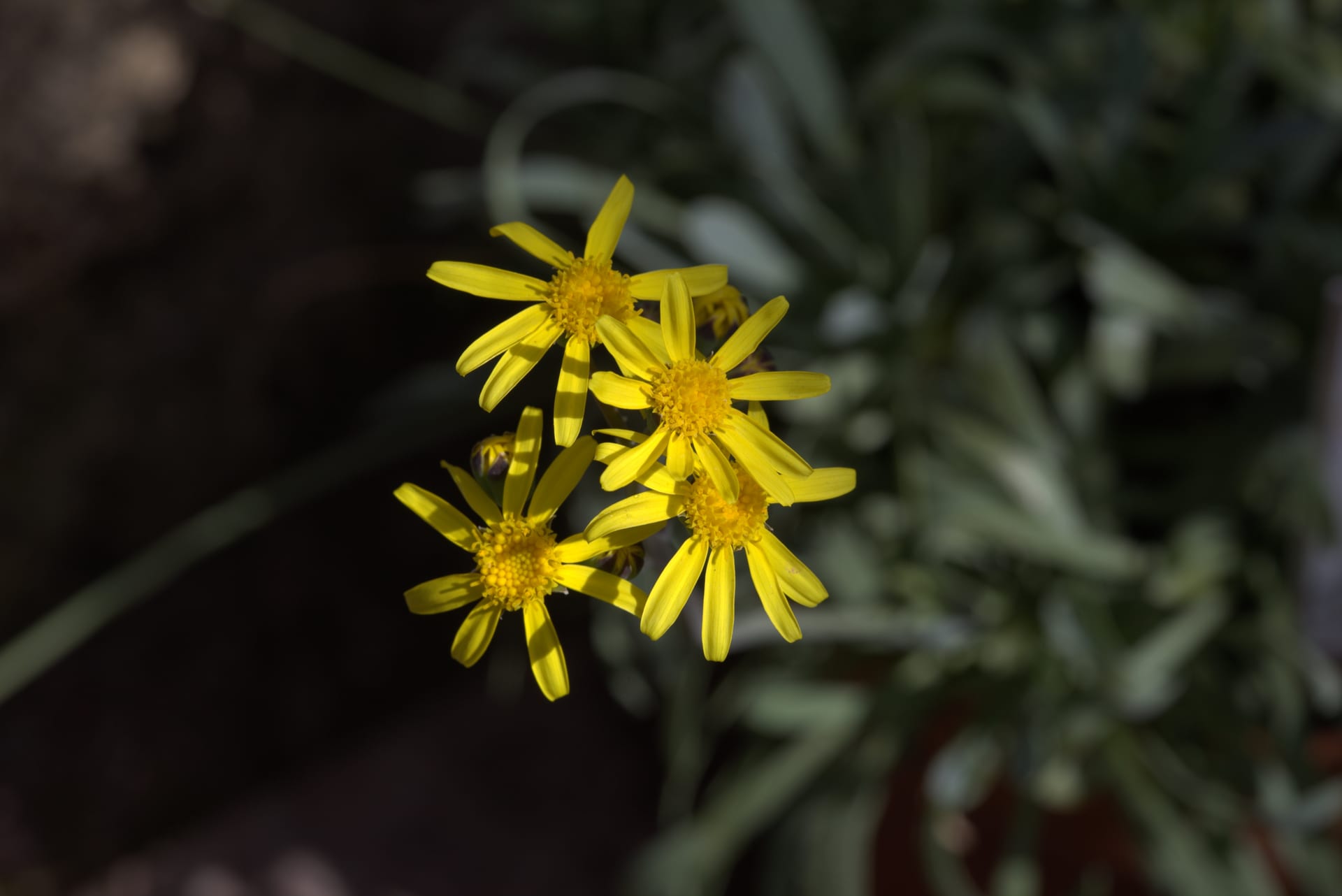
A winter-growing Othonna with a woolly, many-headed caudex bearing rosettes of stiff, chalky grey-green leaves with a raised net of veins. Small white marginal teeth, often pointing backwards, give it its name.
About
Othonna retrorsa is a winter-growing caudiciform in the daisy family, found only in the area bounded by Springbok, Hondeklipbaai and Kamieskroon in Namaqualand, Northern Cape, South Africa. Its extent of occurrence is about 3,035 km², with some 20 known subpopulations and a stable population trend. It grows on bare, exposed rocky slopes in shallow sandy depressions and cracks in granite, and plants in rock cracks are more compact than those in deeper soil; Othonna euphorbioides grows on the same outcrops. The woolly, many-headed caudex forms a cushion that reaches about 10 cm tall and 30 cm across with age. Dense rosettes of stiff, leathery leaves, linear to spoon-shaped, 3–7.5 cm long and 8–15 mm wide, chalky grey-green and prominently net-veined on both sides, crowd the branch tips. The margins carry a few small white teeth that often point backwards. The dried bases of old leaves persist around the stems and decay into a fibrous mass. Flowering stems 10–20 cm tall bear small yellow heads. A seedling caudex can reach half its mature size in a year. In Japan it is sold online as a winter-growing caudex.
Size of the Othonna retrorsa
The Othonna retrorsa grows to A cushion about 10 cm tall and 30 cm across.
Basic Info
Origin
Namaqualand, Northern Cape, South Africa
Lifespan
Long-lived perennial (little published data)
Size
A cushion about 10 cm tall and 30 cm across
Temperature
10〜35℃
Watering & Fertilizer
Light feeding in the growing season
Growing Tips
Light & Placement
Grow it in full sun from autumn to spring; conditions close to its habitat keep it compact.
Watering
A winter grower: start watering in autumn when new leaves show at the growing tip, and let the mix dry between waterings.
Dormancy Care
When the leaves yellow and drop in spring, stop watering and keep it nearly dry through summer.
Soil & Repotting
It grows in shallow sand in rock cracks: use a gritty, free-draining mix and a pot that is not too deep.
Pests & Cautions
The dried bases of old leaves naturally build up around the stems; leave them, removing only any parts that are rotting.
Othonna retrorsa FAQ
QWhat is the growing difficulty level for Othonna retrorsa?
Intermediate. A variety suitable for intermediate growers. Requires some cultivation experience and knowledge of environment management. Pay careful attention to temperature and humidity control.
QHow large does Othonna retrorsa get?
The mature size of Othonna retrorsa is A cushion about 10 cm tall and 30 cm across. This may vary slightly depending on cultivation environment and individual differences.
QHow should I water and fertilize Othonna retrorsa?
Othonna retrorsa: watering & fertilizer — Light feeding in the growing season. Aim for appropriate frequency and amount.
QWhat is the typical price for Othonna retrorsa?
The price of Othonna retrorsa varies significantly by variety, characteristics, size, and lineage. Please check GrowerDirect's price guide for the latest market information.
Last updated: September 23, 2026
References & Sources
Edited & verified by: GrowerDirect Editorial Team
The classifications, regulations, and growing data on this page are created and verified based on the primary information database below.
Taxonomy & Authority
Regulations & Conservation Status
South Africa listed this species in CITES Appendix III in 2023. Appendix III species need an export permit or certificate of origin for international trade, but no registration is required for transfers within Japan.
Sources: Species+ (CITES): Othonna retrorsa
Regulations may change. Always verify the latest information with the relevant authorities.
Related Species
Find listings for this species
Related Articles
How to Grow Uncarina | Differences Between the Madagascar Endemic Species Grandidieri and Roeoesliana
An explanation of the appeal and cultivation methods of the Madagascar endemic caudex plant Uncarina genus. We introduce the differences between Uncarina grandidieri and roeoesliana, seedling cultivation, and repotting timing.
Complete Guide to Choosing Caudex Plants as Gifts | Recommended Varieties by Occasion and How to Include Care Notes
A guide to choosing caudex plants as gifts organized by occasion. We introduce how to select varieties based on the recipient's cultivation experience and how to include care notes for long-term enjoyment.
Diagnosing and Treating Poor Root Development in Caudex Plants | Causes and Solutions for Roots That Won't Emerge or Won't Grow
A detailed guide to root emergence problems in caudex plants. From diagnosis methods to solutions, practical techniques for promoting healthy root development are introduced.
Complete Guide to Growing Jatropha podagrica (Buddha's Navel) | Cultivation Management to Enjoy Its Distinctive Caudex and Coral-Red Flowers
Characteristics and cultivation methods of the caudex plant Jatropha podagrica. Detailed explanation of watering management during dormancy, soil, and propagation methods.
🩺 Common diseases
Can't find the plant you're looking for?
Post your wishes for free and growers with matching plants will contact you with introductions.