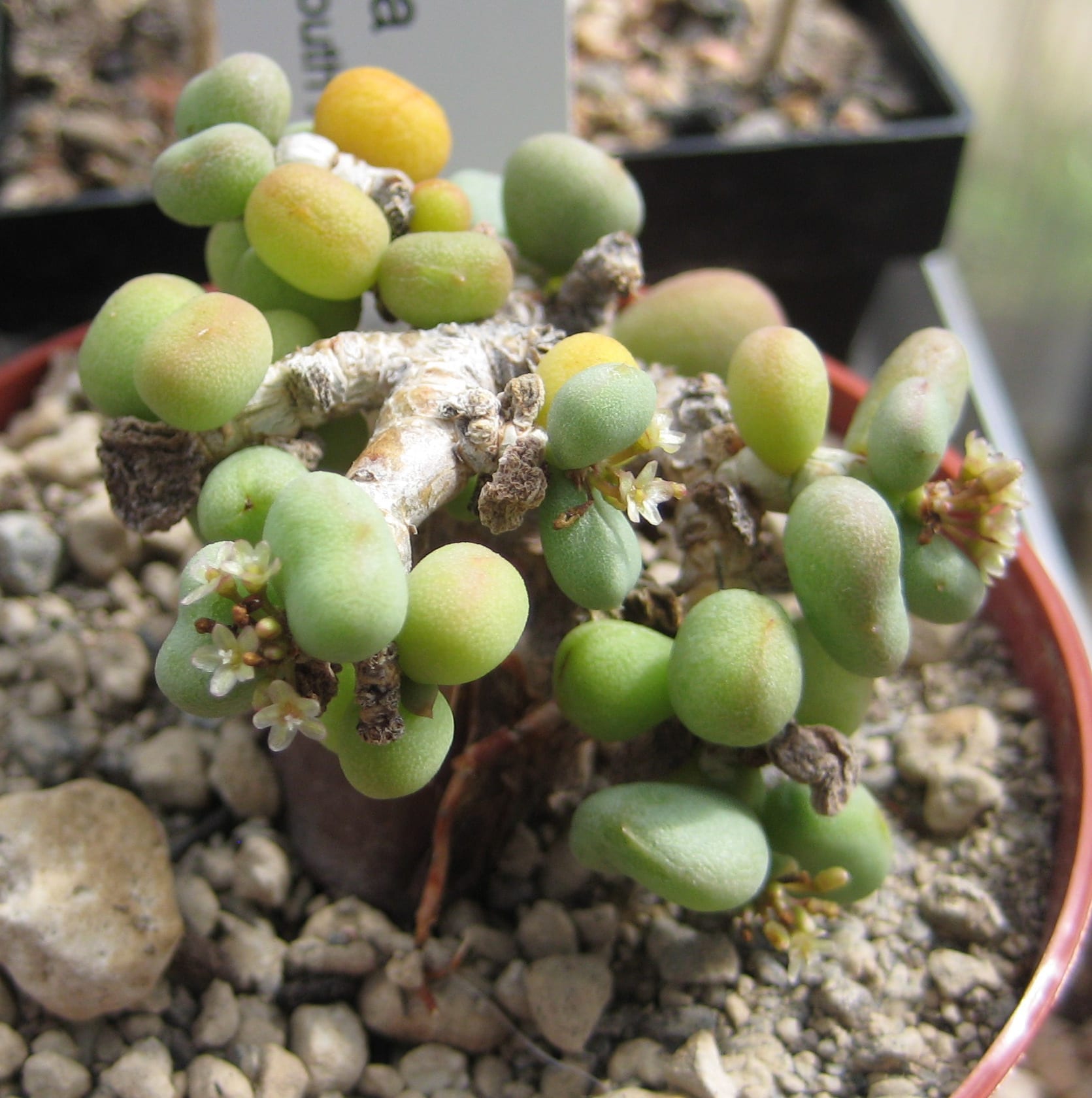
Source: Wikimedia Commons
Ceraria pygmaea
AdvancedPortulacaria pygmaea
A dwarf from the South Africa–Namibia border that forms a low mound of short branches over a knotty, half-buried caudex. The thick blue-green, jelly-bean-like leaves drop off almost at a touch.
About
Ceraria pygmaea is now placed in Portulacaria (Didiereaceae) as Portulacaria pygmaea. It occurs from Grootderm in the northern Richtersveld, Namaqualand, South Africa, across the Orange River to south of Lüderitz in Namibia, on hot hills in quartz-gravel fields rich in extreme succulents. It is a dioecious, more or less evergreen dwarf shrub with an irregular, knotty caudex almost completely buried in the ground and about 7–10 cm wide. Numerous very short branches build a mound about 20 cm tall and 30 cm across. The thick, opposite, jelly-bean-shaped leaves are about 11–14 mm long, finely papillose, blue-green turning yellowish-green, and the tiny flowers are pale pink. It is one of the few succulents that store water in both stem and leaves. Often regarded as difficult, it is relatively easy in cultivation but very slow, and the caudex takes many years to enlarge. It is a different species from Portulacaria afra in the same genus, being much smaller and forming a caudex. In Japan both imported and seed-grown plants are sold online and by specialist nurseries, and seed is also available.
Source: Wikipedia (CC BY-SA 4.0)
Size of the Ceraria pygmaea
The Ceraria pygmaea grows to A mound about 20 cm tall and 30 cm across; caudex 7–10 cm wide.
Basic Info
Origin
North-western South Africa (Richtersveld) to southern Namibia
Lifespan
Slow-growing and long-lived (little published data)
Size
A mound about 20 cm tall and 30 cm across; caudex 7–10 cm wide
Temperature
10〜35℃
Watering & Fertilizer
A little succulent fertilizer in the growing season
Growing Tips
Light & Placement
Very heat-tolerant; grow in full sun to light shade. Strong light is needed for flowering and compact growth.
Watering
Water normally while new leaves and shoots are growing and cut back to almost dry when growth stops. Never let water stand around the roots; overwatering, or watering while it is not growing, can rot it quickly.
Temperature & Overwintering
It is said to tolerate about −5°C if kept dry, but avoid cold combined with wet soil.
Soil & Repotting
The roots are shallow: use a small, shallow pot and a gritty, very free-draining mix; clay pots help it dry between waterings.
Pruning & Shaping
Once lifted above the soil the caudex stops enlarging, so keep it buried for several years and raise it only when the plant is mature.
Propagation
Propagate from seed or cuttings. Sow seed on the surface of a mineral mix; it germinates in one to two weeks at 15–21°C. Being dioecious, it needs male and female plants to set seed.
Ceraria pygmaea FAQ
QWhat is the growing difficulty level for Ceraria pygmaea?
Advanced. A variety suitable for advanced growers. Requires advanced cultivation techniques and specialized equipment, with careful environmental adjustments needed.
QHow large does Ceraria pygmaea get?
The mature size of Ceraria pygmaea is A mound about 20 cm tall and 30 cm across; caudex 7–10 cm wide. This may vary slightly depending on cultivation environment and individual differences.
QHow should I water and fertilize Ceraria pygmaea?
Ceraria pygmaea: watering & fertilizer — A little succulent fertilizer in the growing season. Aim for appropriate frequency and amount.
QWhat is the typical price for Ceraria pygmaea?
The price of Ceraria pygmaea varies significantly by variety, characteristics, size, and lineage. Please check GrowerDirect's price guide for the latest market information.
Last updated: September 23, 2026
References & Sources
Edited & verified by: GrowerDirect Editorial Team
The classifications, regulations, and growing data on this page are created and verified based on the primary information database below.
Taxonomy & Authority
Regulations & Conservation Status
South Africa listed this species in CITES Appendix III in 2023. Appendix III species need an export permit or certificate of origin for international trade, but no registration is required for transfers within Japan.
Sources: Species+ (CITES): Portulacaria pygmaea
Regulations may change. Always verify the latest information with the relevant authorities.
Related Species
Find listings for this species
Related Articles
How to Grow Uncarina | Differences Between the Madagascar Endemic Species Grandidieri and Roeoesliana
An explanation of the appeal and cultivation methods of the Madagascar endemic caudex plant Uncarina genus. We introduce the differences between Uncarina grandidieri and roeoesliana, seedling cultivation, and repotting timing.
Complete Guide to Choosing Caudex Plants as Gifts | Recommended Varieties by Occasion and How to Include Care Notes
A guide to choosing caudex plants as gifts organized by occasion. We introduce how to select varieties based on the recipient's cultivation experience and how to include care notes for long-term enjoyment.
Diagnosing and Treating Poor Root Development in Caudex Plants | Causes and Solutions for Roots That Won't Emerge or Won't Grow
A detailed guide to root emergence problems in caudex plants. From diagnosis methods to solutions, practical techniques for promoting healthy root development are introduced.
Complete Guide to Growing Jatropha podagrica (Buddha's Navel) | Cultivation Management to Enjoy Its Distinctive Caudex and Coral-Red Flowers
Characteristics and cultivation methods of the caudex plant Jatropha podagrica. Detailed explanation of watering management during dormancy, soil, and propagation methods.
🩺 Common diseases
Can't find the plant you're looking for?
Post your wishes for free and growers with matching plants will contact you with introductions.