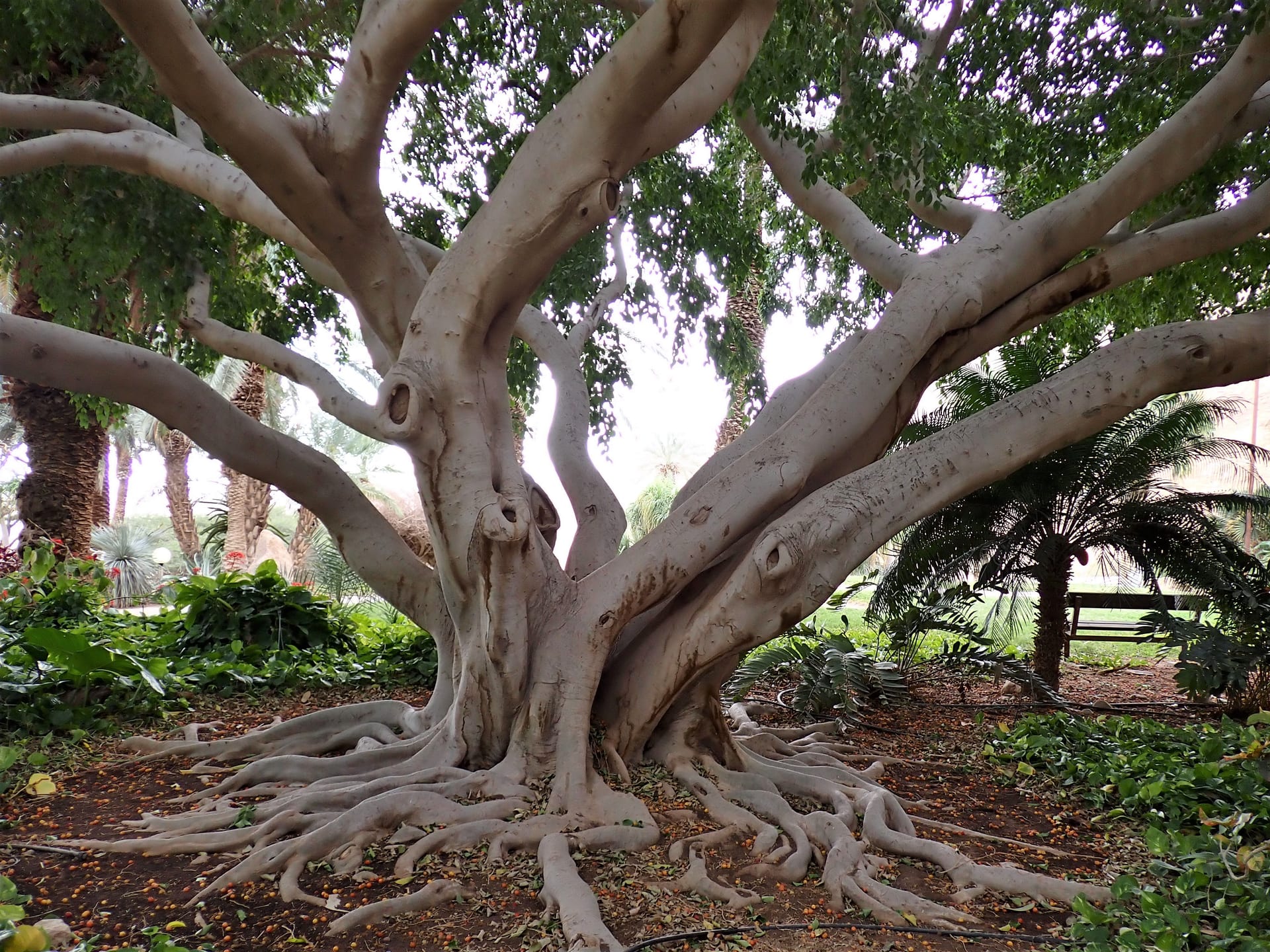
Source: Wikimedia Commons
Weeping Fig
BeginnerFicus benjamina
A fig with small, glossy, pointed leaves on gracefully drooping branches; its Japanese standard name means 'weeping banyan'. Braided-trunk plants and variegated cultivars are common. It tends to drop leaves when moved.
About
Ficus benjamina is an evergreen tree in the mulberry family (Moraceae), native from India through Southeast Asia to northern Australia. In the wild it reaches 30 m, with drooping young branches. The glossy, oval leaves are 6-13 cm long with a long pointed tip, and the stems exude white latex when cut. Indoors it is usually kept at 0.6-3 m, and because young stems are flexible, braided-trunk plants are common. It is very sensitive to light: when moved it may drop leaves and replace them with ones suited to the new position, so leaf fall soon after purchase is not necessarily a sign of disaster. There are many cultivars, such as the variegated 'Starlight' and 'Golden Princess' and 'Barok' with backward-curling leaves, some of which are registered varieties in Japan. It is one of the most widely available houseplants in Japan. Prune lightly to shape, cutting back overlong shoots.
Source: Wikipedia (CC BY-SA 4.0)
Size of the Weeping Fig
The Weeping Fig grows to About 0.6-3 m in pots; up to 30 m in the wild.
Temperature & humidity for the Weeping Fig
The ideal temperature for the Weeping Fig is 20〜25℃.
Basic Info
Origin
India through Southeast Asia to northern Australia
Lifespan
Evergreen tree (long-lived)
Size
About 0.6-3 m in pots; up to 30 m in the wild
Temperature
20〜25℃
Humidity
50〜70%
Watering & Fertilizer
Slow-release fertiliser about every two months from early summer to early autumn
Growing Tips
Light & Placement
Prefers bright light but tolerates shade. Sudden strong sun scorches the leaves, so keep variegated forms in bright indoor light. Avoid moving it around.
Watering
Water well when the surface dries from spring to autumn and keep drier in winter, without letting it dry out completely.
Temperature & Overwintering
Grows best at about 20-25°C. Keep above 10°C in winter and away from drafts; cold with wet soil causes leaf drop.
Soil & Repotting
Any free-draining mix will do. Repot from early summer to early autumn.
Propagation
Easily propagated from cuttings; use 10 cm shoots in early summer.
Pests & Cautions
Watch for scale, aphids, mealybugs, thrips and spider mites. The milky sap (ficin, psoralen) is toxic to dogs and cats and can irritate skin. Some cultivars, such as 'Barok' (No. 14020), are registered varieties and cannot be propagated for sale or transfer without permission.
Weeping Fig FAQ
QWhat is the growing difficulty level for Weeping Fig?
Beginner. A variety suitable for beginners. No special equipment or experience is required—you can grow it without problems by setting up a basic cultivation environment.
QWhat is the ideal temperature for Weeping Fig?
The ideal temperature for Weeping Fig is 20〜25℃. Avoid sudden temperature changes and maintain a stable environment.
QHow large does Weeping Fig get?
The mature size of Weeping Fig is About 0.6-3 m in pots; up to 30 m in the wild. This may vary slightly depending on cultivation environment and individual differences.
QHow should I water and fertilize Weeping Fig?
Weeping Fig: watering & fertilizer — Slow-release fertiliser about every two months from early summer to early autumn. Aim for appropriate frequency and amount.
QWhat is the typical price for Weeping Fig?
The price of Weeping Fig varies significantly by variety, characteristics, size, and lineage. Please check GrowerDirect's price guide for the latest market information.
Last updated: September 23, 2026
References & Sources
Edited & verified by: GrowerDirect Editorial Team
The classifications, regulations, and growing data on this page are created and verified based on the primary information database below.
Primary sources
- Wikipedia
- Species+ (CITES listing check)
- Ministry of the Environment: List of Invasive Alien Species
- MAFF Plant Variety Registration Database
- NC State Extension Plant Toolbox - Ficus benjamina
- Missouri Botanical Garden Plant Finder - Ficus benjamina
- ASPCA Toxic and Non-Toxic Plants - Fig (Ficus benjamina)
- GBIF
Taxonomy & Authority
Regulations & Conservation Status
Not listed in the CITES Appendices. Not a designated invasive alien species in Japan, nor a nationally rare species under the Act on Conservation of Endangered Species.The species itself is not protected, but some cultivars are registered varieties in Japan (e.g. 'Barok', No. 14020; 'Starlight Beauty Queen', No. 15865). Named plants may be protected; registered varieties cannot be propagated for sale or transfer without the breeder's permission.
Sources: Species+ (CITES listing check) / Ministry of the Environment: List of Invasive Alien Species / MAFF Plant Variety Registration Database
Regulations may change. Always verify the latest information with the relevant authorities.
Related Species
Find listings for this species
Related Articles
Complete Guide to Ficus Species and Care Methods | Management and Leaf Drop Prevention for Umbellata, Rubber Plant, and Benjamin Fig
Detailed explanation of the characteristics, cultivation methods, causes of leaf drop, and countermeasures for each variety of Umbellata, Rubber Plant (Ficus elastica), and Benjamin Fig. A complete guide to growing the popular Ficus genus healthily for the long term.
Ficus (Rubber Plant) Care Guide | Umbellata, Bengalensis, and Altissima Care
Learn how to care for popular Ficus species by variety. We introduce daily care, pruning, and tips for winter survival.
Complete Guide to Growing Ficus lyrata (Fiddle Leaf Fig) | Placement, Watering, Pruning, and Leaf Drop Solutions
A practical care guide to Ficus lyrata (Japanese common name: oak-leaf rubber plant) covering placement, light, watering, soil, pruning, pest management, and troubleshooting leaf drop and yellowing.
Why New Leaves on Foliage Plants Are Smaller — Practical Solutions for Light, Humidity, and Nutrition
We analyze the causes behind stunted growth and smaller new leaves on foliage plants. From light environment and humidity management to fertilization strategy and root health, we explain each factor based on empirical data and introduce methods to restore new leaf size.
🩺 Common diseases
Can't find the plant you're looking for?
Post your wishes for free and growers with matching plants will contact you with introductions.