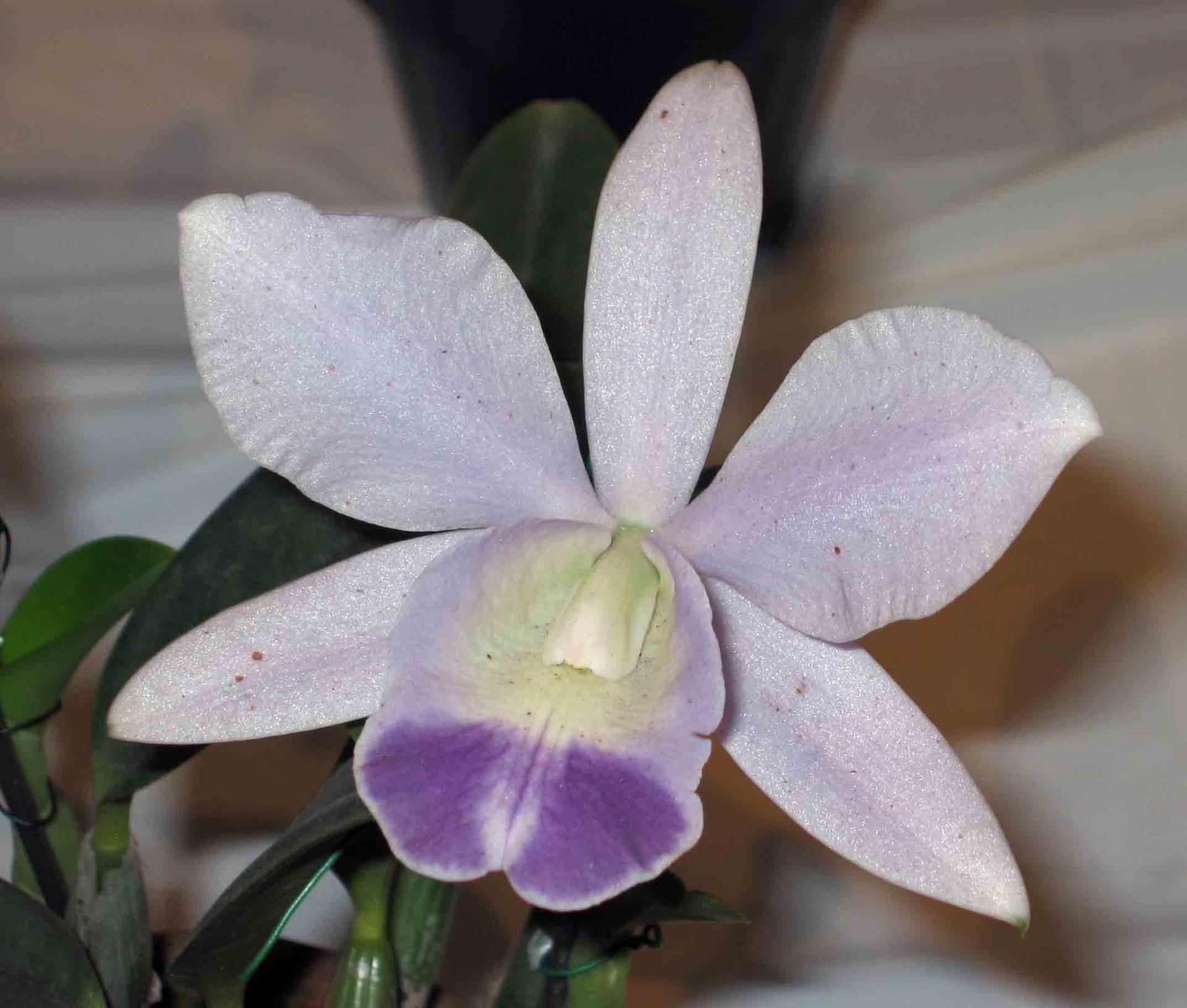
Source: Wikimedia Commons
Cattleya Mini Purple
BeginnerCattleya Mini Purple
A primary hybrid of the small Cattleya pumila and C. walkeriana: a compact mini-Cattleya with surprisingly large purple flowers, sold mainly as named clones such as 'Little Princess'.
About
Cattleya Mini Purple is a primary hybrid between two species, the small Cattleya pumila (formerly Laelia pumila) and C. walkeriana. It was registered in 1965 by M. Yamada. As pumila moved from Laelia to Sophronitis and then to Cattleya, the hybrid was first written Laeliocattleya (Lc.), then Sophrocattleya (Sc.), and is now simply Cattleya (C.); plants labelled "Lc. Mini Purple" are the same hybrid. It stays compact yet bears large flowers and is a standard among mini-Cattleyas. Because a hybrid name covers every seedling from the same parents, flower colour and shape vary from plant to plant. Plants with a clone name such as 'Little Princess' are divisions of a selected plant and should flower alike, whereas unnamed seedlings reveal their quality only when they bloom. Colour lines such as the bluish coerulea are also sold. Grow it like other Cattleyas, with bright light and a free-draining medium. In Japan it is widely available from specialist orchid nurseries.
Basic Info
Origin
Hybrid (C. pumila x C. walkeriana, registered 1965); both parents are Brazilian
Lifespan
Perennial that can be kept for many years by division (little data on lifespan)
Size
Compact (mini-Cattleya); size varies by clone
Temperature
15〜30℃
Humidity
50〜70%
Watering & Fertilizer
Dilute liquid fertilizer in the growing season
Growing Tips
Light & Placement
It likes bright light; shade only from strong midsummer sun and give full light in winter.
Watering
Water when the medium is nearly dry: more while growing, less in winter and during rest.
Temperature & Overwintering
One British orchid society member flowers it in a conservatory kept at 19-26°C year-round with at least 60% humidity.
Soil & Repotting
Pot in a free-draining medium such as bark, in a smallish pot; repot as new growth starts.
Fertilizer
Give dilute liquid fertilizer while growing and reduce it in winter.
Buying Tips
Flowers differ from plant to plant under the same hybrid name. To be sure of the flower, choose a named clone such as 'Little Princess' or a plant in bloom; unnamed seedlings show their colour only when they flower.
Cattleya Mini Purple FAQ
QWhat is the growing difficulty level for Cattleya Mini Purple?
Beginner. A variety suitable for beginners. No special equipment or experience is required—you can grow it without problems by setting up a basic cultivation environment.
QHow should I water and fertilize Cattleya Mini Purple?
Cattleya Mini Purple: watering & fertilizer — Dilute liquid fertilizer in the growing season. Aim for appropriate frequency and amount.
QWhat is the typical price for Cattleya Mini Purple?
The price of Cattleya Mini Purple varies significantly by variety, characteristics, size, and lineage. Please check GrowerDirect's price guide for the latest market information.
Last updated: September 23, 2026
References & Sources
Edited & verified by: GrowerDirect Editorial Team
The classifications, regulations, and growing data on this page are created and verified based on the primary information database below.
Taxonomy & Authority
Accepted name: Cattleya Mini Purple M.Yamada (1965)
Synonyms: Laeliocattleya Mini Purple, Sophrocattleya Mini Purple
Authority databases: RHS International Orchid Register
Nomenclature follows global taxonomic authority databases.
Regulations & Conservation Status
The whole orchid family is listed in CITES Appendix II (checked on Species+). International trade requires permits such as export permits, but no registration is needed to buy, sell or transfer plants within Japan. Hybrids are also covered by Appendix II; the exemption for artificially propagated hybrids applies only to Cymbidium, Dendrobium, Phalaenopsis and Vanda, not to Cattleya.
Sources: Species+ (CITES) / Ministry of the Environment, Japan: list of Nationally Rare Species
Regulations may change. Always verify the latest information with the relevant authorities.
Related Species
Find listings for this species
Related Articles
Complete Window-Sill Cultivation Guide for Mini Orchids | Techniques for Blooming Fragrant Orchids in Small Spaces and Low-Light Environments
A practical guide to growing miniature orchids on windowsills. Optimize light levels, humidity, and fertilizer management to achieve repeated blooms of fragrant orchids in confined indoor spaces.
Complete Guide to Growing Cattleyas | Complete Management to Bloom the Queen of Orchids
A complete guide to growing Cattleyas, the queen of orchids. Learn seasonal watering and fertilizing schedules, light requirements and temperature differential management for blooming, sheath handling, pseudobulb health management, and timing for division.
Mini Orchid Terrarium Cultivation | Enjoying the Small World of Orchids in Glass Containers
Explains how to grow mini orchids in a terrarium. Introduces how to choose suitable varieties, set up glass containers, manage humidity and ventilation, layout tips, and daily care.
How to Grow Cattleya and Tips for Blooming | Light, Temperature, and Watering Management
Guide to growing Cattleya, the "Queen of Orchids." Summarizes key management points for blooming, including light intensity, temperature, watering, and repotting.
Can't find the plant you're looking for?
Post your wishes for free and growers with matching plants will contact you with introductions.