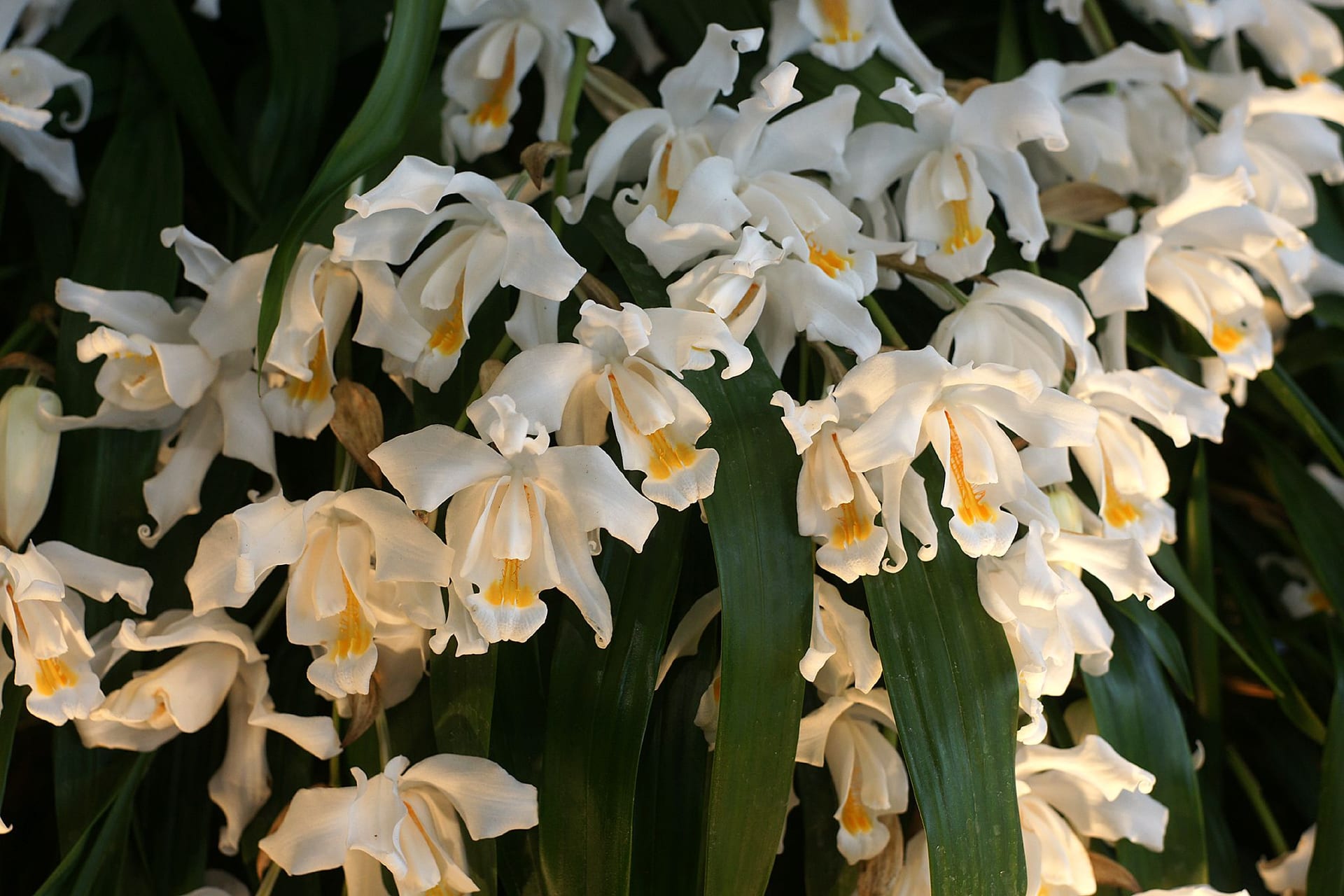
Source: Wikimedia Commons
Crested Coelogyne
IntermediateCoelogyne cristata
A Himalayan orchid that hangs sprays of large, fragrant, pure white, wavy-edged flowers from late winter into spring, with yellow crest-like ridges on the lip. It prefers cool conditions.
About
Coelogyne cristata is an epiphytic orchid and the classic species of its genus. The name means crested, referring to the yellow hair-like ridges down the centre of the lip. It grows in the Himalayas, from Garhwal to Arunachal Pradesh, Nepal, Bhutan, Sikkim and Assam, in montane forest at about 1,500-2,600 m, where fog and mist persist year-round and winters are very bright; it clings to mossy trees and rocks. Oval pseudobulbs 5-8 cm long sit along a rhizome, each with two narrow leaves. From midwinter into spring, pendent stems 15-30 cm long carry three to ten fragrant white flowers 6-10 cm across. A pure white form lacking the yellow crests is called hololeuca, and selected plants are sold under clone names such as 'The Queen'. It reached Europe in 1837 and Japan around the middle of the Meiji era. It likes cool conditions and dislikes summer heat, while bright light and fairly low temperatures in winter are key to setting flower buds. In Japan, specialist orchid nurseries sell selected plants; the hybrid C. Intermedia (cristata x tomentosa) is sturdier and more widely sold.
Source: Wikipedia (CC BY-SA 4.0)
Size of the Crested Coelogyne
The Crested Coelogyne grows to Pseudobulbs 5-8 cm; leaves 15-30 cm; flowers 6-10 cm across.
Basic Info
Origin
Himalayas (Nepal, Bhutan, Sikkim, Assam and nearby, 1,500-2,600 m)
Lifespan
Perennial that can be kept for many years by division (little data on lifespan)
Size
Pseudobulbs 5-8 cm; leaves 15-30 cm; flowers 6-10 cm across
Temperature
15〜30℃
Humidity
50〜70%
Watering & Fertilizer
Dilute liquid fertilizer in the growing season
Growing Tips
Light & Placement
Bright winter light is essential for flower buds, so give full light in winter; in summer keep it shaded and cool.
Watering
A misty-mountain epiphyte, it should not dry out while growing; water less once the pseudobulbs have matured.
Temperature & Overwintering
A cool-growing species that dislikes summer heat; fairly low winter temperatures help it flower.
Soil & Repotting
The rhizome creeps, so use a shallow pot or basket with bark or sphagnum; divide and repot after flowering.
Dormancy Care
From autumn into winter, as buds form, keep it on the dry side, but not so dry that the pseudobulbs shrivel badly.
Crested Coelogyne FAQ
QWhat is the growing difficulty level for Crested Coelogyne?
Intermediate. A variety suitable for intermediate growers. Requires some cultivation experience and knowledge of environment management. Pay careful attention to temperature and humidity control.
QHow large does Crested Coelogyne get?
The mature size of Crested Coelogyne is Pseudobulbs 5-8 cm; leaves 15-30 cm; flowers 6-10 cm across. This may vary slightly depending on cultivation environment and individual differences.
QHow should I water and fertilize Crested Coelogyne?
Crested Coelogyne: watering & fertilizer — Dilute liquid fertilizer in the growing season. Aim for appropriate frequency and amount.
QWhat is the typical price for Crested Coelogyne?
The price of Crested Coelogyne varies significantly by variety, characteristics, size, and lineage. Please check GrowerDirect's price guide for the latest market information.
Last updated: September 23, 2026
References & Sources
Edited & verified by: GrowerDirect Editorial Team
The classifications, regulations, and growing data on this page are created and verified based on the primary information database below.
Taxonomy & Authority
Accepted name: Coelogyne cristata Lindl.
Synonyms: Coelogyne cristata f. hololeuca (Rchb.f.) M.Wolff & O.Gruss, Coelogyne cristata var. hololeuca Rchb.f., Cymbidium speciosissimum D.Don, Pleione speciosissima (D.Don) Kuntze
Authority databases: GBIF · GBIF
Nomenclature follows global taxonomic authority databases.
Regulations & Conservation Status
The whole orchid family is listed in CITES Appendix II (checked on Species+). International trade requires permits such as export permits, but no registration is needed to buy, sell or transfer plants within Japan.
Sources: Species+ (CITES) / Ministry of the Environment, Japan: list of Nationally Rare Species
Regulations may change. Always verify the latest information with the relevant authorities.
Related Species
Find listings for this species
Related Articles
Coelogyne Genus Seasonal Care Guide | Withholding Water in the Dry Season and Tips for Regulating the Bloom Cycle
A seasonal guide to Coelogyne, a type of epiphytic orchid, from watering during the growing season to dry-season drought management and tips for regulating the bloom cycle.
Post-Bloom Care: The Annual Cycle from New Growth to Flower Formation
Learn the annual care cycle for orchids from the end of flowering to the next bloom. This guide covers post-flower care including flower stem cutting methods, signs to observe during new shoot development, summer growth period considerations, requirements for flower bud formation, and finishing care from bud emergence through blooming.
A Complete Guide to Enjoying Orchid Exhibitions and Sales Events | Variety Selection and Post-Purchase Care
A guide to enjoying orchid exhibitions and sales events. Covering practical tips on variety selection, how to identify rare species, and post-purchase environmental acclimatization.
Complete Window-Sill Cultivation Guide for Mini Orchids | Techniques for Blooming Fragrant Orchids in Small Spaces and Low-Light Environments
A practical guide to growing miniature orchids on windowsills. Optimize light levels, humidity, and fertilizer management to achieve repeated blooms of fragrant orchids in confined indoor spaces.
Can't find the plant you're looking for?
Post your wishes for free and growers with matching plants will contact you with introductions.