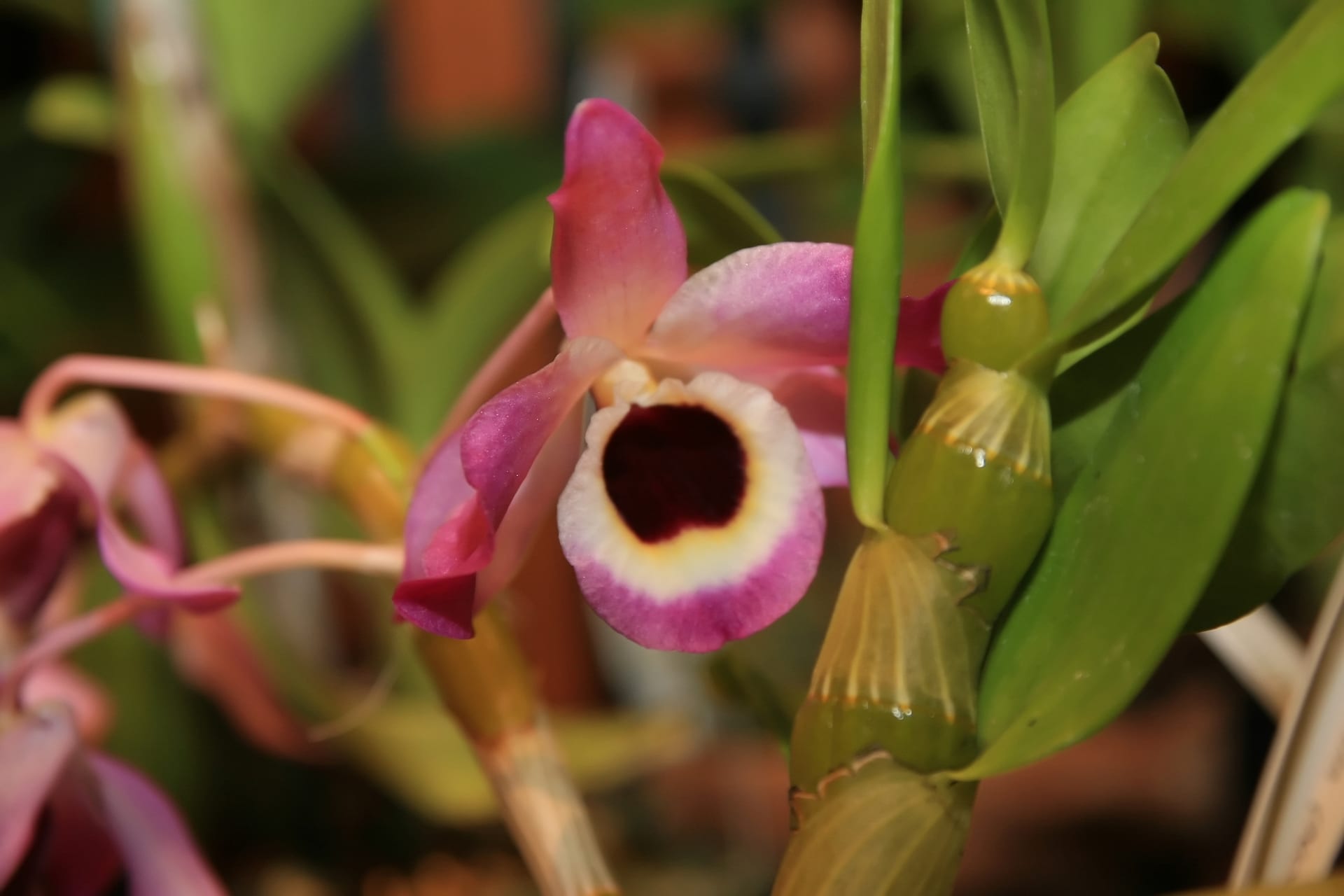
Source: Wikimedia Commons
Noble Dendrobium
IntermediateDendrobium nobile
The species behind the nobile-type Dendrobium hybrids. Upright, yellowish canes carry fragrant, waxy flowers in twos to fours at the nodes, ranging in colour from white to pink and purple.
About
Dendrobium nobile is the species from which the familiar nobile-type Dendrobium hybrids were developed. It grows in southern China (including Tibet), the Himalayas (India, Nepal, Bhutan, Sikkim), Myanmar, Thailand, Laos and Vietnam, in evergreen forest and on mossy limestone at 200-2,000 m, and is the state flower of Sikkim. Its flattened, yellowish canes rise in clumps and carry alternate strap-shaped leaves. Mainly in winter and spring, short sprays of two to four waxy, long-lasting, fragrant flowers appear from the upper nodes of both leafy and leafless canes. Colour varies widely from white to pink and purple; the white virginale and selected clones such as 'Cooksonianum' are sold. To set flower buds it needs a definite rest from water and fertilizer in autumn and winter; yellowing leaves in autumn are the signal to start. Older canes sometimes produce keikis (plantlets). In Japan, specialist orchid nurseries sell the species and selected clones.
Source: Wikipedia (CC BY-SA 4.0)
Size of the Noble Dendrobium
The Noble Dendrobium grows to Flowers up to about 7.5 cm across.
Basic Info
Origin
Southern China, the Himalayas, Myanmar, Thailand, Laos and Vietnam (200-2,000 m)
Lifespan
Perennial that can be renewed by division or keikis (little data on lifespan)
Size
Flowers up to about 7.5 cm across
Temperature
15〜30℃
Humidity
50〜70%
Watering & Fertilizer
Feed in the spring-summer growing season; stop from autumn
Growing Tips
Light & Placement
Grow in good light from spring to autumn, shading only from harsh midsummer sun; too little light reduces flower buds.
Watering
Water generously in spring and summer; cut back sharply when leaves start yellowing in autumn.
Temperature & Overwintering
It ranges from cool hills to hot lowlands and is fairly adaptable. Expose it to cooler autumn temperatures, then bring it in before frost.
Soil & Repotting
Pot in sphagnum or bark in a smallish pot; repot after flowering as new shoots begin to grow.
Dormancy Care
A definite rest from water and fertilizer in autumn and winter decides how well it flowers the next spring.
Noble Dendrobium FAQ
QWhat is the growing difficulty level for Noble Dendrobium?
Intermediate. A variety suitable for intermediate growers. Requires some cultivation experience and knowledge of environment management. Pay careful attention to temperature and humidity control.
QHow large does Noble Dendrobium get?
The mature size of Noble Dendrobium is Flowers up to about 7.5 cm across. This may vary slightly depending on cultivation environment and individual differences.
QHow should I water and fertilize Noble Dendrobium?
Noble Dendrobium: watering & fertilizer — Feed in the spring-summer growing season; stop from autumn. Aim for appropriate frequency and amount.
QWhat is the typical price for Noble Dendrobium?
The price of Noble Dendrobium varies significantly by variety, characteristics, size, and lineage. Please check GrowerDirect's price guide for the latest market information.
Last updated: September 23, 2026
References & Sources
Edited & verified by: GrowerDirect Editorial Team
The classifications, regulations, and growing data on this page are created and verified based on the primary information database below.
Taxonomy & Authority
Accepted name: Dendrobium nobile Lindl.
Synonyms: Callista nobilis (Lindl.) Kuntze, Dendrobium caerulescens Wall., Dendrobium caerulescens Wall. ex Lindl., Dendrobium chlorostylum Gagnep., Dendrobium coerulescens Wall., Dendrobium coerulescens Wall. ex Lindl.
Authority databases: GBIF · GBIF
Nomenclature follows global taxonomic authority databases.
Regulations & Conservation Status
The whole orchid family is listed in CITES Appendix II (checked on Species+). International trade requires permits such as export permits, but no registration is needed to buy, sell or transfer plants within Japan. Artificially propagated Dendrobium hybrids can be exempt, but this species itself remains in Appendix II.
Sources: Species+ (CITES) / Ministry of the Environment, Japan: list of Nationally Rare Species
Regulations may change. Always verify the latest information with the relevant authorities.
Related Species
Find listings for this species
Related Articles
Complete Guide to Growing Dendrobium | Autumn Management for Flowering and Year-Round Care
Explains autumn cold treatment, watering restrictions, fertilizer timing, and repotting cycles for year-round dendrobium blooms. Introduces management differences for both Nobile and Phalaenopsis types.
How to Grow Dendrobium nobile Orchids | Flower Bud Initiation Through Cold Treatment
Detailed guide to Dendrobium nobile characteristics, year-round care schedule, flower bud initiation through cold treatment, and management of unwanted shoots.
How to Grow Sekkoku (Chōsei Orchid) — Basics for Enjoying Japan's Traditional Oriental Orchids
A practical guide to the characteristics of Sekkoku (Dendrobium moniliforme, Chōsei Orchid), planting options using sphagnum moss, tree fern, and rock mounting, seasonal placement, watering and fertilizing, flowering tips, propagation methods including division and keiki (plantlets), and pest and disease management.
Denphale Care Guide: Tips for Enjoying Long-Lasting Cluster Flowers with Year-Round Warm Management
This guide explains the characteristics of Denphale, a warm-climate hybrid of Dendrobium, how it differs from Nobile types, temperature and watering management, and how to propagate using high growths.
Can't find the plant you're looking for?
Post your wishes for free and growers with matching plants will contact you with introductions.