Source: Wikimedia Commons
Queen Victoria's Dendrobium
AdvancedDendrobium victoriae-reginae
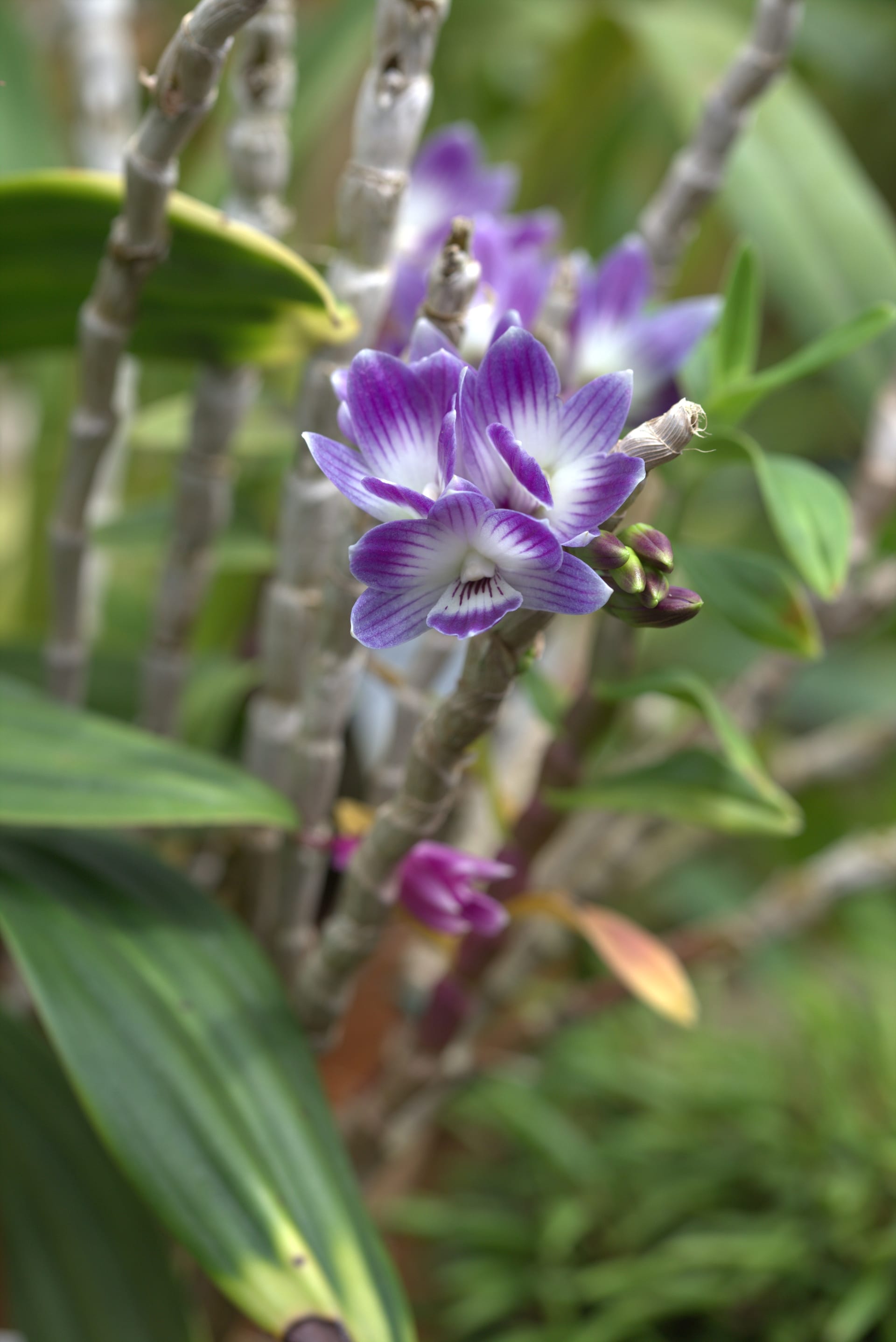
A Dendrobium with rare violet-blue flowers, darker at the tips and white at the centre. Endemic to mossy Philippine forests at 1,300-2,700 m, it needs cool, moist conditions all year.
About
Dendrobium victoriae-reginae is named after Queen Victoria. It is endemic to the Philippines, growing at 1,300-2,700 m in deeply mossy montane forest with oaks and rhododendrons, clinging to moss-covered trunks with its roots buried in the moss. Its slender stems hang and branch from the base, with swollen nodes and up to about 12 thin, papery leaves. The flowers, 3-4 cm across, are violet to blue-violet with darker tips and a white centre, a colour rare among orchids. They appear one to three at a time from older leafless stems, potentially at almost any time of year but most freely in May and June, and tend not to open widely. As it comes from cool, misty forest, it needs to be kept evenly moist all year, in deep shade with plenty of air movement. It dislikes the summer heat of lowland Japan, where getting it through summer is the main challenge. It is sold by specialist orchid nurseries in Japan but not in large numbers.
Source: Wikipedia (CC BY-SA 4.0)
Size of the Queen Victoria's Dendrobium
The Queen Victoria's Dendrobium grows to Small to medium; flowers 3-4 cm across.
Basic Info
Origin
Endemic to the Philippines (mossy montane forest at 1,300-2,700 m)
Lifespan
Perennial (little data on lifespan)
Size
Small to medium; flowers 3-4 cm across
Temperature
15〜30℃
Humidity
50〜70%
Watering & Fertilizer
Very dilute liquid fertilizer while growing
Growing Tips
Light & Placement
It prefers deep shade; keep it out of direct sun, in bright shade.
Watering
Keep the medium moist all year without letting it dry; it has no dry rest.
Temperature & Overwintering
A cool highland species that is sensitive to heat; keeping it cool and airy in summer matters most.
Soil & Repotting
Its roots grow buried in moss, so pot it in sphagnum or mount it with a pad of sphagnum.
Pests & Cautions
It suffers in stagnant humidity, so combine moisture with plenty of air movement.
Queen Victoria's Dendrobium FAQ
QWhat is the growing difficulty level for Queen Victoria's Dendrobium?
Advanced. A variety suitable for advanced growers. Requires advanced cultivation techniques and specialized equipment, with careful environmental adjustments needed.
QHow large does Queen Victoria's Dendrobium get?
The mature size of Queen Victoria's Dendrobium is Small to medium; flowers 3-4 cm across. This may vary slightly depending on cultivation environment and individual differences.
QHow should I water and fertilize Queen Victoria's Dendrobium?
Queen Victoria's Dendrobium: watering & fertilizer — Very dilute liquid fertilizer while growing. Aim for appropriate frequency and amount.
QWhat is the typical price for Queen Victoria's Dendrobium?
The price of Queen Victoria's Dendrobium varies significantly by variety, characteristics, size, and lineage. Please check GrowerDirect's price guide for the latest market information.
Last updated: September 23, 2026
References & Sources
Edited & verified by: GrowerDirect Editorial Team
The classifications, regulations, and growing data on this page are created and verified based on the primary information database below.
Taxonomy & Authority
Regulations & Conservation Status
The whole orchid family is listed in CITES Appendix II (checked on Species+). International trade requires permits such as export permits, but no registration is needed to buy, sell or transfer plants within Japan.
Sources: Species+ (CITES) / Ministry of the Environment, Japan: list of Nationally Rare Species
Regulations may change. Always verify the latest information with the relevant authorities.
Related Species
Find listings for this species
Related Articles
Complete Guide to Growing Dendrobium | Autumn Management for Flowering and Year-Round Care
Explains autumn cold treatment, watering restrictions, fertilizer timing, and repotting cycles for year-round dendrobium blooms. Introduces management differences for both Nobile and Phalaenopsis types.
How to Grow Dendrobium nobile Orchids | Flower Bud Initiation Through Cold Treatment
Detailed guide to Dendrobium nobile characteristics, year-round care schedule, flower bud initiation through cold treatment, and management of unwanted shoots.
How to Grow Sekkoku (Chōsei Orchid) — Basics for Enjoying Japan's Traditional Oriental Orchids
A practical guide to the characteristics of Sekkoku (Dendrobium moniliforme, Chōsei Orchid), planting options using sphagnum moss, tree fern, and rock mounting, seasonal placement, watering and fertilizing, flowering tips, propagation methods including division and keiki (plantlets), and pest and disease management.
Denphale Care Guide: Tips for Enjoying Long-Lasting Cluster Flowers with Year-Round Warm Management
This guide explains the characteristics of Denphale, a warm-climate hybrid of Dendrobium, how it differs from Nobile types, temperature and watering management, and how to propagate using high growths.
Can't find the plant you're looking for?
Post your wishes for free and growers with matching plants will contact you with introductions.