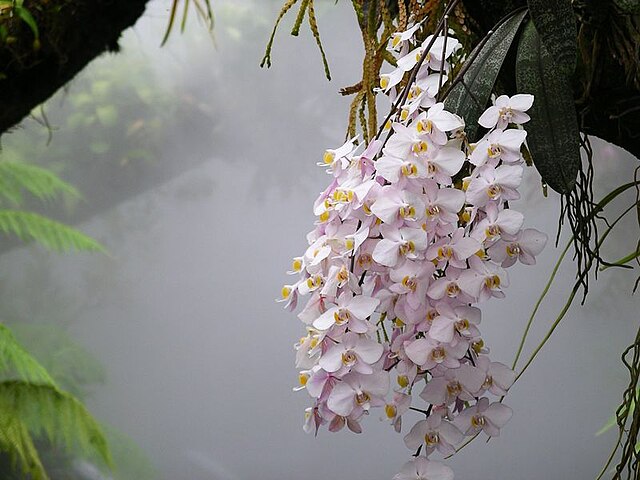
Source: Wikimedia Commons
Phalaenopsis
BeginnerPhalaenopsis spp.
Japan's most beloved gift orchid with butterfly-like blooms lasting weeks. Epiphytic, typically grown in sphagnum moss. Proper care allows re-blooming multiple times a year.
About
Phalaenopsis, commonly known as moth orchids, is a genus of approximately 70 species in the family Orchidaceae, native to tropical and subtropical Asia—particularly the Philippines and Indonesia—as well as New Guinea and northern Australia. These monopodial epiphytes grow on tree trunks and rocky surfaces in humid rainforests, producing long, coarse aerial roots adapted to absorb moisture from the atmosphere. The flat, symmetrical flowers, arranged on arching or branching inflorescences, bear ten or more blooms that persist for several months. Flower colors span pure white, pink, purple, yellow, and intricate multicolored patterns. Watering is best timed when aerial roots turn silvery-white. The combination of long-lasting blooms, diverse coloration, and adaptability to indoor environments has made Phalaenopsis the world's most commercially successful potted orchid.
Source: Wikipedia (CC BY-SA 4.0)
Lifespan of the Phalaenopsis
The Phalaenopsis lives 10-20+ years.
Size of the Phalaenopsis
The Phalaenopsis grows to 20-60cm (including flower spike).
Temperature & humidity for the Phalaenopsis
The ideal temperature for the Phalaenopsis is 20〜25℃. Ideal humidity is 50〜70%.
In cultivation, plants thrive in bright indirect light, minimum temperatures of 15°C, and a well-draining medium of bark or sphagnum moss.
Basic Info
Origin
Asia, New Guinea, and Australia
Lifespan
10-20+ years
Size
20-60cm (including flower spike)
Temperature
18〜30℃
Humidity
50〜70%
Watering & Fertilizer
Dilute liquid fertilizer twice monthly spring-fall
Growing Tips
Light & Placement
From spring to autumn, keep it in a bright indoor spot behind a sheer curtain. Direct sun scorches the leaves, so avoid it.
Watering
Water once the sphagnum moss has dried. Silver-white roots signal watering time; avoiding overwatering is the key to long-term success.
Temperature & Overwintering
Grow it at 18-30°C (ideally 20-25°C) and keep it above 15°C in winter. Keep it away from cold drafts by windows.
Soil & Repotting
Pot in sphagnum moss or bark. Aim for 50-70% humidity, and replace the medium once it breaks down.
Fertilizer
From spring to autumn, give diluted liquid fertilizer twice a month. Growth slows in winter, so hold off on feeding and water only after the medium dries.
Pruning & Shaping
After flowering, cutting the spike back above a node may produce a side branch that blooms again. If the plant is weak, cut the spike at the base instead.
Phalaenopsis FAQ
QWhat is the growing difficulty level for Phalaenopsis?
Beginner. A variety suitable for beginners. No special equipment or experience is required—you can grow it without problems by setting up a basic cultivation environment.
QWhat is the ideal temperature for Phalaenopsis?
The ideal temperature for Phalaenopsis is 20〜25℃. Recommended humidity is 50〜70%. Avoid sudden temperature changes and maintain a stable environment.
QWhat is the lifespan of Phalaenopsis?
The average lifespan of Phalaenopsis is 10-20+ years. With proper cultivation environment and nutrient management, you can keep it healthy for a long time.
QHow large does Phalaenopsis get?
The mature size of Phalaenopsis is 20-60cm (including flower spike). This may vary slightly depending on cultivation environment and individual differences.
QHow should I water and fertilize Phalaenopsis?
Phalaenopsis: watering & fertilizer — Dilute liquid fertilizer twice monthly spring-fall. Aim for appropriate frequency and amount.
QWhat is the typical price for Phalaenopsis?
The price of Phalaenopsis varies significantly by variety, characteristics, size, and lineage. Please check GrowerDirect's price guide for the latest market information.
Last updated: September 18, 2026
Growing Specifications
- USDA Zone
- 10–12
- Hardiness (RHS)
- H1a
Sources: Missouri Botanical Garden Plant Finder: Phalaenopsis (group) (Zone 10 to 12) / RHS Find a Plant: Phalaenopsis (H1a)
References & Sources
Edited & verified by: GrowerDirect Editorial Team
The classifications, regulations, and growing data on this page are created and verified based on the primary information database below.
Primary sources
- Wikipedia
- CITES Appendices (Orchidaceae spp. = Appendix II)
- CITES Appendix I Orchid Checklist (Kew/UNEP-WCMC 2019)
- Missouri Botanical Garden Plant Finder: Phalaenopsis (group) (Zone 10 to 12)
- RHS Find a Plant: Phalaenopsis (H1a)
- GBIF
- POWO
- RHS orchid hybrid registration (International Orchid Register)
- AOS (American Orchid Society)
Taxonomy & Authority
Accepted name: Phalaenopsis spp. Blume
Synonyms: Phalaenopsis spp., Kingidium, Nothodoritis, Ornithochilus, Stauritis, Polychilos, Synadena, Polystylus
Authority databases: GBIF · POWO · RHS orchid hybrid registration (International Orchid Register) · AOS (American Orchid Society)
Nomenclature follows global taxonomic authority databases.
Regulations & Conservation Status
The family Orchidaceae is listed entirely in CITES Appendix II (except for the genera Paphiopedilum and Phragmipedium and certain species, which are in Appendix I). Cultivars and hybrids are subject to family-level regulation; however, artificially propagated specimens may benefit from simplified trading procedures under the Appendices.
Sources: CITES Appendices (Orchidaceae spp. = Appendix II) / CITES Appendix I Orchid Checklist (Kew/UNEP-WCMC 2019)
Regulations may change. Always verify the latest information with the relevant authorities.
Related Species
Find listings for this species
Related Articles
Complete Guide to Growing Phalaenopsis Orchids | Tips for Beginners to Keep Them Blooming Long-Term
A beginner-friendly guide to enjoying popular gift Phalaenopsis orchids long-term, covering watering, placement, fertilizing, and post-bloom care. We also introduce temperature management and techniques to encourage new flower buds.
Moth Orchid Reblooming Technique | How to Make Flowers Bloom Again After They Fade
Explains how to rebloom moth orchids after flowers fade. Introduces how to cut flower stems, temperature management, watering and fertilizer adjustment, and creating an environment for successful reblooming.
How to Care for Phalaenopsis After Blooming | Tips for Encouraging Re-blooms
Learn how to prune orchid flower stems after blooming, proper care methods, and temperature and fertilizer management to encourage second blooms.
Denphale Care Guide: Tips for Enjoying Long-Lasting Cluster Flowers with Year-Round Warm Management
This guide explains the characteristics of Denphale, a warm-climate hybrid of Dendrobium, how it differs from Nobile types, temperature and watering management, and how to propagate using high growths.
Can't find the plant you're looking for?
Post your wishes for free and growers with matching plants will contact you with introductions.