Source: Wikimedia Commons
Lithops salicola
BeginnerLithops salicola
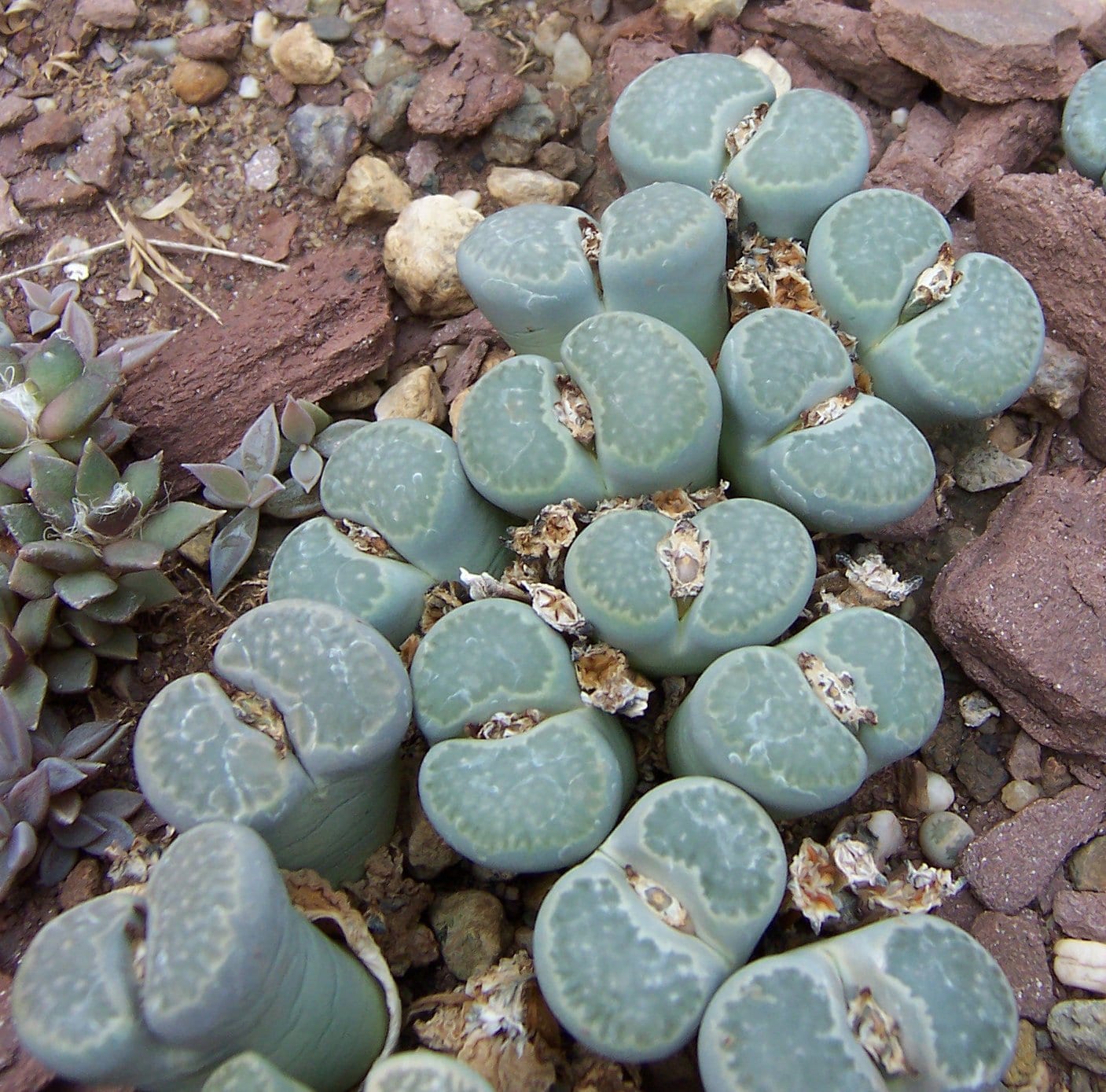
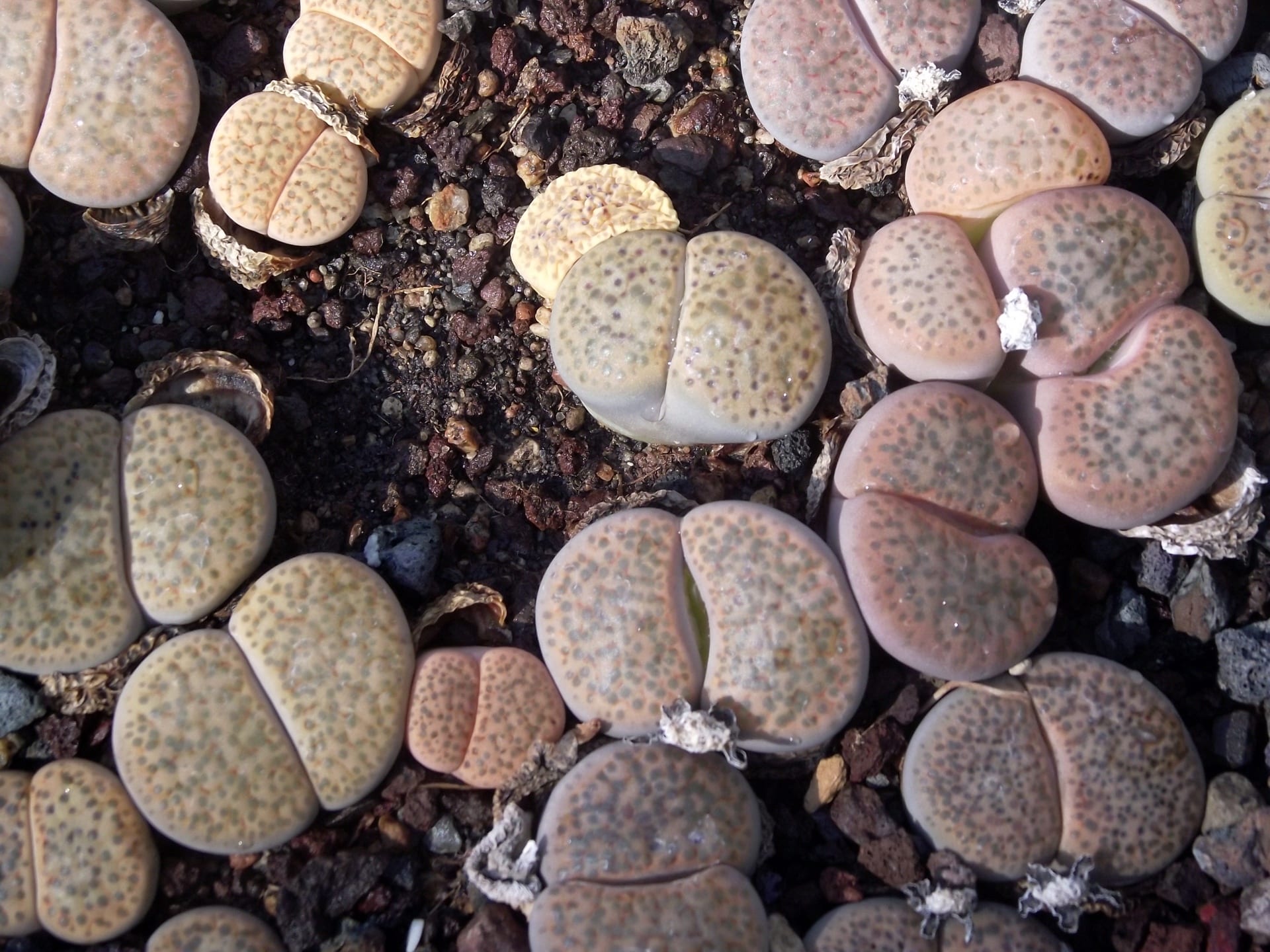
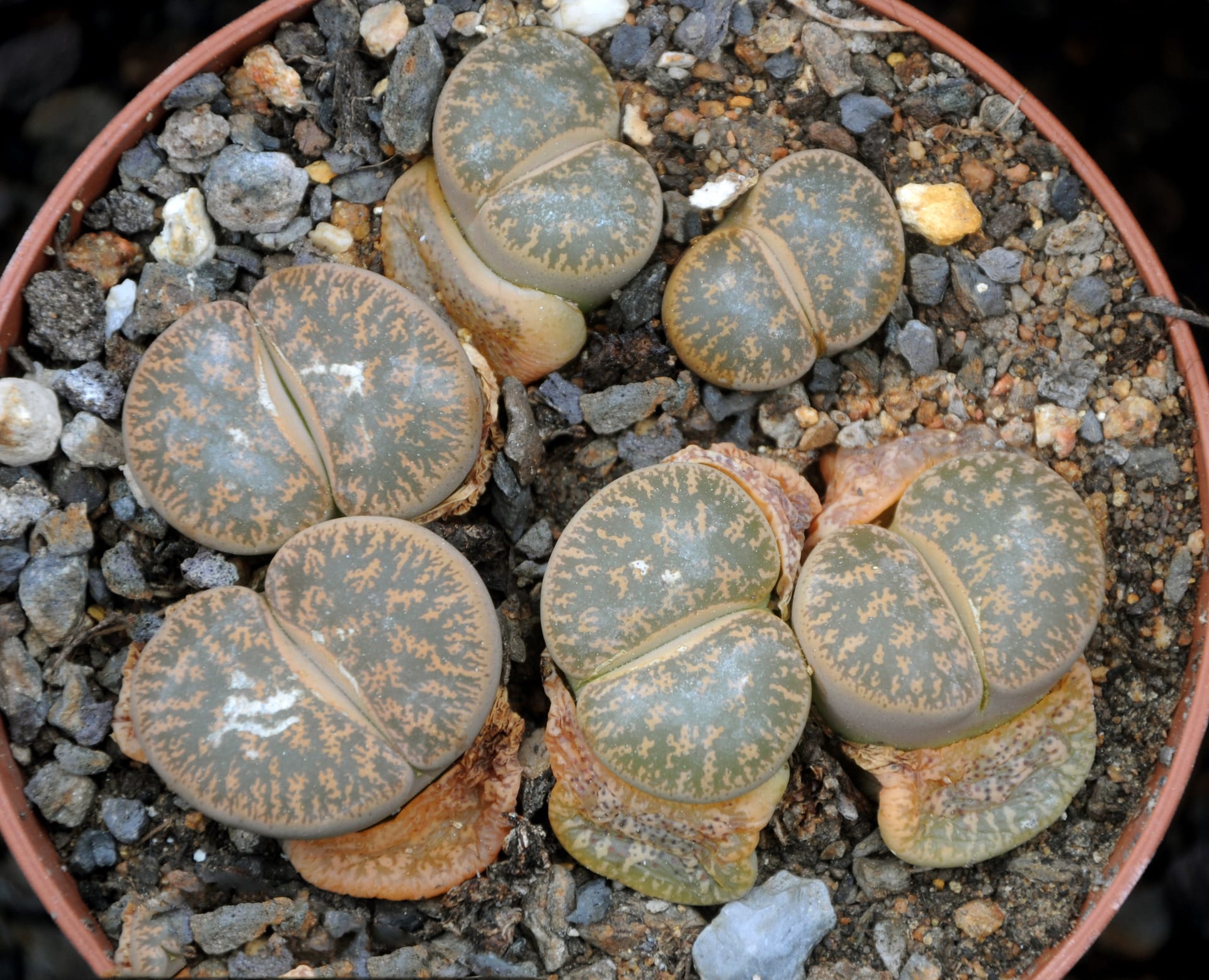
A tall Lithops with grey sides and large olive to dark green windows. It bears white flowers in autumn and clumps readily; a purple selection is also well known.
About
Lithops salicola is a succulent in the Aizoaceae from the Free State and Northern Cape of South Africa at 1,000-1,350 m, a summer-rainfall area, where it grows on salt pans and may be partly submerged in the rainy season. Heads are 17-35 mm tall and 11-26 mm wide, tall for the genus, so the grey bodies stand above the soil. The slightly convex tops have distinct margins and large translucent windows, usually wide open, in olive, grey-green, dark green, reddish or brown to dark violet. White flowers 20-50 mm across appear in autumn. It clumps readily into groups of 2-50 heads and over decades can reach 25 cm across. In Japan a purple selection, 'Murasaki-rifujin' ('Bacchus', also called Sato's Violet), which arose among seedlings raised by a Japanese enthusiast, is widely sold; its wine-coloured body and vivid red-purple windows distinguish it from the typical form. It is one of the Lithops most tolerant of overwatering and cold, and is considered easy.
Source: Wikipedia (CC BY-SA 4.0)
Lifespan of the Lithops salicola
The Lithops salicola lives Perennial; clumps take decades to reach full size.
Size of the Lithops salicola
The Lithops salicola grows to Heads 17-35 mm tall, 11-26 mm wide; clumps can reach 25 cm across.
Temperature & humidity for the Lithops salicola
The ideal temperature for the Lithops salicola is 8〜25℃.
Basic Info
Origin
Free State and Northern Cape, South Africa (1,000-1,350 m)
Lifespan
Perennial; clumps take decades to reach full size
Size
Heads 17-35 mm tall, 11-26 mm wide; clumps can reach 25 cm across
Temperature
8〜25℃
Humidity
30〜50%
Watering & Fertilizer
A little slow-release or liquid fertiliser from autumn to spring
Growing Tips
Light & Placement
Keep it sunny and sheltered from rain all year. In midsummer avoid heat and humidity by giving airflow and shade so it can rest cool.
Watering
It is a winter grower. From September to November water thoroughly when the soil dries, and in winter water on warm days. In the summer rest just mist two or three times a month. It is relatively tolerant of overwatering for a Lithops.
Temperature & Overwintering
Kept dry it is relatively tolerant of winter cold. Keep winter minimums above about 3°C to keep plants looking good (they survive down to roughly 0-3°C). Light frost rarely kills them, but bring them in or protect them in the coldest spell.
Soil & Repotting
It sends down a thick taproot, so use a reasonably deep pot and free-draining mix. It needs repotting only when growth slows or the pot is crowded, ideally in October-November.
Propagation
Propagate from seed (October-November) or by division; self-sown seedlings often appear in the parent's pot. Divide 'Bacchus' to be sure of keeping its colour.
Pests & Cautions
Scale insects and aphids may attack buds and flowers and root mealybugs the roots; slugs eat petals and cutworms the leaves. Pick off spent flowers, which can cause rot.
Lithops salicola FAQ
QWhat is the growing difficulty level for Lithops salicola?
Beginner. A variety suitable for beginners. No special equipment or experience is required—you can grow it without problems by setting up a basic cultivation environment.
QWhat is the ideal temperature for Lithops salicola?
The ideal temperature for Lithops salicola is 8〜25℃. Avoid sudden temperature changes and maintain a stable environment.
QWhat is the lifespan of Lithops salicola?
The average lifespan of Lithops salicola is Perennial; clumps take decades to reach full size. With proper cultivation environment and nutrient management, you can keep it healthy for a long time.
QHow large does Lithops salicola get?
The mature size of Lithops salicola is Heads 17-35 mm tall, 11-26 mm wide; clumps can reach 25 cm across. This may vary slightly depending on cultivation environment and individual differences.
QHow should I water and fertilize Lithops salicola?
Lithops salicola: watering & fertilizer — A little slow-release or liquid fertiliser from autumn to spring. Aim for appropriate frequency and amount.
QWhat is the typical price for Lithops salicola?
The price of Lithops salicola varies significantly by variety, characteristics, size, and lineage. Please check GrowerDirect's price guide for the latest market information.
Last updated: September 23, 2026
References & Sources
Edited & verified by: GrowerDirect Editorial Team
The classifications, regulations, and growing data on this page are created and verified based on the primary information database below.
Taxonomy & Authority
Accepted name: Lithops salicola L.Bolus
Authority databases: GBIF · GBIF: Lithops salicola · Wikipedia: Lithops salicola
Nomenclature follows global taxonomic authority databases.
Regulations & Conservation Status
Lithops salicola is not listed in CITES (checked on Species+). No special procedure is needed for transfers within Japan.
Sources: Species+ (CITES): Lithops salicola
Regulations may change. Always verify the latest information with the relevant authorities.
Related Species
Find listings for this species
Related Articles
Complete Guide to Growing Lithops | Mastering Shedding and Dormancy Management
A detailed explanation of how to grow Lithops, known as living jewels. We cover the mechanism and management of shedding, watering during dormancy, and common pitfalls and their solutions.
Autumn Preparation Management for Summer-Type Succulents
A guide to autumn care for summer-type succulents, covering plant changes from September to November, timing for gradual watering reduction, placement and temperature management for transitioning plants indoors, autumn fertilizing and pest control, variety-specific care checkpoints, and preparation for winter dormancy.
Mealybug Control on Succulents | Complete Guide to Early Detection, Removal, and Prevention
Mealybugs hide easily at the base of succulent leaves and on new growth. This guide covers their characteristics, the environments where they thrive, tips for early detection, removal methods using cotton swabs and alcohol, and daily care practices to prevent recurrence.
Summer and Winter Type Succulents: Growth Cycles and Watering Management Strategy
This article explains the differences in growth types of succulent plants, their annual growth cycles, seasonal watering management strategies, common failures, and countermeasures.
🩺 Common diseases
Can't find the plant you're looking for?
Post your wishes for free and growers with matching plants will contact you with introductions.