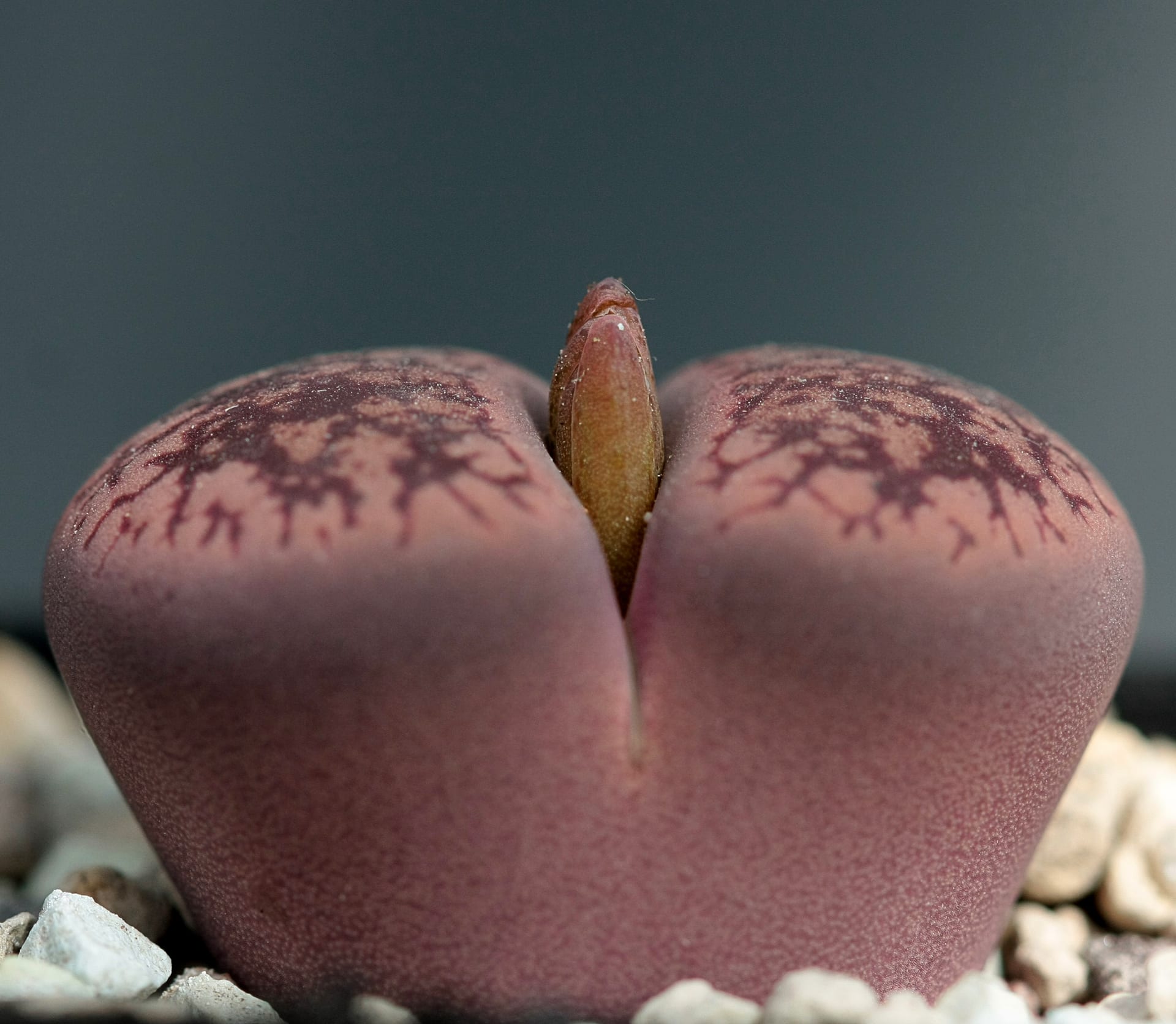
Source: Wikimedia Commons
Lithops aucampiae
BeginnerLithops aucampiae
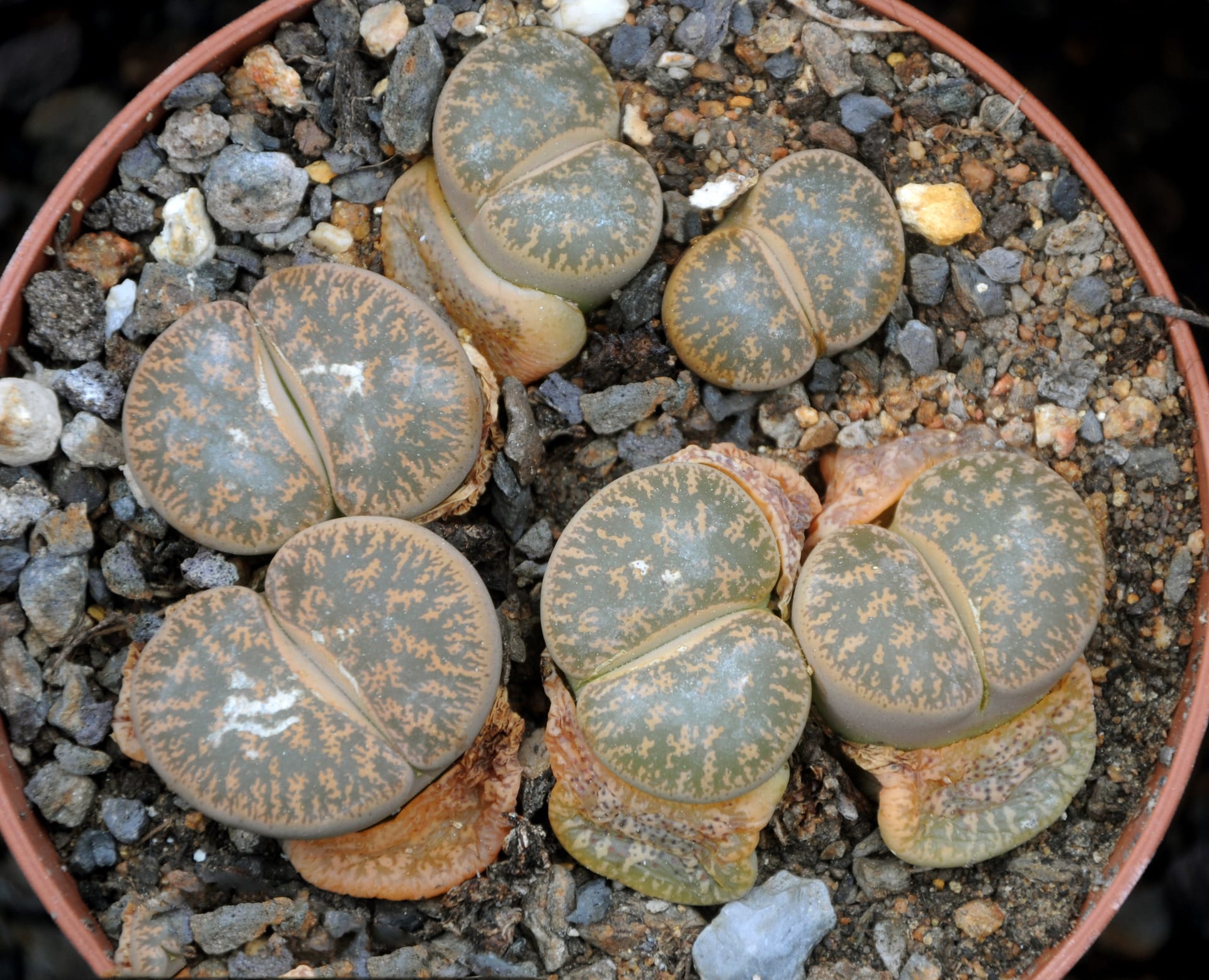
A large Lithops with red-brown tops netted in darker brown. It bears big bright yellow flowers and is a tough, common species fairly forgiving of watering mistakes.
About
Lithops aucampiae is a succulent in the Aizoaceae from dry ground of ironstone, sandstone and chert between Hopetown and west of Vryburg in South Africa's Northern Cape, a summer-rainfall area. It is named after Juanita Aucamp, who found it on her father's farm near Postmasburg in 1929. In habitat it sits almost buried in red soil with only the truncated leaf tops showing among pebbles. Each head is 25-55 mm long and 20-40 mm wide, large for the genus, with slightly convex tops showing brown windows and intricate netting inside yellowish to reddish-brown margins. Older plants form clusters of 2-5 or more heads. Flowers are bright yellow and up to 52 mm across. Var. koelemanii, with reduced windows and a dull, pitted surface like old brick, is also known. It is among the Lithops most tolerant of occasional watering mistakes and, with L. lesliei and L. salicola, is counted among the easiest. In Japan it is widely sold as a tough beginner's species.
Source: Wikipedia (CC BY-SA 4.0)
Size of the Lithops aucampiae
The Lithops aucampiae grows to Heads 25-55 mm long and 20-40 mm wide; flowers up to 52 mm across.
Temperature & humidity for the Lithops aucampiae
The ideal temperature for the Lithops aucampiae is 8〜25℃.
Basic Info
Origin
Hopetown to west of Vryburg, Northern Cape, South Africa
Lifespan
Perennial (little published data on lifespan)
Size
Heads 25-55 mm long and 20-40 mm wide; flowers up to 52 mm across
Temperature
8〜25℃
Humidity
30〜50%
Watering & Fertilizer
A little slow-release or liquid fertiliser from autumn to spring
Growing Tips
Light & Placement
Grow it in a sunny, rain-sheltered spot; bright light is needed for good colour. From the end of the rainy season through summer let it rest in airy shade.
Watering
It is a winter grower. The key rule is to keep it dry from the end of flowering until the old leaves are fully replaced. Resume watering as autumn cools, soak the pot when the soil dries while growing, and keep it dry in the June-September rest.
Temperature & Overwintering
Keep winter minimums above about 3°C to keep plants looking good (they survive down to roughly 0-3°C). Light frost rarely kills them, but bring them in or protect them in the coldest spell.
Soil & Repotting
It sends down a thick taproot, so use a reasonably deep pot and free-draining mix. It needs repotting only when growth slows or the pot is crowded, ideally in October-November.
Propagation
Propagate from seed (October-November) or by dividing clumps; divisions are slow to root, so do it early in the season.
Pests & Cautions
Scale insects and aphids may attack buds and flowers and root mealybugs the roots; slugs eat petals and cutworms the leaves. Pick off spent flowers, which can cause rot.
Lithops aucampiae FAQ
QWhat is the growing difficulty level for Lithops aucampiae?
Beginner. A variety suitable for beginners. No special equipment or experience is required—you can grow it without problems by setting up a basic cultivation environment.
QWhat is the ideal temperature for Lithops aucampiae?
The ideal temperature for Lithops aucampiae is 8〜25℃. Avoid sudden temperature changes and maintain a stable environment.
QHow large does Lithops aucampiae get?
The mature size of Lithops aucampiae is Heads 25-55 mm long and 20-40 mm wide; flowers up to 52 mm across. This may vary slightly depending on cultivation environment and individual differences.
QHow should I water and fertilize Lithops aucampiae?
Lithops aucampiae: watering & fertilizer — A little slow-release or liquid fertiliser from autumn to spring. Aim for appropriate frequency and amount.
QWhat is the typical price for Lithops aucampiae?
The price of Lithops aucampiae varies significantly by variety, characteristics, size, and lineage. Please check GrowerDirect's price guide for the latest market information.
Last updated: September 23, 2026
References & Sources
Edited & verified by: GrowerDirect Editorial Team
The classifications, regulations, and growing data on this page are created and verified based on the primary information database below.
Taxonomy & Authority
Accepted name: Lithops aucampiae L.Bolus
Synonyms: Lithops koelemanii de Boer, Lithops aucampiae var. koelemanii (de Boer) D.T.Cole
Authority databases: GBIF · GBIF: Lithops aucampiae · Wikipedia: Lithops aucampiae
Nomenclature follows global taxonomic authority databases.
Regulations & Conservation Status
Lithops aucampiae is not listed in CITES (checked on Species+). No special procedure is needed for transfers within Japan.
Sources: Species+ (CITES): Lithops aucampiae
Regulations may change. Always verify the latest information with the relevant authorities.
Related Species
Find listings for this species
Related Articles
Complete Guide to Growing Lithops | Mastering Shedding and Dormancy Management
A detailed explanation of how to grow Lithops, known as living jewels. We cover the mechanism and management of shedding, watering during dormancy, and common pitfalls and their solutions.
Autumn Preparation Management for Summer-Type Succulents
A guide to autumn care for summer-type succulents, covering plant changes from September to November, timing for gradual watering reduction, placement and temperature management for transitioning plants indoors, autumn fertilizing and pest control, variety-specific care checkpoints, and preparation for winter dormancy.
Mealybug Control on Succulents | Complete Guide to Early Detection, Removal, and Prevention
Mealybugs hide easily at the base of succulent leaves and on new growth. This guide covers their characteristics, the environments where they thrive, tips for early detection, removal methods using cotton swabs and alcohol, and daily care practices to prevent recurrence.
Summer and Winter Type Succulents: Growth Cycles and Watering Management Strategy
This article explains the differences in growth types of succulent plants, their annual growth cycles, seasonal watering management strategies, common failures, and countermeasures.
🩺 Common diseases
Can't find the plant you're looking for?
Post your wishes for free and growers with matching plants will contact you with introductions.