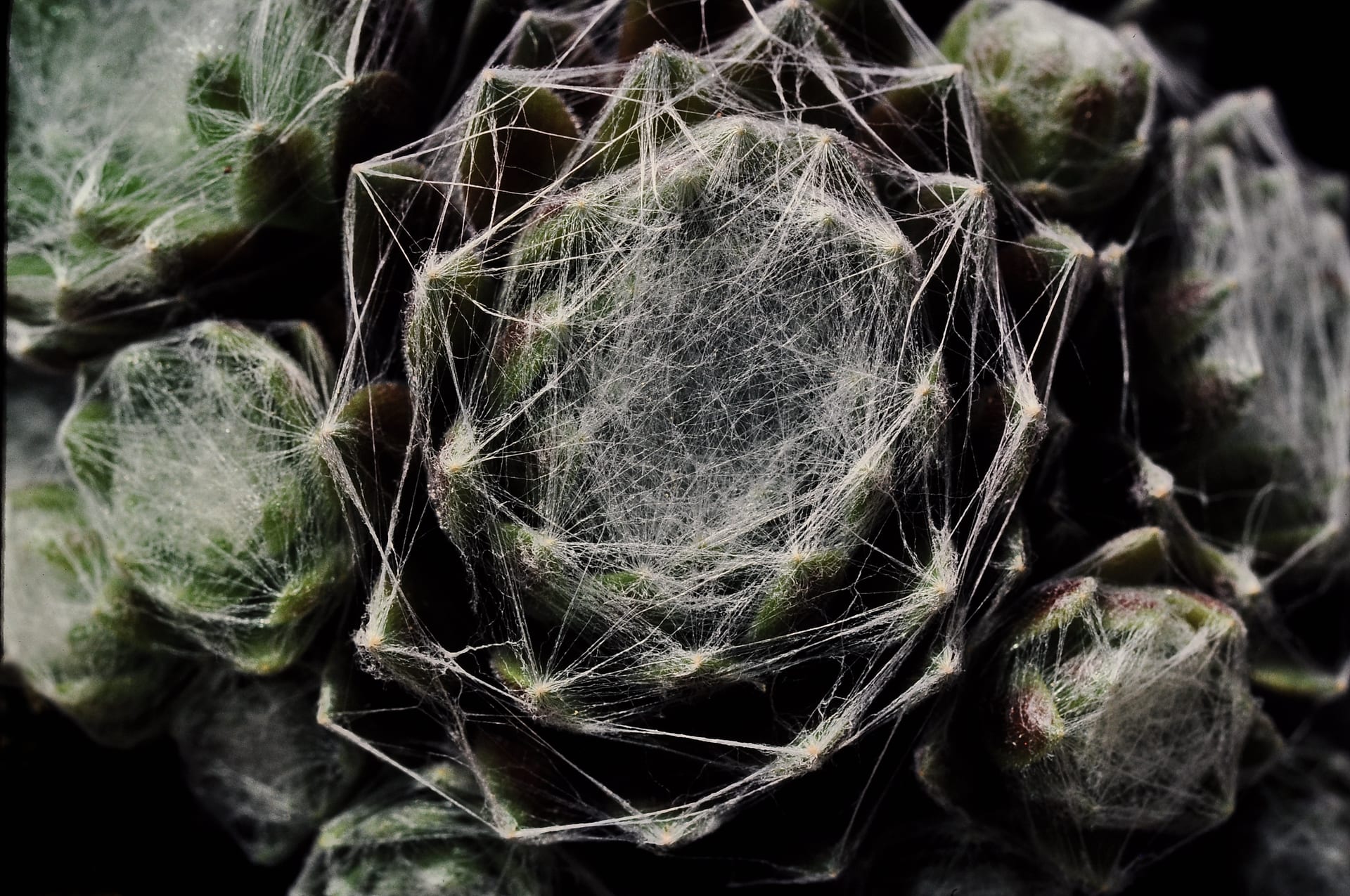
Source: Wikimedia Commons
Cobweb houseleek
BeginnerSempervivum arachnoideum
A houseleek whose small rosettes have leaf tips linked by white threads like cobwebs. Native to European mountains and extremely cold-hardy.
About
Sempervivum arachnoideum is a succulent in the Crassulaceae from the mountains of Europe, including the Pyrenees, Alps, Apennines and Carpathians, at 280-2,900 m. It is a small evergreen perennial with up to 50-60 leaves packed into each rosette, varying from tiny balls 1-2 cm across to somewhat larger forms. The leaf tips are linked by fine white hairs like a spider's web, so the plant looks wrapped in threads, its defining feature; there are many clones, more or less hairy and with red, maroon or green leaves. It produces offsets on runners and spreads into mats 30 cm or more across. From summer into early autumn thick stems about 20 cm tall carry flowers 1-2.5 cm across, usually pink but also white or red; a rosette that flowers dies after setting seed, and the surrounding offsets take its place. It hybridises readily and is a parent of many cultivars. In Japan it is also treated as an alpine plant and is sold by garden centres and alpine-plant nurseries.
Size of the Cobweb houseleek
The Cobweb houseleek grows to Rosettes from about 1-2 cm; clumps form mats 30 cm or more across.
Basic Info
Origin
European mountains (Pyrenees, Alps, Apennines, Carpathians; 280-2,900 m)
Lifespan
Perennial; each rosette dies after flowering and is replaced by offsets
Size
Rosettes from about 1-2 cm; clumps form mats 30 cm or more across
Temperature
5〜35℃
Humidity
30〜50%
Watering & Fertilizer
A little slow-release or liquid fertiliser in spring and autumn
Growing Tips
Light & Placement
Grow it outdoors in full sun except in midsummer. It is not heat-tolerant, so from the rainy season through summer keep it in airy partial shade out of the rain. Leaves colour from late autumn.
Watering
It is a spring-autumn grower (March-June and September-November). Water thoroughly when the surface dries in these periods and hold back from the end of the rainy season through summer. It rots if watered too often.
Temperature & Overwintering
It is very cold-hardy, reportedly to at least -12°C. However, the cobweb hairs trap rain and invite rot, so keep it out of prolonged winter wet.
Soil & Repotting
Use a gritty, free-draining mix; it dislikes rich soil. Repot every 2-3 years just before or early in a growing season.
Propagation
It is easily increased by division or by rooting the offsets on the ends of runners, in March-May or September-October.
Pests & Cautions
A rosette that flowers dies, so remove flower stems early to help the offsets grow. Scale insects and aphids may attack stems and leaves, and root mealybugs the roots.
Cobweb houseleek FAQ
QWhat is the growing difficulty level for Cobweb houseleek?
Beginner. A variety suitable for beginners. No special equipment or experience is required—you can grow it without problems by setting up a basic cultivation environment.
QHow large does Cobweb houseleek get?
The mature size of Cobweb houseleek is Rosettes from about 1-2 cm; clumps form mats 30 cm or more across. This may vary slightly depending on cultivation environment and individual differences.
QHow should I water and fertilize Cobweb houseleek?
Cobweb houseleek: watering & fertilizer — A little slow-release or liquid fertiliser in spring and autumn. Aim for appropriate frequency and amount.
QWhat is the typical price for Cobweb houseleek?
The price of Cobweb houseleek varies significantly by variety, characteristics, size, and lineage. Please check GrowerDirect's price guide for the latest market information.
Last updated: September 23, 2026
References & Sources
Edited & verified by: GrowerDirect Editorial Team
The classifications, regulations, and growing data on this page are created and verified based on the primary information database below.
Taxonomy & Authority
Accepted name: Sempervivum arachnoideum L.
Synonyms: Sempervivum laggeri Schott
Authority databases: GBIF · GBIF: Sempervivum arachnoideum
Nomenclature follows global taxonomic authority databases.
Regulations & Conservation Status
Sempervivum arachnoideum is not listed in CITES (checked on Species+). No special procedure is needed for transfers within Japan.
Sources: Species+ (CITES): Sempervivum arachnoideum
Regulations may change. Always verify the latest information with the relevant authorities.
Related Species
Find listings for this species
Related Articles
Sempervivum Care Guide | Enjoying Hardy Succulents Outdoors
A comprehensive guide to growing Sempervivum that tolerates temperatures as low as -20°C. From outdoor ground planting methods and variety selection to summer care tips and propagation from offsets, we'll share the appeal of succulents that can be enjoyed even in cold regions.
Autumn Preparation Management for Summer-Type Succulents
A guide to autumn care for summer-type succulents, covering plant changes from September to November, timing for gradual watering reduction, placement and temperature management for transitioning plants indoors, autumn fertilizing and pest control, variety-specific care checkpoints, and preparation for winter dormancy.
Mealybug Control on Succulents | Complete Guide to Early Detection, Removal, and Prevention
Mealybugs hide easily at the base of succulent leaves and on new growth. This guide covers their characteristics, the environments where they thrive, tips for early detection, removal methods using cotton swabs and alcohol, and daily care practices to prevent recurrence.
Summer and Winter Type Succulents: Growth Cycles and Watering Management Strategy
This article explains the differences in growth types of succulent plants, their annual growth cycles, seasonal watering management strategies, common failures, and countermeasures.
🩺 Common diseases
Can't find the plant you're looking for?
Post your wishes for free and growers with matching plants will contact you with introductions.