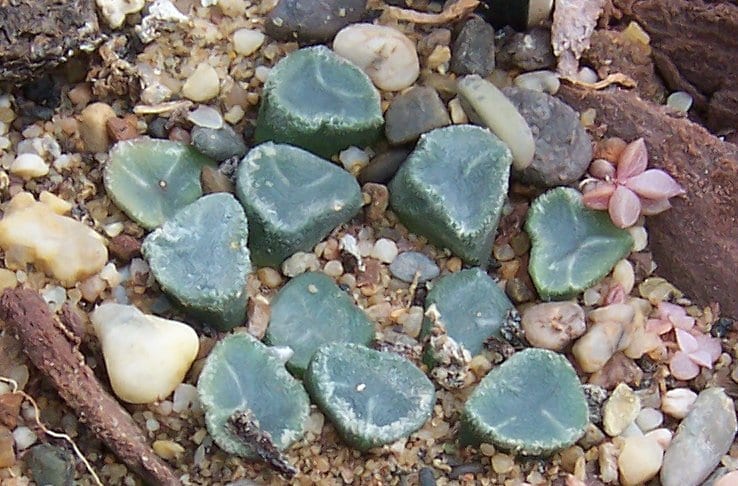
Source: Wikimedia Commons
Haworthia maughanii
IntermediateHaworthia truncata var. maughanii
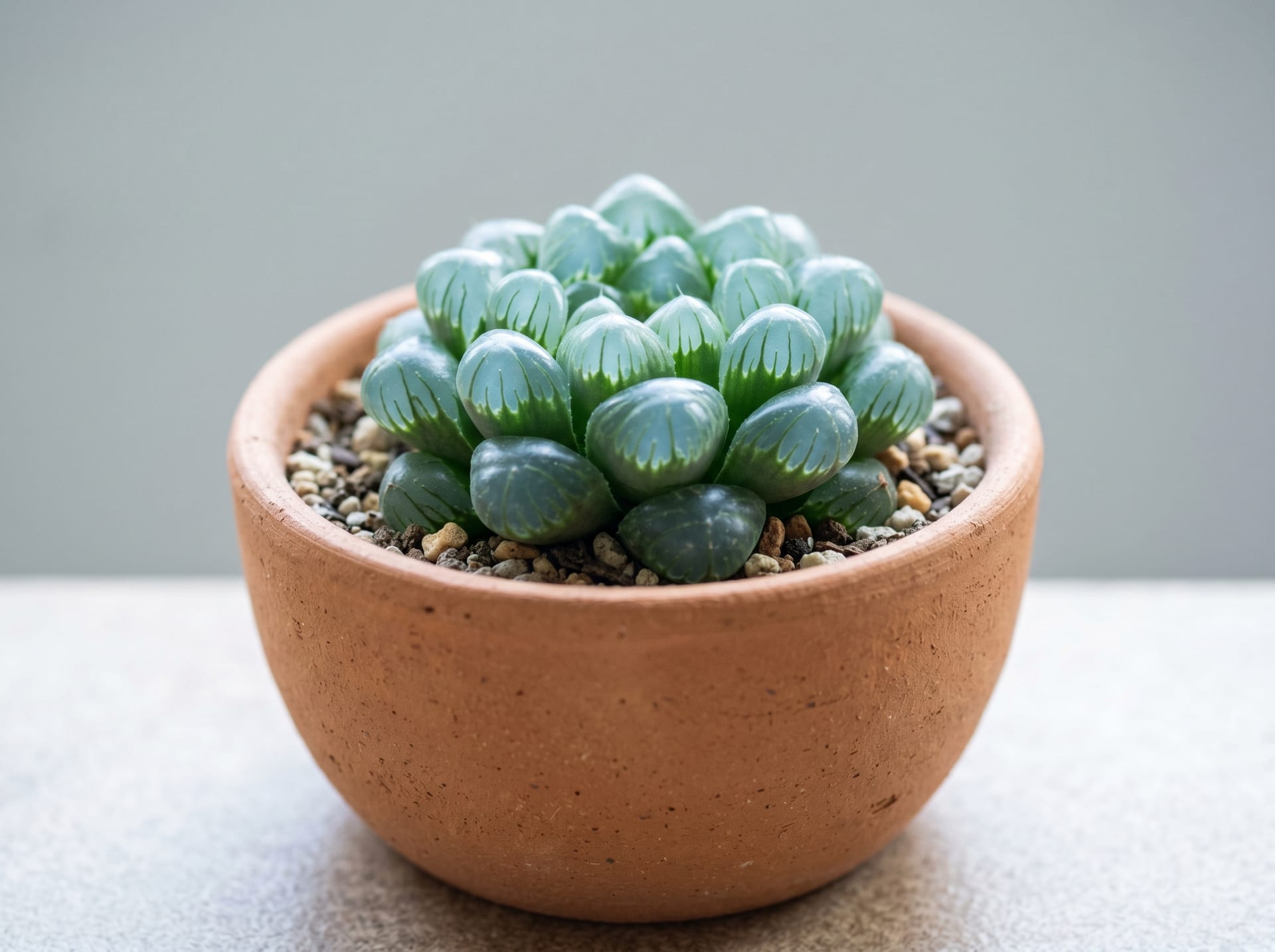
A Haworthia whose short cylindrical leaves end in round, sliced-off windows arranged in a rosette. Windows range from clear to opaque or veined, and many selections exist.
About
Haworthia maughanii is treated as a variety of H. truncata (GBIF accepts Haworthia truncata var. maughanii). It is endemic to a very small area south of Calitzdorp in the Little Karoo, Western Cape, at the western edge of H. truncata's range, where it grows with a form of that species and intermediates occur. It is stemless, with leaves round in cross-section and up to 2.5 cm long arranged spirally in a rosette; each ends abruptly in a flat, irregular round window about 1-1.5 cm across. The rosette arrangement separates it from H. truncata, whose leaves form a two-ranked fan. Windows may be clear, opaque or variously veined, and their size and thickness vary greatly between clones. In habitat the leaf tips sit level with or below the soil surface; in cultivation they stay above it. Japanese growers have selected and bred it intensively, producing named forms such as 'Murasake', with red lines in the window, and 'Yukiguni', with white snowflake-like patterns. In Japan named selections are actively traded among specialists and enthusiasts.
Size of the Haworthia maughanii
The Haworthia maughanii grows to Stemless, medium-sized rosette; leaves to 2.5 cm, windows 1-1.5 cm across.
Basic Info
Origin
South of Calitzdorp, Little Karoo, Western Cape, South Africa
Lifespan
Long-lived perennial (little published data on lifespan)
Size
Stemless, medium-sized rosette; leaves to 2.5 cm, windows 1-1.5 cm across
Temperature
5〜35℃
Humidity
30〜50%
Watering & Fertilizer
A little dilute, low-nitrogen fertiliser in spring and autumn
Growing Tips
Light & Placement
Keep it in bright shade all year. Sudden exposure to strong sun scorches it and spoils the windows. Keep it cool in summer.
Watering
It is a spring-autumn grower (March-June and September-November). Water thoroughly when the soil dries in these periods and hold back in summer and winter, without letting the soil dry out completely during rest.
Temperature & Overwintering
Overwinter it at about 5°C minimum, bringing it into a bright room where frosts occur.
Soil & Repotting
Use a deep pot and gritty, free-draining mix for the deep contractile roots. Part of the root system dies each year, so repot often and remove damaged roots.
Propagation
It can be increased by division, leaf or root cuttings, or seed. Named selections should be propagated vegetatively to stay true.
Pests & Cautions
It is prone to root rot, so avoid wet soil. Scale insects, aphids and root mealybugs can attack it.
Haworthia maughanii FAQ
QWhat is the growing difficulty level for Haworthia maughanii?
Intermediate. A variety suitable for intermediate growers. Requires some cultivation experience and knowledge of environment management. Pay careful attention to temperature and humidity control.
QHow large does Haworthia maughanii get?
The mature size of Haworthia maughanii is Stemless, medium-sized rosette; leaves to 2.5 cm, windows 1-1.5 cm across. This may vary slightly depending on cultivation environment and individual differences.
QHow should I water and fertilize Haworthia maughanii?
Haworthia maughanii: watering & fertilizer — A little dilute, low-nitrogen fertiliser in spring and autumn. Aim for appropriate frequency and amount.
QWhat is the typical price for Haworthia maughanii?
The price of Haworthia maughanii varies significantly by variety, characteristics, size, and lineage. Please check GrowerDirect's price guide for the latest market information.
Last updated: September 23, 2026
References & Sources
Edited & verified by: GrowerDirect Editorial Team
The classifications, regulations, and growing data on this page are created and verified based on the primary information database below.
Taxonomy & Authority
Accepted name: Haworthia truncata var. maughanii (Poelln.) B.Fearn
Synonyms: Haworthia maughanii Poelln.
Authority databases: GBIF · GBIF: Haworthia truncata var. maughanii
Nomenclature follows global taxonomic authority databases.
Regulations & Conservation Status
Haworthia truncata is not listed in CITES (checked on Species+). No special procedure is needed for transfers within Japan.
Sources: Species+ (CITES): Haworthia truncata
Regulations may change. Always verify the latest information with the relevant authorities.
Related Species
Find listings for this species
Related Articles
Complete Guide to Growing Haworthia | Differences Between Soft-Leaf and Hard-Leaf Types and Care Tips
A complete growing guide that explains the differences between soft-leaf and hard-leaf Haworthia, proper light conditions, watering and soil selection, propagation methods, and repotting timing in an easy-to-understand way for beginners.
How to Keep Haworthia Windows Clear | Window Transparency by Variety and Cultivation Without Fogging
Haworthia window transparency is determined largely by variety; cultivation can only prevent fogging. This guide explains four causes of clouding and indentation, the difference between deep planting to emphasize windows and etiolation, and how to select varieties by transparency, such as Obtusa.
Echeveria vs Haworthia: Complete Comparison | Growing Methods, Cost, and Key Differences
In-depth comparison of Echeveria and Haworthia covering basic profiles including native habitat and appearance, care differences in light, watering, and placement, propagation methods and pricing, which one fits your lifestyle, seasonal care calendar, and selection guide.
Echeveria vs. Haworthia: Which Is Easier to Grow? A Thorough Comparison
A thorough comparison of Echeveria and Haworthia, popular beginner succulents. We explain the key points beginners want to know, including lighting conditions, watering frequency, how to enjoy fall colors, and ease of propagation.
🩺 Common diseases
Can't find the plant you're looking for?
Post your wishes for free and growers with matching plants will contact you with introductions.