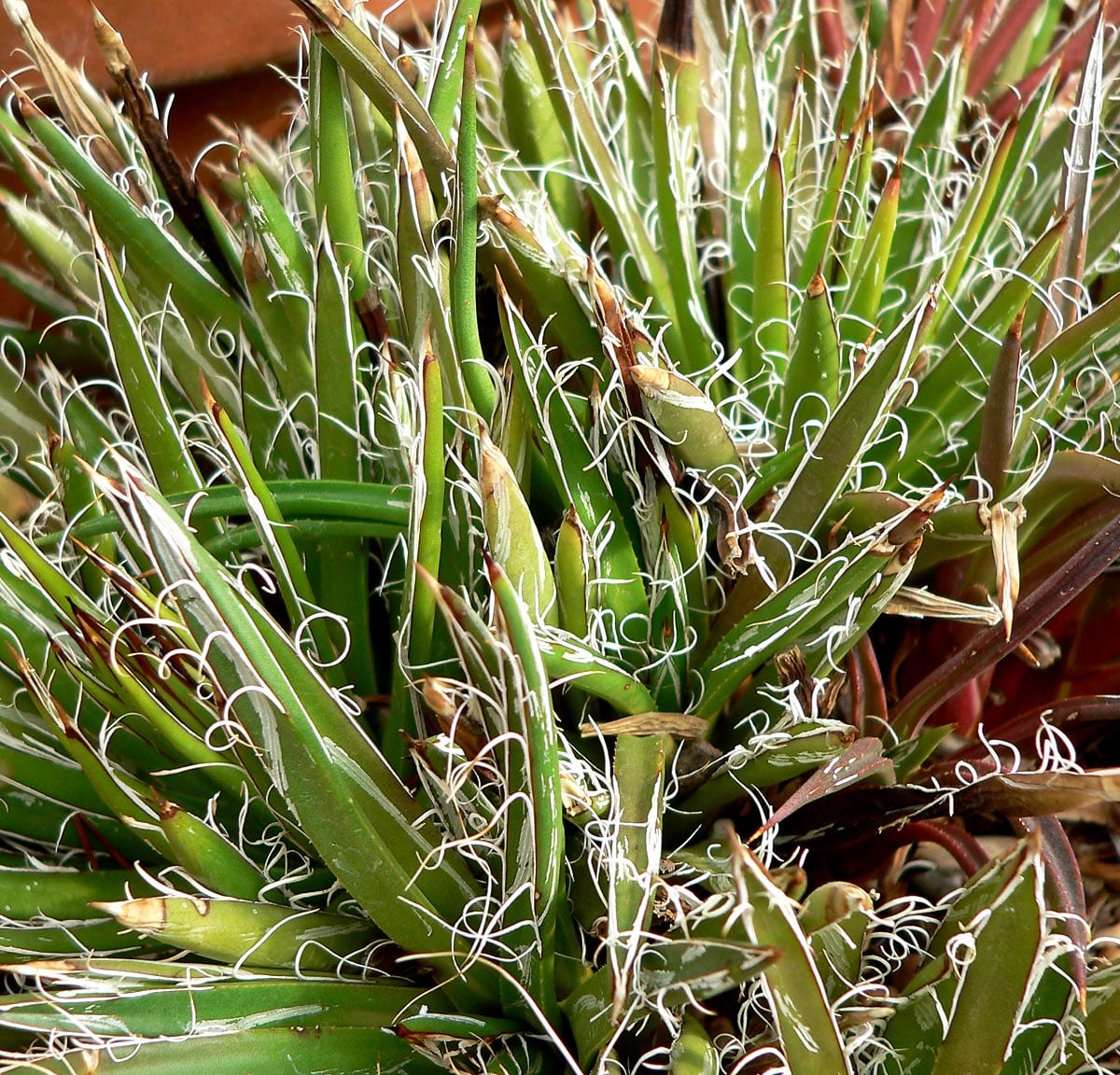
 © Stan Shebs / CC BY-SA 3.0
Agave parviflora (Santa Cruz striped agave)
Agave parviflora, sometimes called Santa Cruz striped agave, is a compact species whose rosette tops out at around 25 cm tall and 20 cm wide. Its narrow, deep green leaves are etched with fine white lines, and curling white fibers that peel away from the leaf margins give the whole plant a softly frosted, thread-wrapped look. Like other agaves, it is a perennial that flowers only once — the flowering rosette dies back afterward, but offsets forming around its base carry the plant forward. This is considered an intermediate-level plant to grow, appreciated for its compact size and finely detailed rosette form.
View Agave parviflora (Santa Cruz striped agave) encyclopedia →0% commission on your first sales!Register by September 30, 2026 and your first 2 plants are commission-free!
Grower Wanted!
List your plants on GrowerDirect and sell directly to customers nationwide!
6 Transparency Commitments from GrowerDirect
Every Agave from our Grower includes full transparency: variety, origin, light requirements, and care difficulty.
- Variety Disclosed
- Real Plant Photos
- Color Details
- Origin Disclosed
- Light Requirements
- Care Difficulty
Browse all 142 varieties
Light Requirements
Difficulty Level
Verified growers wanted for Agave
Growers are signing up now ahead of launch. Subscribe to be notified when new listings go live.
Getting alerts is free with a member account. When new listings match your saved search, we'll notify you by email and in-app.
Browse other categories
Verified growers (preview)
Agave parviflora (Santa Cruz striped agave) key facts
- Growing Difficulty
- Intermediate
- Lifespan
- Perennial; the flowering rosette dies and offsets carry on
- Size
- Rosette about 25 cm tall and 20 cm wide
- Watering
- Light feeder; a little slow-release fertiliser in the growing season is enough
- Light & Placement
- Sun and good airflow; in low light the leaves stretch and the white markings fade.
- Watering
- Chronically damp roots lead to root rot; water only when the mix has dried well.
- Temperature & Winter
- Hardiness data are scarce; being small, winter it bright and on the dry side, away from frost and wet.
- Soil & Repotting
- Free-draining mix in a small pot to suit its size.
- Notes
- CITES Appendix I and a nationally protected species in Japan: transfers require, in principle, a registration certificate, including for plants propagated in Japan. Always check for the certificate when buying.
About Agave parviflora (Santa Cruz striped agave)
Agave parviflora (Santa Cruz striped agave) is a compact agave reaching about 25 cm tall and 20 cm wide, with narrow striped leaves and curling white marginal fibers. An intermediate-level species for growers.
7 things to know before growing Agave parviflora (Santa Cruz striped agave)
1Placement & Sunlight
This agave thrives in full sun with good air circulation. Without enough light, the leaves stretch out and the rosette loses its tight form, which also makes the white leaf markings and curling marginal fibers less defined. Keep it outdoors in a bright spot, or as close to a sunny window as possible if grown indoors.
2Watering Rhythm
Water thoroughly once the soil has dried out, then wait until it dries again before the next watering. Avoid letting water pool in the center of the rosette, since standing moisture between the leaves can lead to rot — direct water toward the base of the plant instead.
3Well-Draining Soil
Use a fast-draining mineral mix with a generous portion of akadama or pumice to prevent root rot. Soil that's too rich in organic matter stays wet longer, which is hard on this plant's relatively small root system.
4Repotting Timing
Repot in spring, during the growing season, once roots have filled the pot. Because this is a compact variety, avoid jumping to an oversized pot — excess soil volume stays damp longer and raises the risk of root rot.
5Humid-Season Care
During the rainy season and peak summer humidity, move the plant somewhere sheltered from direct rain with good airflow to prevent rot-related damage. It also helps to water less frequently during these humid stretches, since moisture tends to linger between the leaves and at the base.
6Winter Protection
This agave tolerates cool temperatures reasonably well but is sensitive to frost and freezing. Move it to a bright indoor spot or a covered area as temperatures drop, and cut back watering significantly during dormancy to keep the plant on the dry side.
7Check for the Registration Certificate First
Agave parviflora is listed in CITES Appendix I and designated an Internationally Endangered Species of Wild Fauna and Flora under Japan's Act on Conservation of Endangered Species. Transferring a plant within Japan generally requires a registration certificate under that act, and this applies to plants propagated in Japan as well. Whenever you buy or transfer one, always confirm that a registration certificate comes with the plant. Beyond that, look for deep green leaves, a tightly formed rosette, and intact white fibers along the leaf margins. Keep in mind that a rosette showing an emerging flower stalk is nearing the end of its life, since it dies after blooming.
Frequently asked questions about Agave parviflora (Santa Cruz striped agave)
- Q.Is Agave parviflora difficult to grow?
- A.It's generally considered an intermediate-level plant. Avoiding excess moisture and insufficient light, along with fast-draining soil and measured watering, makes it manageable for most growers. If you're new to agaves, it can help to start with a hardier species before taking this one on.
- Q.How large does this agave get?
- A.The rosette typically reaches around 25 cm tall and 20 cm wide, making it one of the smaller agave species. Its compact size makes it well suited to long-term container growing.
- Q.Should I trim off the curling white fibers on the leaf edges?
- A.There's no need to remove them. These white fibers unraveling from the leaf margins are one of the plant's defining features, giving the whole rosette its frosted appearance — it's worth simply enjoying how they develop and fray naturally over time.
- Q.What happens to the rosette after it flowers?
- A.The rosette that flowers will die back afterward. However, since this is a perennial species, offsets that form around the base carry the plant forward as new rosettes.
- Q.Can it be grown indoors?
- A.Yes, as long as it's placed in a bright, well-ventilated spot such as a sunny windowsill. That said, insufficient light can cause the rosette to stretch out, so an outdoor spot or bright balcony is preferable whenever possible to maximize sun exposure.
Handy Growing Tools for Agave parviflora (Santa Cruz striped agave)
Learn more about Agave parviflora (Santa Cruz striped agave) in the encyclopedia
View Agave parviflora (Santa Cruz striped agave) encyclopedia entry →
Care difficulty, size, origin and light needs — all basics covered.
More in this category
Can't find the plant you're looking for?
Post your wishes for free and growers with matching plants will contact you with introductions.