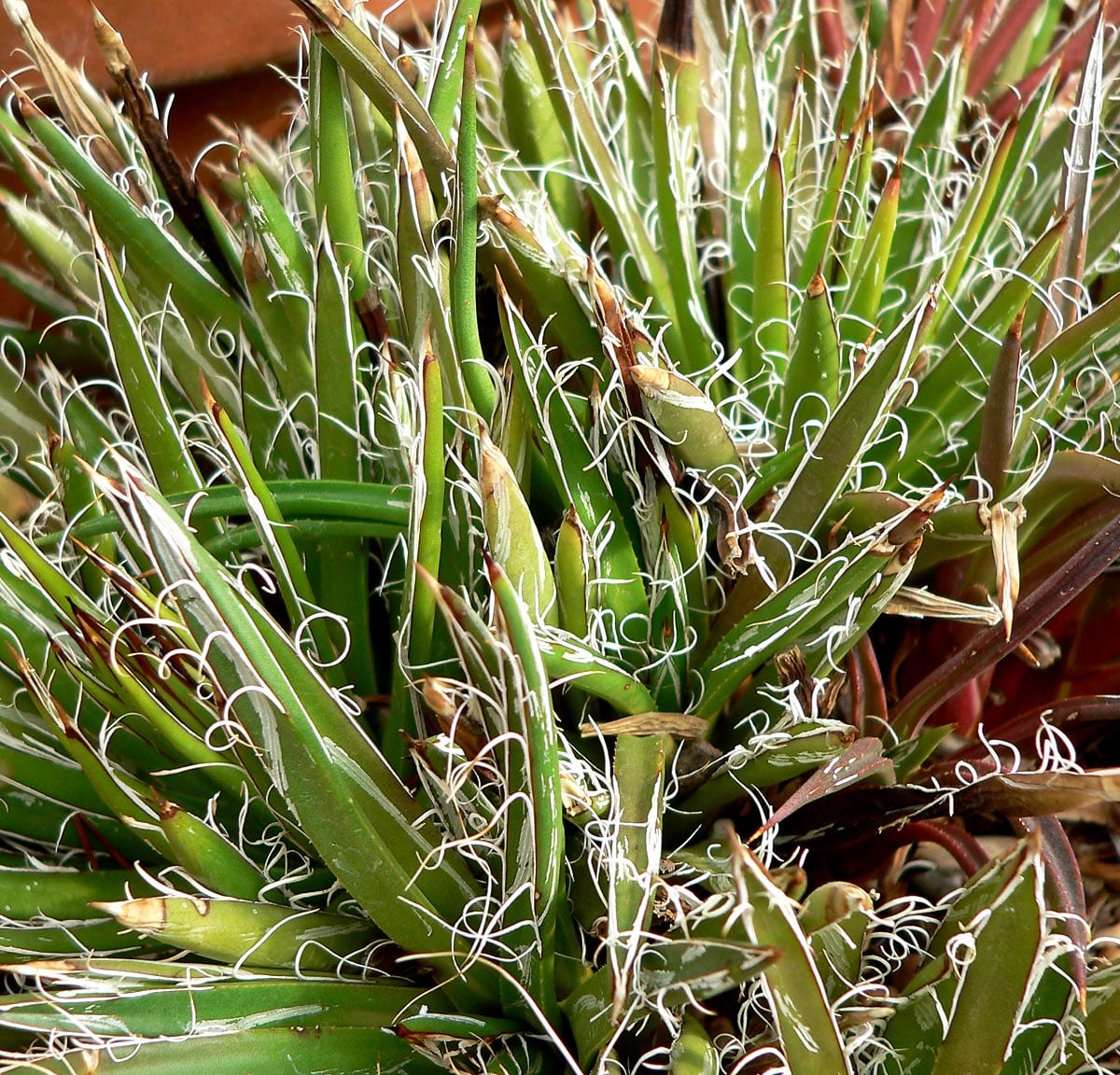
Source: Wikimedia Commons
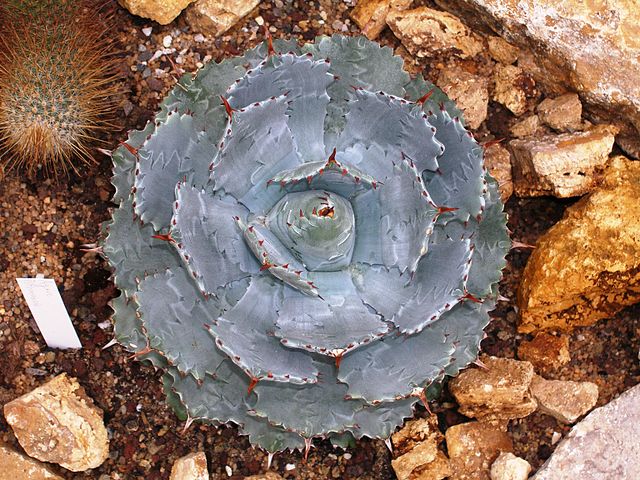
Agave parviflora (Santa Cruz striped agave)
IntermediateAgave parviflora
A tiny agave only about 20 cm across. Its narrow, dark green leaves carry white markings and shed white threads from the margins, so the whole plant looks white. Listed in CITES Appendix I; transfers in Japan require a registration certificate.
About
Agave parviflora (Japanese name Hime-midareyuki) ranges from southern Arizona into Sonora, Mexico; the epithet means 'small-flowered'. Its rosette reaches only about 25 cm tall and 20 cm wide, among the smallest in the genus. The leaves, up to about 20 cm long, are glossy dark green with white markings, and their margins peel into fine white threads. After some 10-15 years it sends up a 1-2 m flower stalk with cream to pale yellow flowers, then dies. According to a Japanese succulent encyclopedia, it is a distinct species rather than a dwarf form of the similarly named A. filifera, told apart by straighter, denser threads, narrower and thicker leaves, and more white marking at the leaf tips on a deeper green ground; A. polianthiflora looks very similar. Constantly damp roots readily lead to root rot. It is listed in CITES Appendix I, and transferring plants within Japan requires, in principle, a registration certificate under the Act on Conservation of Endangered Species (plants propagated in Japan also need registering). In Japan registered plants are sold by specialist nurseries.
Source: Wikipedia (CC BY-SA 4.0)
Size of the Agave parviflora (Santa Cruz striped agave)
The Agave parviflora (Santa Cruz striped agave) grows to Rosette about 25 cm tall and 20 cm wide.
Basic Info
Origin
Southern Arizona, USA, to Sonora, Mexico
Lifespan
Perennial; the flowering rosette dies and offsets carry on
Size
Rosette about 25 cm tall and 20 cm wide
Temperature
5〜40℃
Watering & Fertilizer
Light feeder; a little slow-release fertiliser in the growing season is enough
Growing Tips
Light & Placement
Sun and good airflow; in low light the leaves stretch and the white markings fade.
Watering
Chronically damp roots lead to root rot; water only when the mix has dried well.
Temperature & Winter
Hardiness data are scarce; being small, winter it bright and on the dry side, away from frost and wet.
Soil & Repotting
Free-draining mix in a small pot to suit its size.
Notes
CITES Appendix I and a nationally protected species in Japan: transfers require, in principle, a registration certificate, including for plants propagated in Japan. Always check for the certificate when buying.
Agave parviflora (Santa Cruz striped agave) FAQ
QWhat is the growing difficulty level for Agave parviflora (Santa Cruz striped agave)?
Intermediate. A variety suitable for intermediate growers. Requires some cultivation experience and knowledge of environment management. Pay careful attention to temperature and humidity control.
QHow large does Agave parviflora (Santa Cruz striped agave) get?
The mature size of Agave parviflora (Santa Cruz striped agave) is Rosette about 25 cm tall and 20 cm wide. This may vary slightly depending on cultivation environment and individual differences.
QHow should I water and fertilize Agave parviflora (Santa Cruz striped agave)?
Agave parviflora (Santa Cruz striped agave): watering & fertilizer — Light feeder; a little slow-release fertiliser in the growing season is enough. Aim for appropriate frequency and amount.
QWhat is the typical price for Agave parviflora (Santa Cruz striped agave)?
The price of Agave parviflora (Santa Cruz striped agave) varies significantly by variety, characteristics, size, and lineage. Please check GrowerDirect's price guide for the latest market information.
Last updated: September 23, 2026
References & Sources
Edited & verified by: GrowerDirect Editorial Team
The classifications, regulations, and growing data on this page are created and verified based on the primary information database below.
Primary sources
- Wikipedia
- Species+ (CITES) query for Agave parviflora: Appendix I
- e-Gov: Cabinet Order for the Act on Conservation of Endangered Species (Agave parviflora in Appended Table 2)
- Ministry of the Environment, list of Invasive Alien Species (no Agave listed)
- Flora of North America (efloras): Agave parviflora
- PUKUBOOK succulent encyclopedia: 姫乱れ雪
- GBIF
- POWO
Taxonomy & Authority
Regulations & Conservation Status
Listed in CITES Appendix I and designated an Internationally Endangered Species under Japan's Act on Conservation of Endangered Species of Wild Fauna and Flora (Cabinet Order, Appended Table 2). Transferring plants within Japan requires, in principle, a registration certificate under the Act (plants propagated in Japan are also subject to registration). Always confirm the plant comes with its certificate when buying or passing it on. It is not designated as an Invasive Alien Species or Uncategorized Alien Species under Japanese law.
Sources: Species+ (CITES) query for Agave parviflora: Appendix I / e-Gov: Cabinet Order for the Act on Conservation of Endangered Species (Agave parviflora in Appended Table 2) / Ministry of the Environment, list of Invasive Alien Species (no Agave listed)
Regulations may change. Always verify the latest information with the relevant authorities.
Related Species
Agave parviflora (Santa Cruz striped agave) Listings
![Kodama-hime Sasanoyuki [Small] Rare High-Quality Specimen - Direct from Agave Grower | 五本幸二 Nursery](https://img.botachoku.com/listings/bd75d031-53ca-4369-b7e2-884bdb80f54f/c9a39afe-50e5-4e00-89d6-03b4060e4699_thumb.webp)
Find listings for this species
Related Articles
Preventing Leaf Burn in Agave and Light Management | Transition Strategy from Indoor to Outdoor Cultivation
Light management strategy to prevent agave leaf burn completely while successfully transitioning from indoor to outdoor environments. This article explains practical methods including gradual light intensity adjustment, seasonal placement changes, and UV protection measures.
Tips for Cultivating White Variegated Agave Varieties
Tips for Cultivating White Variegated Agave Varieties
Complete Care Guide for Agave oteroi | Tips for Training Beautiful Large Rosettes
We explain the characteristics and cultivation of Agave oteroi, a large agave native to Oaxaca, Mexico. From placement location and soil to watering and overwintering—a practical guide for those beginning to cultivate this species.
The Deep Connection Between Agave and Tequila | The Secret of a Distilled Spirit Born from Century Plant
Tequila is made from only Agave tequilana among the Agave genus. This essay explains the ecology of century plants, the Jalisco region as a production area, and the differences from ornamental agaves.
🩺 Common diseases
Can't find the plant you're looking for?
Post your wishes for free and growers with matching plants will contact you with introductions.