Adenium (Desert Rose) Overwintering Management | Winter Temperature, Water, and Dormancy Strategy
Adenium is a caudex plant native to the tropics, and winter management is the greatest challenge. This article provides detailed, practical overwintering strategies covering essential temperature management, securing light, and water adjustment, from autumn preparation through winter watering and spring recovery. It also covers troubleshooting for common problems such as leaf drop, root rot, and poor sprouting.
Key Takeaways
Adenium is a caudex plant native to the tropics, and winter management is the greatest challenge. This article provides detailed, practical overwintering strategies covering essential temperature management, securing light, and water adjustment, from autumn preparation through winter watering and spring recovery. It also covers troubleshooting for common problems such as leaf drop, root rot, and poor sprouting.
The greatest challenge in growing Adenium is "overwintering." This plant, native to the tropical arid regions of Africa, has not adapted to Japan's winter climate, and improper management can easily result in plant death. However, with correct knowledge and preparation, successful overwintering is entirely achievable. This article provides a detailed explanation of the essential methods for managing Adenium's temperature, water, and light during winter, based on practical observation.
Adenium Ecology and the Limits of Cold Tolerance
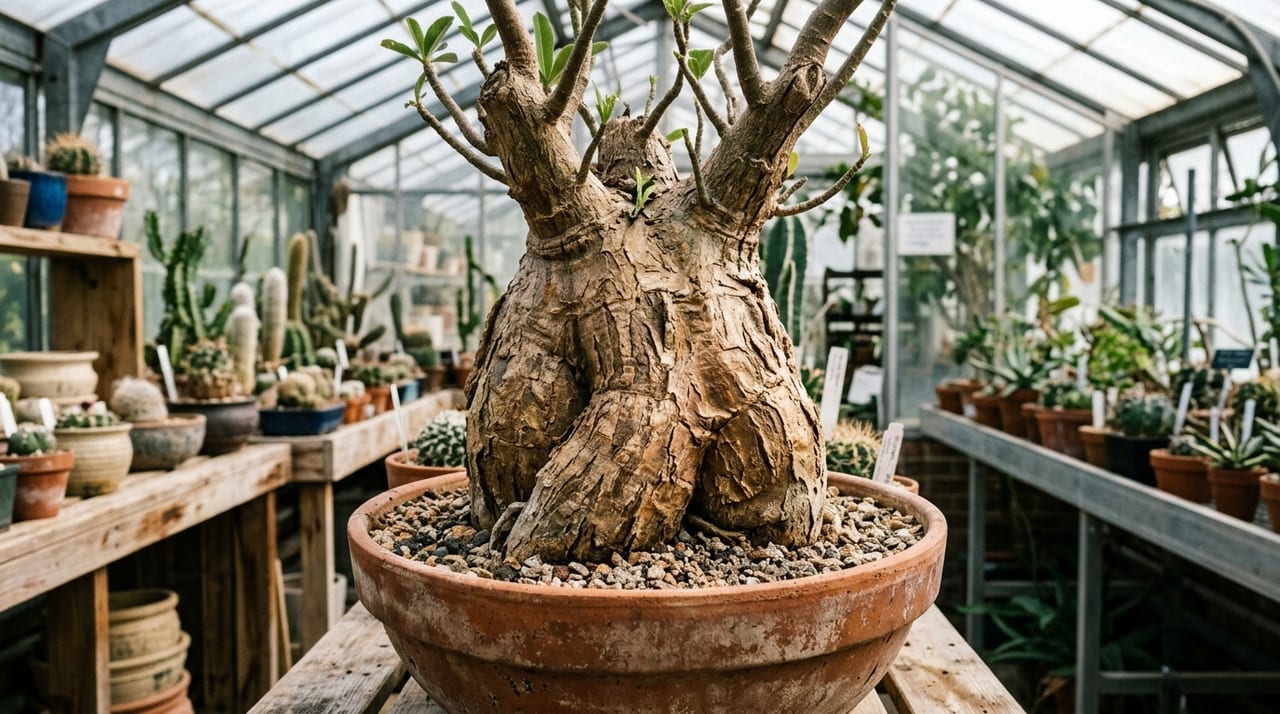
Adenium is a caudex plant native to the Arabian Peninsula, including Yemen and Oman, and evolved in extremely arid environments. As a result, it has developed both a caudex that accumulates water in its stem and a dormancy mechanism in which it sheds its leaves to prevent water loss.
However, in the plant's native climate, the minimum winter temperature generally does not fall below 15°C. By contrast, Japan's winter drops below freezing in northern regions and falls to around 5°C even in the south. Adenium's cold tolerance is said to have a limit of around 10°C; below this temperature, roots cease activity and the risk of frost damage to cells increases rapidly.
In other words, to overwinter Adenium in Japan, an environment that "artificially prevents winter" is essential. The plant must either pass through a complete dormant state (no watering, around 10°C) or be kept warm to maintain growth activity—one of these two approaches is necessary.
The Three Elements of Overwintering: Temperature, Light, and Water Management
Three factors interact to make Adenium overwintering successful.
Temperature This is the most critical factor. The ideal is a stable environment above 15°C. Below 10°C is dangerous and should be avoided. However, if complete dormancy is desired, the plant can intentionally be placed in a low-temperature environment of 10–15°C. In this case, it is absolutely critical to cease watering completely. When providing heat, aim for 18°C or higher, and keeping temperature fluctuations to a minimum is key to success.
Light Light is essential even during overwintering. If winter indoor light is insufficient, Adenium becomes etiolated (grows tall and spindly), and the plant loses balance. Moreover, without light, photosynthesis cannot occur, and the plant lacks energy to prepare for the resumption of growth in spring. If possible, secure direct sunlight from a south-facing window, or use LED grow lights. A target is 4–8 hours of light exposure per day.
Water This is the source of the greatest misunderstanding. The correct approach for winter Adenium is "give almost no water." Even if the air temperature is kept above 15°C, reduce watering to about 1/10 of the summer frequency. On the other hand, in a state of complete dormancy below 10°C, watering must cease entirely. It is not a problem if the soil remains completely dry. In fact, watering increases the risk of root rot and poor sprouting the following spring dramatically.
Autumn Preparation: Gradual Reduction in Watering from September
Success in Adenium overwintering depends on autumn preparation. It is important to adjust gradually rather than switching abruptly to a winter environment.
September: Begin responding to temperature decline Adenium that has been growing actively until August begins to show physiological changes as temperatures drop in September. From this time, reduce watering compared to summer. A guideline is watering "about once every 7–10 days." Make sure the soil dries sufficiently before the next watering, rather than watering while the soil is still moist.
October: Leaf drop begins and watering frequency is greatly reduced When the temperature drops below 20°C, Adenium begins to shed its leaves. This is a normal response, indicating that the plant is entering dormancy. From this time, reduce watering frequency further to "about once every 2–3 weeks." Once the leaves have completely fallen, reduce watering even more.
November onward: Transition to complete dormancy From mid-November onward, as temperatures fall below 15°C, Adenium enters a state of complete dormancy. At this point, cease watering entirely. It is fine if the soil dries completely. In fact, the mindset "wet soil is the enemy" is necessary.
Winter Management: Indoor Environment, Heating Methods, and Watering Frequency
Winter management of Adenium varies depending on the strategy adopted.
Strategy 1: Low-Temperature Complete Dormancy Type (10–15°C) This is the most common and beginner-friendly approach. Place the plant during winter in a vinyl greenhouse, glass greenhouse, or an unheated location indoors (such as an unheated vinyl house). The target temperature range is 10–15°C, and heating is not necessary within this range.
The advantage of this method is that there is no heating cost and equipment investment is minimal. The disadvantage is that spring sprouting is somewhat delayed.
Management tips:
- Cease watering entirely. Do not give any water after leaf drop.
- Ensure air circulation, but avoid exposure to cold drafts.
- When bringing indoors, choose a location where window condensation does not occur.
- Once a month or so, lightly mist the entire plant to prevent excessive drying (but be careful not to water the roots).
Strategy 2: Heated, Light-Watering Type (18°C or higher) This method uses heating equipment to maintain 18°C or higher, allowing Adenium to maintain some growth activity. Adjust temperature with heat mats, heaters, air conditioners, and similar equipment.
The advantage of this method is that spring sprouting occurs earlier and the possibility of reaching flowering increases. The disadvantage is that electricity costs accumulate and equipment investment is necessary. Additionally, because some growth continues even in winter, light watering is required.
Management tips:
- Maintain temperature at 18–25°C (ideally within ±3°C variation).
- Water at about 1/5 the summer rate, "about once every two weeks, small amounts."
- Secure 8 hours of LED grow light daily to support photosynthesis.
- Do not apply fertilizer (winter fertilization causes root damage).
- Target humidity of 40–60%.
Strategy 3: Hybrid Type (Graduated Temperature Management) There is also a hybrid approach in which the plant experiences low-temperature dormancy from autumn through early winter, with heating only during the coldest period of deep winter. For example, 10°C or so from November to December, then keeping above 15°C from January to February during the coldest months—a method that balances electricity costs with flowering.
Spring Recovery: Revival Cultivation from March
Adenium that has survived winter begins to awaken in response to rising spring temperatures. Management at this stage significantly influences subsequent growth.
March: Temperature rise and signs of sprouting From early to mid-March, when temperatures consistently exceed 15°C, Adenium begins to awaken. First, small buds swell at the branch tips, a phenomenon called "sprouting."
Watering at this stage requires care. Giving large amounts of water all at once is forbidden. The guideline is "three days after the soil dries, moisten lightly." Roots have not yet resumed activity, so excess moisture causes root rot.
April: Full resumption of activity and increased watering frequency When temperatures exceed 20°C, new leaves begin to unfold. From this time, increase watering to about once a week and gradually transition to summer management. Once new leaves begin to appear, it is acceptable to apply dilute liquid fertilizer about once weekly, four times per month.
May onward: Transition to summer management From mid-May onward, as days with temperatures exceeding 25°C increase, Adenium fully resumes activity. From this timing, return to summer management (watering once a week with enough water to thoroughly moisten).
Troubleshooting: Leaf Drop, Root Rot, and Poor Sprouting
Common problems encountered in winter Adenium management and their solutions.
Leaf drop does not stop; all leaves have fallen Winter leaf drop is a normal response. In fact, if leaves remain, water loss continues and the plant weakens. However, there is no strict rule that "complete defoliation should occur by December." Individual and varietal differences exist; leaves sometimes remain through January or February. What is important is ceasing watering after leaf drop.
Root rot has softened the plant; there is an unpleasant smell This is caused by overwatering in winter 90% of the time. Unfortunately, it is difficult to rescue a plant with advanced root rot. Prevention is paramount. In winter, a strict judgment of "if in doubt, don't water" is necessary.
If root rot is mild, a last resort exists: remove the plant, cut away the rotted roots, and repot in fresh soil.
Spring arrives but buds do not sprout; sprouting is delayed This is caused either by insufficient temperature during overwintering or by insufficient watering. Adenium subjected to cold stress may experience delayed spring awakening.
The solution is "patience." If buds do not appear even after waiting from March through May, the plant may truly be dead. On the other hand, even if a plant appears "dead" to the eye, scratching the bark with a knife may reveal green tissue inside, indicating the plant is still alive.
Leaves appeared but no flowers bloomed Even if a plant was maintained with added heat during winter, flowers may not bloom from spring through early summer. This is often caused by insufficient light during winter. A plant that overwintered with only limited indoor daylight and no LED grow light lacks the energy to bloom.
The solution is to place it in full direct sunlight (6 or more hours per day) from spring onward and apply liquid fertilizer about twice per month.
Using the Plant After Overwintering: Seed Propagation, Cuttings, and Grafting
If your Adenium safely reaches spring after overwintering, it is a good opportunity to attempt propagation. In particular, because "having overwintered" indicates a strong plant, failures are fewer.
Seed propagation (sowing) is optimal after spring temperatures stabilize (April onward). Cuttings are suitable after new buds grow to about 5 cm in May. Grafting is also possible at this time. For details on these methods, please refer to other articles.
Adenium Overwintering Management Checklist
A final confirmation checklist for overwintering success:
- Did you gradually reduce watering frequency from September?
- Was defoliation nearly complete by the end of October?
- Was the winter temperature kept at a minimum of 10°C, preferably 15°C or higher?
- Did you completely stop watering during the winter period (or keep it to about once weekly for heated plants)?
- Did you ensure air circulation while avoiding direct exposure to cold drafts?
- Did you secure 4 or more hours of light per day (LED grow lights are acceptable)?
- After spring sprouting in March, did you avoid suddenly increasing watering?
- From spring onward, did you apply fertilizer only after 3 or more new leaves had unfolded?
If all of these items are checked, your Adenium overwintering management should be successful.
Summary
Adenium overwintering may appear difficult at first glance, but once the principles are understood, success is entirely achievable. The key is the simple principle of "let the plant rest in winter." Rather than replicating the native climate, what matters most is managing temperature, water, and light according to the plant's physiological state.
For beginners, I recommend starting with the low-temperature complete dormancy type. There is no equipment investment, management is simple, and failures are rare. After gaining experience, you can then try heated or hybrid approaches.
Above all, the moment a spring-blooming Adenium that has overwintered displays flowers is one of the greatest joys of plant cultivation. I hope the knowledge in this article helps bring about that joy.