Complete Guide to Agave Seedling Cultivation | A 3–5 Year Roadmap from Seed to Market Size
Cultivating agave from seedling to market size is the project that most deeply teaches you how plants live. This guide explains environmental management and mindset across five stages: germination, early stage, mid-stage, growth, and market stage.
Key Takeaways
Cultivating agave from seedling to market size is the project that most deeply teaches you how plants live. This guide explains environmental management and mindset across five stages: germination, early stage, mid-stage, growth, and market stage.
Related Species
Agave seedling cultivation is one of the most fascinating and challenging projects for plant enthusiasts. Growing from seed to a tiny seedling of merely 3–5 mm takes just weeks, but reaching market size (10–15 cm diameter) requires 3–5 years. Yet this long-term cultivation process is precisely the opportunity to most deeply understand how agave lives. This article presents a growth roadmap from seed to market size, along with cultivation management and mindset for each stage.
Agave Seeds and Germination Characteristics
Agave seeds are in a "dormant state" immediately after purchase. Evolutionarily, this is an adaptation to avoid germinating and dying during the dry season with no rainfall. As a result, simply sowing purchased seeds as-is yields a germination rate of only around 10%.
Stratification is effective for dramatically improving germination rates. By keeping seeds in a 4°C refrigerator for 2–4 weeks, they experience winter cold. Then, when watered at room temperature, the seeds recognize that "winter has ended" and switch to germination mode. This treatment raises germination rates to 60–80%.
The ideal sowing medium is 100% small-grain akadama. Peat moss and coconut peat retain too much moisture and are prone to fungal issues, so they should be avoided. Place seeds on the surface of the akadama, cover lightly with a thin layer of akadama (about 1 mm), and lightly mist to moisten. Then, maintaining 70–80% humidity and 25–28°C temperature, wait for germination. Usually, germination begins within 1–3 weeks.
At the moment of germination, a white root emerges downward and bean-sized cotyledons appear upward. This is when the life cycle of agave as a living being truly begins.
Stage 1: Ultra-Early Stage (Germination–2 Months Old)
In the ultra-early stage immediately after germination, seedlings are extremely fragile. The roots are thread-like and extremely fine, and they can die from even slight environmental changes.
The critical priorities at this stage are "humidity maintenance" and "disease prevention." To keep humidity consistently above 70%, cover a plastic container with plastic wrap to create a pseudo-greenhouse environment. Removing the wrap daily for a few hours of aeration protects seedlings from mold and moisture buildup.
Watering via misting aims to maintain the medium in a "moist state." The distinction between "wet" and "moist" is subtle and challenging; aim for the akadama to show a faintly damp color. Overwatering immediately invites mold, and seedlings die within days.
Fertilizer is entirely unnecessary. The nutrients stored in the seed are sufficient for the first 2 months of growth. Fertilizing actually damages roots, so it should be absolutely avoided at this stage.
Stage 2: Early Stage (2–6 Months Old)
After 2 months of age, seedlings unfold their cotyledons and the first true leaves (the thin, distinctive leaves of agave) begin to emerge. At this stage, seedlings transition to "individual cultivation."
Transplant into plastic cell trays (approximately 2 cm square per cell). The medium is 70% medium-grain akadama + 30% coarse pumice, which improves drainage compared to akadama alone. This soil blend promotes robust root development.
Humidity management becomes less stringent than the previous stage. Aim for 50–70% relative humidity; daily misting is no longer necessary. Instead, water 2–3 days after the medium surface dries. Around this time, roots gradually develop the ability to tolerate dryness.
Starting at this stage, apply dilute liquid fertilizer once a month. The recommended fertilizer is low-nitrogen type at N:P:K = 5:10:5, diluted 500-fold. High nitrogen weakens seedling leaves and reduces disease resistance, so it should be avoided.
Light environment is also important. At this stage, gradually acclimate seedlings from soft dappled light to direct sunlight. Abrupt increases in light cause sunburn, and leaves may yellow and die.
Stage 3: Mid-Stage (6 Months–2 Years Old)
By 6 months of age, seedlings have grown into plants of 2–3 cm diameter. From this stage, marked "individual variation" begins to appear. Even among the same species, fast-growing and slower-growing individuals become clearly distinguishable.
At this stage, transplant each individual into a 3-size pot (9 cm diameter). Change the medium to 60% medium-grain akadama + 25% coarse pumice + 15% leaf mold, adding some organic matter. This blend improves root retention and accelerates plant growth.
Water 3–5 days after the pot surface dries. At this stage, mild drought stress is not harmful; it hardens plants and promotes dense foliage. Daily watering should actually be avoided.
Transition from liquid fertilizer (500-fold dilution) once or twice a month to solid slow-release fertilizer once a month. Fertilizer application at this stage is critical in determining future individual variation. Underfertilization halts growth; overfertilization weakens leaves.
At this stage, the optimal light environment is "direct sunlight." In partial shade under an eave, agave becomes etiolated (leggy) and loses its natural form. However, in early summer's intense sunlight (over 35°C), even young plants may sunburn, so consider using 35% shade cloth.
Stage 4: Growth Stage (2–4 Years Old)
After 2 years, plants reach 5–10 cm diameter, and "the true form of agave" becomes clearly visible. At this stage, the cultivation environment greatly influences agave's final appearance.
Transplant into a 5-size pot (15 cm diameter) using 50% medium-grain akadama + 35% coarse pumice + 15% leaf mold. With this blend, the root system becomes robust and plant expansion begins in earnest.
Watering frequency varies greatly by season. Spring and autumn are growth periods, so water about once weekly. Summer's high temperatures increase evapotranspiration, sometimes requiring twice-weekly watering. Conversely, winter plants enter full dormancy, requiring only about monthly watering.
Apply solid fertilizer once or twice monthly during spring and autumn. A fertilizer with N:P:K ≈ 8:10:8 is recommended. This ratio maximizes leaf density and color depth.
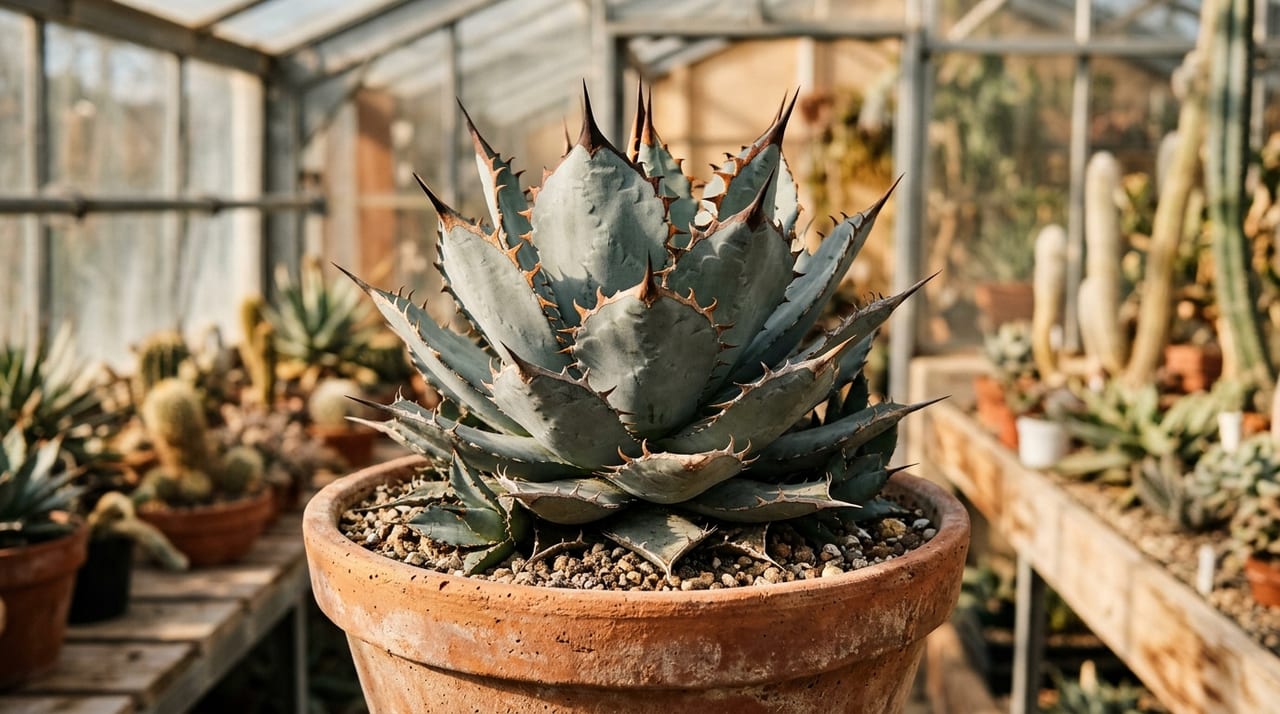
The major management challenge at this stage is "form maintenance." Popular agave varieties like Agave titanota have been selected for densely packed, beautiful leaves. To maintain this form, uniform light over the entire plant is essential. Rotate the pot 1–2 times monthly to prevent light from favoring one direction.
Stage 5: Market Stage (3–5 Years Old and Beyond)
By 3–5 years of age, plants reach 10–15 cm diameter, growing to the "standard size" sold in markets. At this stage, the focus shifts from mere "management" to "appreciation."
However, cultivation need not end here; many enthusiasts aim for larger specimens. In such cases, upsizing to a 7-size pot (21 cm diameter) and continued careful management follow.
The greatest value of seedling cultivation lies not in reaching market size, but in "personally experiencing the passage of 3–5 years." Through the process from tiny cotyledons to mature plants, you come to understand how full of vitality agave is and how delicate the environmental adjustments it requires truly are.