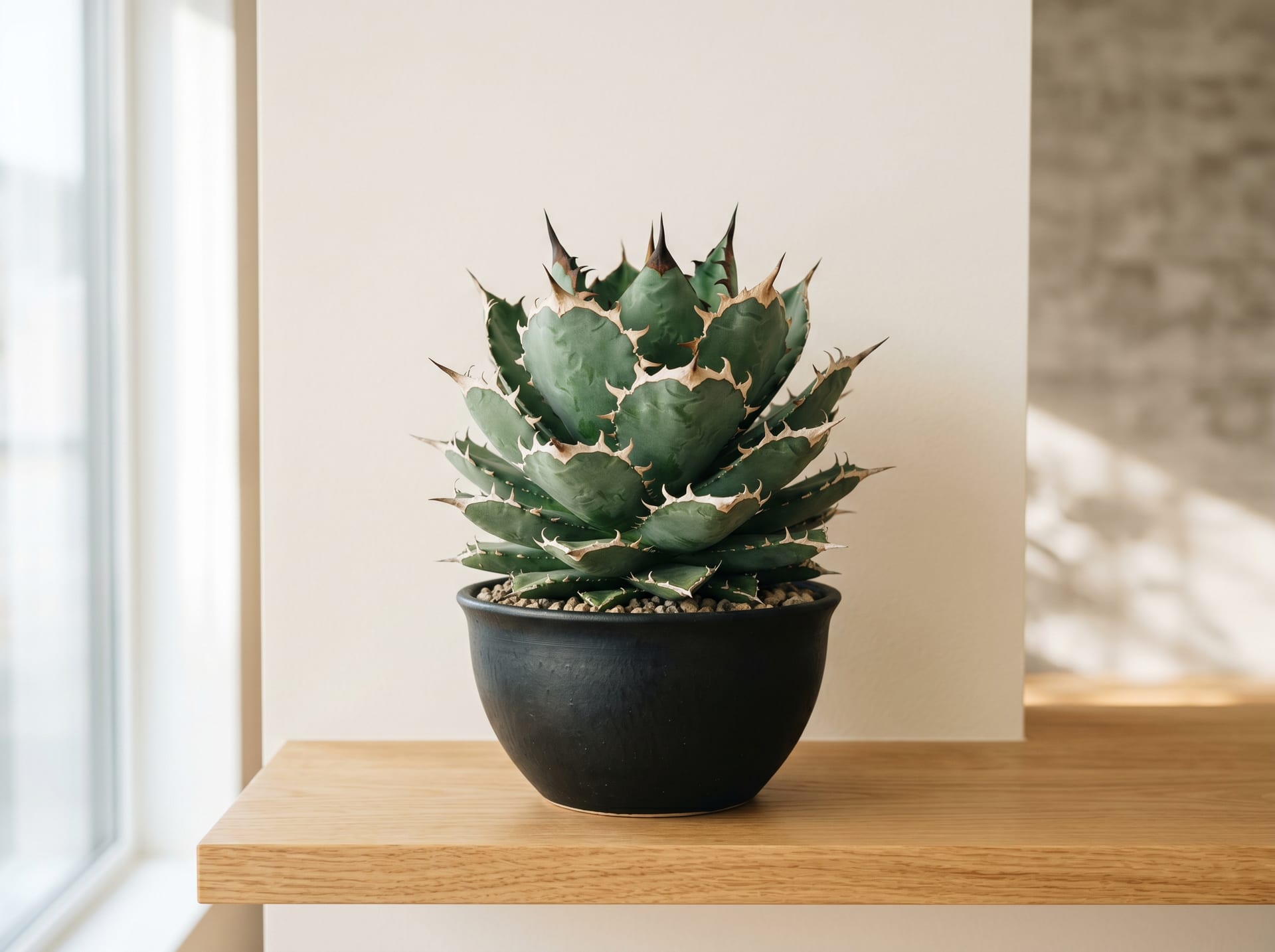
AI-generated image
Agave Titanota
IntermediateAgave titanota
The mid-sized agave that set off the current agave boom. It stays a manageable size in pots, with white marginal teeth and thick leaves. Provenance-based selections circulate under names such as 'Hakugei' and 'Himeganryu'.
About
Agave titanota, commonly called the chalk agave, is a medium-sized succulent native to the rocky limestone canyons of the Tehuacán-Cuicatlán Valley in Oaxaca, Mexico. Its stiff, blue-gray leaves are edged with sharp cream to white teeth and terminate in a rigid spine. The plant forms a compact rosette typically reaching 30–60 cm tall and 60–90 cm wide, making it well-suited for container cultivation. Growth is slow and deliberate, gradually building a symmetrical rosette over several years. It demands excellent drainage—a mix of akadama, pumice, and decomposed granite works well. Full sun is essential; supplemental grow lighting is needed for indoor culture. Water thoroughly but infrequently, allowing the soil to dry completely between waterings. The extraordinary diversity of spine forms and colorations found in cultivated selections has made this one of the most sought-after agave species among collectors worldwide.
Source: Wikipedia (CC BY-SA 4.0)
Size of the Agave Titanota
The Agave Titanota grows to 20-50cm rosette.
Temperature & humidity for the Agave Titanota
The ideal temperature for the Agave Titanota is 15〜35℃.
Basic Info
Origin
Oaxaca, Mexico
Size
20-50cm rosette
Temperature
5〜40℃
Watering & Fertilizer
Water: when dry in spring/fall / reduce in summer / monthly in winter
Growing Tips
Soil
Akadama:Hyuga:Pumice 1:1:1. Prioritize drainage
Light
Direct sunlight recommended. Supplement with LED indoors
Watering
Water only after the soil has dried out completely, and in winter cut back to once or twice a month. Keep it out of prolonged rain.
Temperature & Overwintering
The ideal range is 15-35°C, and it tolerates around 5°C. In winter keep it out of frost and bring it indoors before it drops below 5°C.
Rooting
Bare root: water culture → soil planting in two stages
Notes
Susceptible to rot. Ensure airflow in rainy season. Bring indoors in winter
Agave Titanota FAQ
QWhat is the growing difficulty level for Agave Titanota?
Intermediate. A variety suitable for intermediate growers. Requires some cultivation experience and knowledge of environment management. Pay careful attention to temperature and humidity control.
QWhat is the ideal temperature for Agave Titanota?
The ideal temperature for Agave Titanota is 15〜35℃. Avoid sudden temperature changes and maintain a stable environment.
QHow large does Agave Titanota get?
The mature size of Agave Titanota is 20-50cm rosette. This may vary slightly depending on cultivation environment and individual differences.
QHow should I water and fertilize Agave Titanota?
Agave Titanota: watering & fertilizer — Water: when dry in spring/fall / reduce in summer / monthly in winter. Aim for appropriate frequency and amount.
QWhat is the typical price for Agave Titanota?
The price of Agave Titanota varies significantly by variety, characteristics, size, and lineage. Please check GrowerDirect's price guide for the latest market information.
Last updated: August 31, 2026
Growing Specifications
Varieties & Lineages
These are all selected individuals or horticultural cultivars (named varieties), representing traits that are not genetically fixed, but rather superior individuals maintained through vegetative reproduction (division and tissue culture). Seedlings do not reproduce the parental form.
Sources: PlantsChain Agave Encyclopedia (JA)
A curated selection of notable varieties. Inheritance modes are a reference for crossing plans; actual appearance varies with combinations.
References & Sources
Edited & verified by: GrowerDirect Editorial Team
The classifications, regulations, and growing data on this page are created and verified based on the primary information database below.
Taxonomy & Authority
Regulations & Conservation Status
Sources: CITES Appendices (List of species protected by CITES Appendix II) / Ministry of the Environment Designated Invasive Species List (confirmed Agave non-applicable)
Regulations may change. Always verify the latest information with the relevant authorities.
Related Species
Find listings for this species
Related Articles
Agave Titanota vs. Horrida Complete Buyer's Guide | Comprehensive Price Comparison, Cultivation Difficulty, and Where to Buy
A comprehensive price comparison, cultivation difficulty analysis, size considerations, and sourcing guide for Agave titanota and horrida. This expert guide helps you decide which variety suits you best, with detailed explanations of each plant's characteristics and purchasing tips.
Agave Titanota Varieties & Cultivars Catalog | Distinguishing NO WAY, FJ, Black, and Dwarf: Characteristics Comparison
Comprehensive guide to the main Agave titanota cultivars (NO WAY, FJ, Black Titanota, Dwarf, White Ice, and others). Learn how to identify and compare spine shape, leaf color, size, and price range—perfect as a beginner's introduction to collecting Agave titanota.
Agave Titanota vs. Horrida Care Guide: Managing Two Popular Species Despite Their Similarities
Agave titanota and horrida species are hugely popular among collectors. Although they look similar, their origins, growing conditions, and care requirements differ significantly. This guide details the characteristics of both species and practical tips for managing each.
Agave Titanota Popular Clones and How to Distinguish Them | FO-076, White Whale, Caesar
We explain the characteristics and how to distinguish popular Titanota clones (FO-076, White Whale, Caesar, Hades, etc.), and precautions when acquiring them.
🩺 Common diseases
Can't find the plant you're looking for?
Post your wishes for free and growers with matching plants will contact you with introductions.