What Are Agave Meristem (Tissue Culture) Seedlings? | Differences from Seed-Grown and Wild-Collected Plants, and How to Choose
Explains the mechanisms and characteristics of meristem propagation in agave. Introduces the differences between seed-grown and wild-collected plants, how to distinguish them, and the importance of verifying provenance when purchasing.
Key Takeaways
Explains the mechanisms and characteristics of meristem propagation in agave. Introduces the differences between seed-grown and wild-collected plants, how to distinguish them, and the importance of verifying provenance when purchasing.
Related Species
When searching for agave, you may encounter the term "meristem propagation" on sales pages or at plant fairs. While it is often discussed alongside seed-grown plants and wild-collected specimens, relatively few people may have a precise understanding of the technology behind it or how it differs from plants of other origins. This article provides a detailed explanation of meristem (tissue culture) propagation in agave, including how it works, its characteristics, how it differs from seed-grown and wild-collected plants, why verifying provenance at purchase matters, and key points for distinguishing between propagation methods.
What is Meristem (Tissue Culture) Technology?
Meristem propagation is a technique that extracts meristematic tissue—the growth point of a plant—and multiplies these cells in a sterile culture environment to mass-produce seedlings that carry the exact same genetic information as the parent plant. Unlike seed propagation, which is fundamentally different as plants are grown from seeds, meristem propagation copies the parent plant at the cellular level, so the resulting seedlings are referred to as clones of the parent plant.
This tissue culture technology was originally widely used for mass production of orchids and tropical orchids, but its adoption in the agave world is steadily increasing. In particular, meristem propagation is an extremely practical technique for consistently producing variegated varieties and selected plants with highly valued spines, form, and leaf coloration.
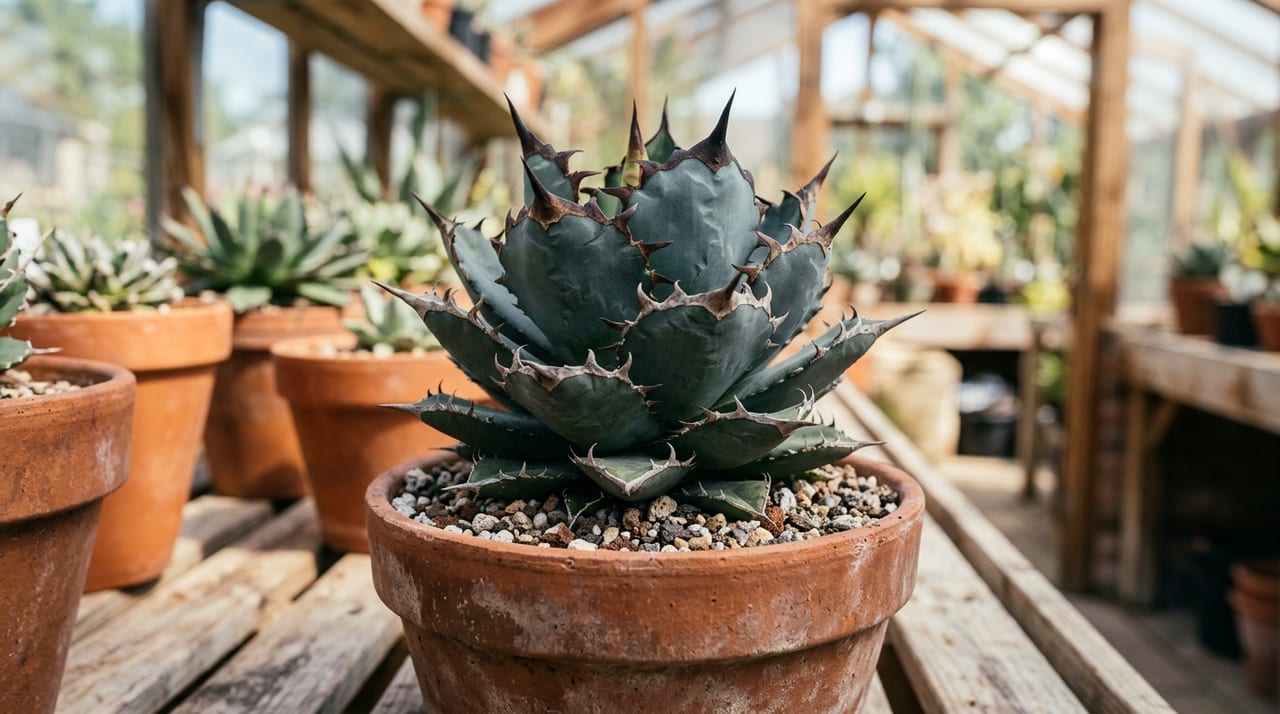
For example, consider an Agave titanota specimen with standout features such as triangular spines, glossy black skin, and high density of sharp spines. With seed propagation, it is difficult to reproduce individuals with the same characteristics, requiring repeated hybridization and selection. With meristem propagation, however, seedlings with identical characteristics can be reliably produced from that specimen's cells. This is why meristem propagation is widely used for highly collectible agave varieties.
Three Differences Between Seed-Grown and Wild-Collected Plants
Agave origins generally fall into three categories: "seed-grown," "wild-collected (wild stock)," and "meristem-propagated." The characteristics of each are as follows.
- Seed-grown plants: Plants grown from germinated seeds. Because they result from crossbreeding, even plants from the same parent can vary in form, pattern, and spine texture from one individual to another. Suited to collectors who enjoy appreciating individual variation.
- Wild-collected plants (wild stock): Plants collected and imported from native habitats such as Mexico. Wild-grown specimens have a distinctive presence cultivated over many years in their natural environment, offering a ruggedness and vigorous root development not found in cultivated plants. Many species are subject to the CITES convention, limiting supply; furthermore, rooting management after import is often necessary.
- Meristem-propagated plants: Clones produced by tissue culture from a parent plant. Because they uniformly inherit the parent plant's traits, plants in the same batch have remarkably uniform appearance. Characterized by stable quality and mass-production capability.
Rather than thinking in terms of which is superior, it is natural to understand that each offers a different kind of appeal. The basic approach is to choose seed-grown plants if you want to appreciate the uniqueness of individual variation, wild-collected plants if you value natural vigor and rarity, or meristem-propagated plants if you want to reliably obtain the same form as the parent plant.
How to Identify Meristem-Propagated Plants
Meristem-propagated plants have characteristics that can be judged to some extent from appearance. The most obvious is that plants from the same batch have remarkably uniform form and size. When multiple plants of the same cultivar name are displayed on sales pages or at exhibitions and the leaf orientation, spine shape, and leaf width spread appear nearly identical, it is likely that they are meristem-propagated.
Conversely, if plants of the same cultivar name show clear differences in individual form, they are likely seed-grown. Seed-grown plants have genetic variation, so even siblings grown from the same parent's seeds will have different mature silhouettes.
Also, seller information is an important source. Trustworthy vendors typically specify the origin—whether seed-grown, meristem-propagated, or wild-collected—in their product descriptions. Developing the habit of checking this information before purchasing can help prevent the disappointment of receiving something other than expected.
Understanding the Relationship Between Price and Rarity
Because meristem-propagated plants can be mass-produced, plants of the same cultivar and trait tend to have more stable pricing compared to seed-grown or wild-collected plants. However, if the original selected plant is highly valued, meristem-propagated plants may command correspondingly higher prices. For example, meristem-propagated material from specially selected Agave oteroi individuals with exceptional spine development may be traded at high prices as rare varieties.
With seed-grown plants, finding an individual with desired traits involves an element of luck due to individual variation. "Prize specimens" selected from large batches of seedlings can command high premiums, so prices for the same cultivar can vary considerably.
Wild-collected plants have limited availability, so prices fluctuate significantly based on condition. Specimens requiring repotting and rooting treatment after import involve additional labor, and this risk tends to be reflected in the price.
Understanding the background behind pricing and rarity helps explain seemingly high prices and prompts you to verify provenance when prices are suspiciously below market.
Knowing Provenance Leads to Long-Term Satisfaction
Checking provenance when purchasing agave is not only intellectually interesting but also affects long-term satisfaction with cultivation. Meristem-propagated plants from the same batch tend to have uniform growth rates and characteristics, offering the practical advantage of being easier to manage when cultivating multiple plants under the same care regimen.
By contrast, seed-grown and wild-collected plants tend to have variable growth rates between individuals, sometimes requiring adjustments to watering timing and placement environment for each plant. Whether you view this as a burden or as an opportunity to engage more intimately with each specimen depends on your cultivation style.
As you build a collection over time, choosing plants while being mindful of their origins leads to deeper understanding of the specimens in your care. Knowing "how this plant came to be" enriches your perspective as you observe it during cultivation, allowing you to develop a longer-lasting relationship with each plant.
Summary
Meristem-propagated agave plants shine as clones that reliably inherit parent plant traits, particularly when you want to obtain selected specimens or variegated cultivars with uniform appearance. Seed-grown plants offer the interest of individual variation, while wild-collected plants offer the charm of natural vigor—each has distinct value. Rather than asking which is "correct," the key is to choose based on "what you enjoy most." Selecting plants with an understanding of their provenance enhances satisfaction after purchase and makes your relationship with agave more fulfilling.