Jewel Orchid Care Guide | Appreciating Foliage Beauty in the World of Gem Orchids
A guide to growing Jewel Orchids with leaf veins that shimmer like jewels. Detailed introduction to cultivation methods for Macodes petola and Ludisia, proper humidity and light management, soil selection, and propagation techniques.
Key Takeaways
A guide to growing Jewel Orchids with leaf veins that shimmer like jewels. Detailed introduction to cultivation methods for Macodes petola and Ludisia, proper humidity and light management, soil selection, and propagation techniques.
Related Species
Jewel Orchid Care Guide | Appreciating Foliage Beauty in the World of Gem Orchids
Jewel Orchids are orchids appreciated primarily for their foliage rather than flowers. The veins running across the velvety-textured leaves shimmer when catching light—a truly jewel-like beauty. While they require different care methods compared to typical orchids, when you master the key points, these plants can provide years of indoor enjoyment. This article will explain everything from how to choose varieties to daily care practices.
---
What Are Jewel Orchids?
Jewel Orchids is a collective term for several genera within the Orchidaceae family. It includes the genera Macodes, Ludisia, Anoectochilus, and Dossinia, which grow naturally on the forest floor of tropical rainforests in Southeast and South Asia.
The defining characteristic is undoubtedly the pattern of the leaves. While typical orchids showcase the beauty of their flowers, Jewel Orchids' greatest appeal lies in the radiance of their leaf veins. Depending on the angle of light, they shimmer in gold, silver, and copper tones—like meticulously crafted jewelry. While they do produce flowers, these are small and inconspicuous, so most enthusiasts cultivate them primarily to appreciate the foliage.
In their natural habitat, they grow on forest floors covered with leaf litter, protected from strong direct sunlight and in an environment of consistently high humidity. Recreating this growing environment indoors is the fundamental principle for successful cultivation.
---
Representative Varieties and How to Choose
Macodes petola
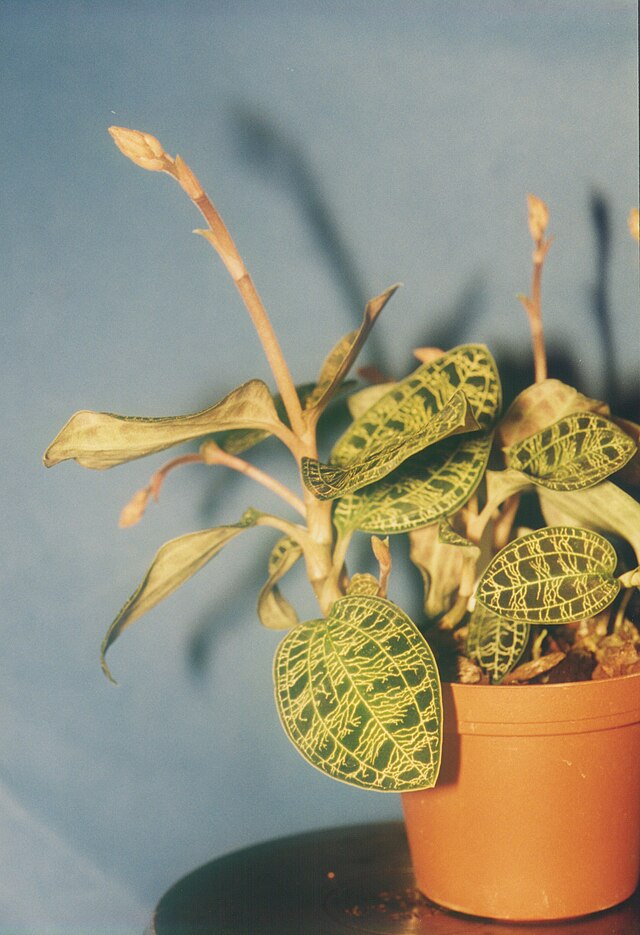
The most widely available variety and practically synonymous with Jewel Orchids. It features deep green leaves with golden leaf veins reminiscent of lightning, and when exposed to light, the entire leaf surface glows with a golden luster. Native to Southeast Asia, it thrives in humid, low-light environments. The pattern of leaf veins varies among individual plants, and specimens with darker, more distinct veining are considered more ornamental.
Ludisia discolor
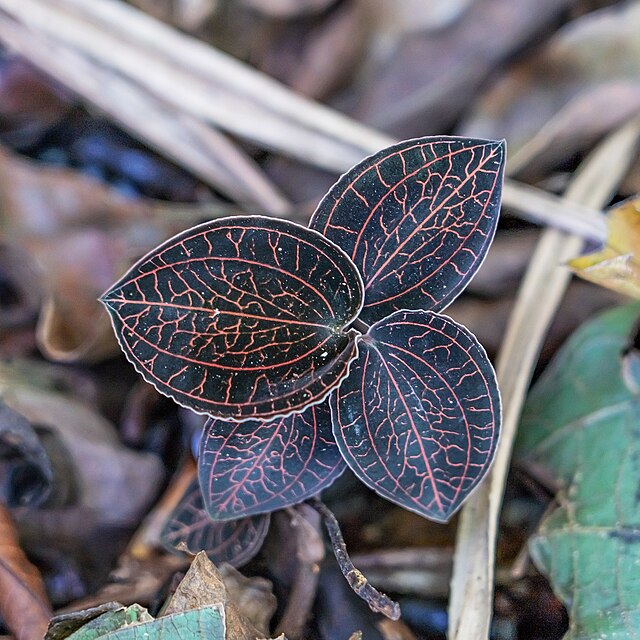
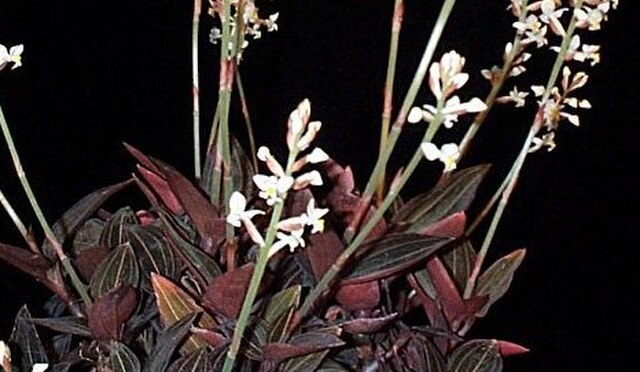
This variety features dark reddish to burgundy leaves with white to pale pink leaf veins. In contrast to Macodes, it offers a rich, deep coloration that makes a striking interior accent. It's relatively hardy among Jewel Orchids with good adaptability, making it the best choice for beginners.
Anoectochilus roxburghii
This variety features fine, net-like golden veining spread across the leaves and is also called "Golden Net." It's somewhat more challenging to cultivate, so it's best to attempt it after gaining experience with Macodes and Ludisia.
Dossinia marmorata
A larger-growing variety characterized by marble-like patterns across the leaf surface. It's difficult to obtain and typically circulates as a collector's item among specialist growers and enthusiasts—a rare species.
---
Light, Temperature, and Placement Management
Weaker Light Is Ideal
Jewel Orchids dislike intense light, and direct sunlight is strictly prohibited. Not only do the leaves bleach white, but the radiance of the leaf veins diminishes, significantly reducing ornamental value. The ideal light intensity is 1,000–3,000 lux—half or less than what typical orchids require.
The ideal placement is a bright indoor location 1–2 meters from a window or by a north-facing windowsill. If using LED lights, set them to low intensity and provide 8–10 hours of light per day. Using a grow light allows stable growth even in poorly lit indoor areas.
Temperature and Air Circulation
The ideal temperature range is 18–28°C (64–82°F). Growth stops below 15°C (59°F), and damage may occur at 10°C (50°F) or lower. Windowsills become cold in winter, so moving plants to the center of the room at night is recommended. Avoid areas where air conditioning drafts blow directly on the plants, as this causes drying and temperature fluctuations.
---
Humidity Management and Watering
Humidity Is the Top Priority
Humidity management is the most important and challenging aspect of Jewel Orchid cultivation. In their native habitat, they grow in environments with consistently 80% or higher humidity, so typical indoor humidity (40–50%) falls short. The target humidity is 60–80%.
Methods to increase humidity include:
- Terrarium or glass case cultivation: The easiest way to maintain humidity with excellent display potential—highly recommended
- Humidifier placement: Raises ambient humidity around the plants
- Placing damp gravel or water on a tray: Improves the microclimate around the pots
Misting the leaves directly is also an option, but water droplets that remain can cause rot and mold, so only do this if there is adequate air circulation.
When to Water
Water when the surface of the growing medium (moss) begins to dry. While ideally maintaining consistent moisture, overwatering causes root rot, so ensure water doesn't pool at the bottom of the pot. Use room-temperature water and pour gently at the base of the plant. Cold water damages roots.
---
Growing Medium, Pots, and Repotting Tips
Choosing the Growing Medium
Jewel Orchids need growing medium with both water retention and aeration. The simplest and easiest to manage is cultivation using sphagnum moss alone. Select AA-grade or higher quality moss, and plant loosely without packing it too tightly, wrapping the roots gently.
For better aeration, you can also use a blend of peat moss, perlite, and bark chips mixed in a 1:1:1 ratio.
Pot Material
Plastic pots or glass containers are suitable. Terracotta pots dry out too quickly due to their high breathability and are not ideal for Jewel Orchids. Transparent containers offer the advantage of monitoring root condition from outside.
Repotting and Propagation
Repot annually or when the moss begins to brown and deteriorate. Regular replacement helps prevent root rot.
Stem propagation is the typical method. When stems elongate, cut at a node and place on moist moss where it will develop roots. Keep humidity high while avoiding direct sunlight until roots develop.
---
botachoku's Safe and Reliable System
Jewel Orchids have limited distribution, and rare varieties like Anoectochilus and Dossinia are rarely found in garden centers. botachoku connects you directly with growers who specialize in Jewel Orchids, making it easy to discover these rare varieties.
Since leaf vein patterns and luster vary greatly between individual plants, botachoku enforces a policy that sellers must post photos of the actual plants to prevent disappointment. You can also message growers directly before purchasing to ask questions about growing conditions and care methods, allowing you to purchase with confidence while receiving expert advice.
For those new to Jewel Orchids, starting with the easy-to-grow Ludisia discolor is recommended. As you gain experience, expanding your collection to Macodes and rare varieties offers a unique enjoyment that makes Jewel Orchid collecting so rewarding.