Agave 'Blue Ember'
BeginnerAgave 'Blue Ember'
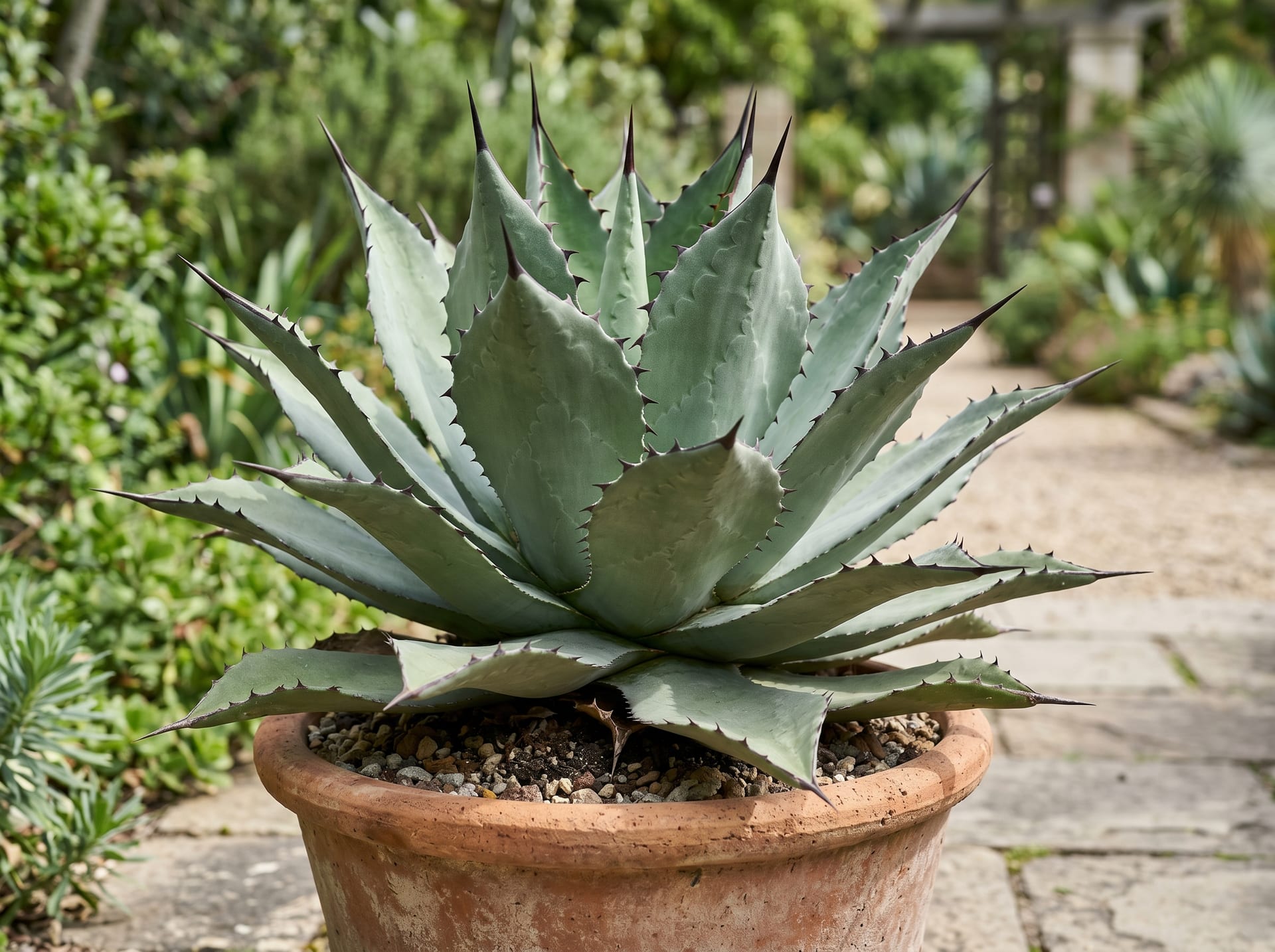
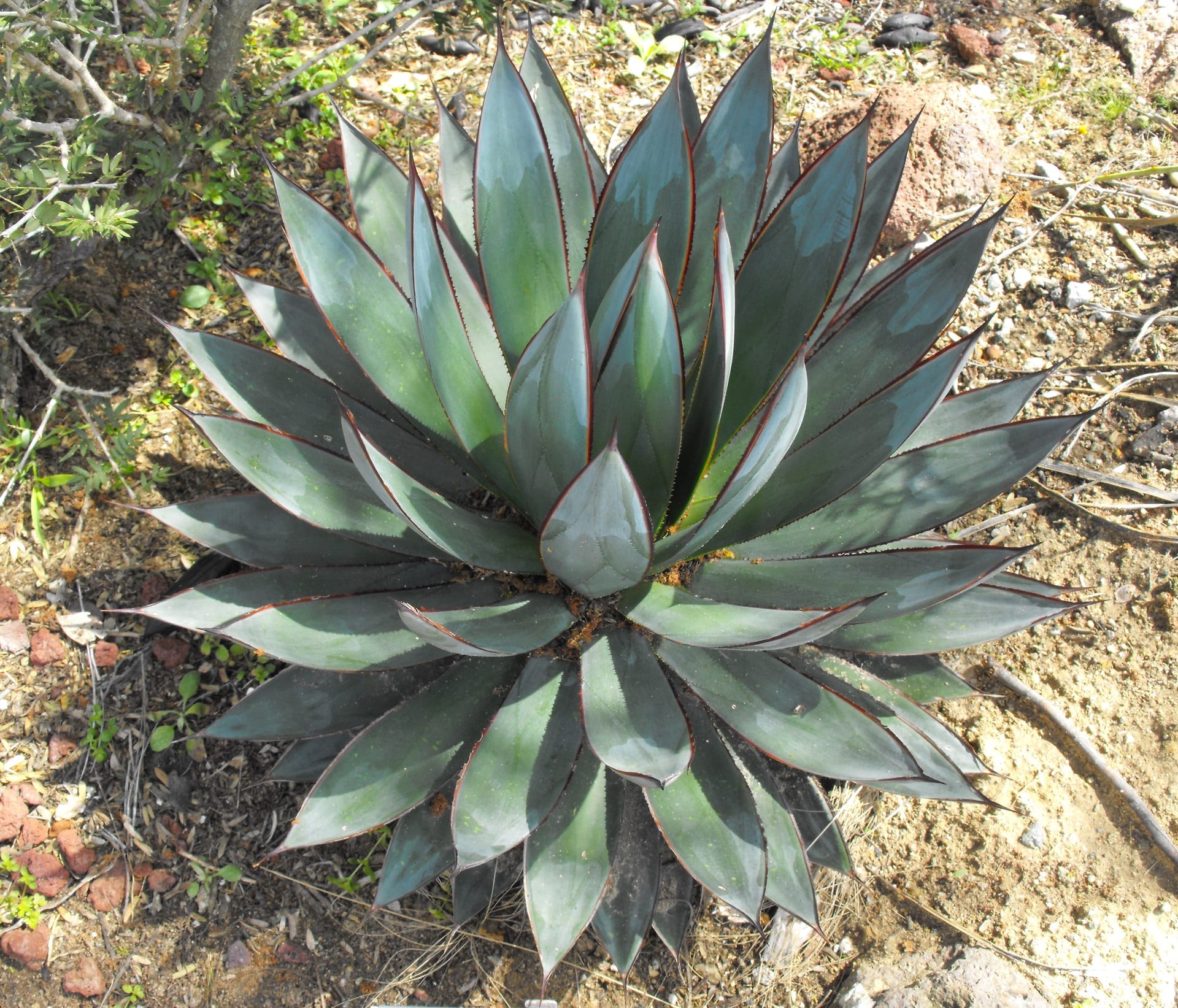
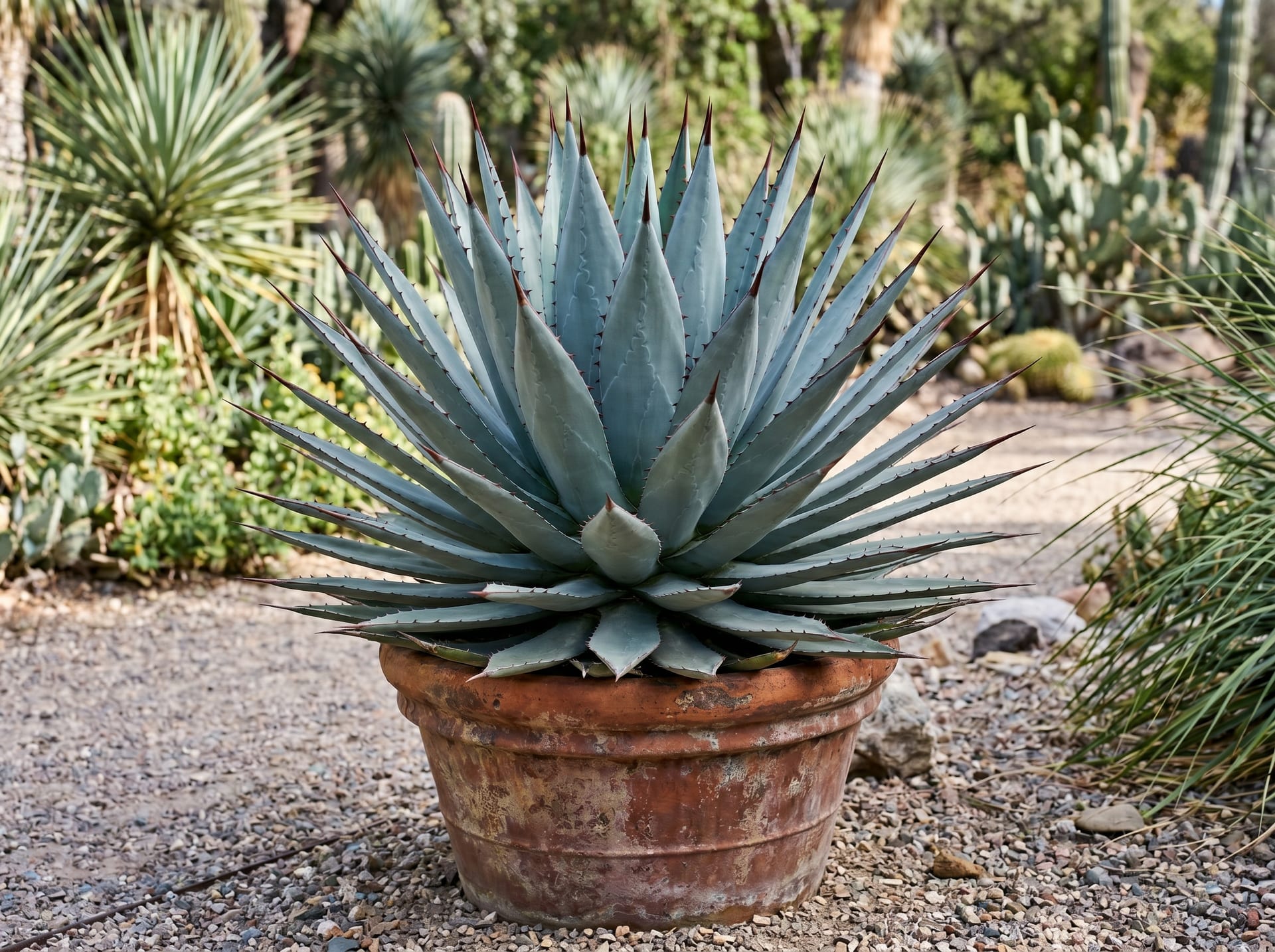
A hybrid with powdery blue-grey leaves set off by dark to reddish margins and sharp spines. Its parentage has not been published, and some think it may be the same plant as the very similar 'Burnt Burgundy'.
About
Blue Ember is a hybrid agave propagated by a US tissue-culture lab and named by breeder Kelly Griffin. Its parentage is unclear: an Arizona State University plant sheet reports that the namer himself does not know the parents and thinks it may be the same as 'Burnt Burgundy', a cross of A. victoriae-reginae and A. palmeri. Experts disagree on whether the two look-alikes are genetically identical. The producer describes powdery blue-grey leaves with dark charcoal margins and spines in a neat, symmetrical, compact rosette, while the university sheet describes narrow, strap-shaped blue-green leaves with smooth burgundy-red margins and stout red tip spines, reaching about 60 cm tall and 90 cm wide at maturity and producing offsets. A Japanese succulent encyclopedia highlights wine-red and orange edging on blue leaves and white patterning on the leaf backs, notes that the similarly named 'Blue Emperor' differs in its narrower leaves and edge colour, and says it is closer to 'Blue Glow', which has narrower leaves and smoother edges. In Japan it is sold by specialist nurseries and online shops as a cold-tolerant cultivar.
Size of the Agave 'Blue Ember'
The Agave 'Blue Ember' grows to Recorded at about 60 cm tall and 90 cm wide at maturity.
Basic Info
Origin
Hybrid propagated by tissue culture in the USA (parentage unknown)
Lifespan
Perennial; the rosette dies after flowering
Size
Recorded at about 60 cm tall and 90 cm wide at maturity
Temperature
5〜40℃
Watering & Fertilizer
Light feeder; a little slow-release fertiliser in the growing season is enough
Growing Tips
Light & Placement
Full sun to light shade; good light sharpens the leaf and edge colour.
Watering
Drought tolerant; once established it needs little water.
Temperature & Winter
The producer rates it to about -6°C and the university sheet says it is injured below about -7°C; winter potted plants away from frost.
Soil & Repotting
Use a free-draining mix to prevent rot; divide offsets when they appear.
Notes
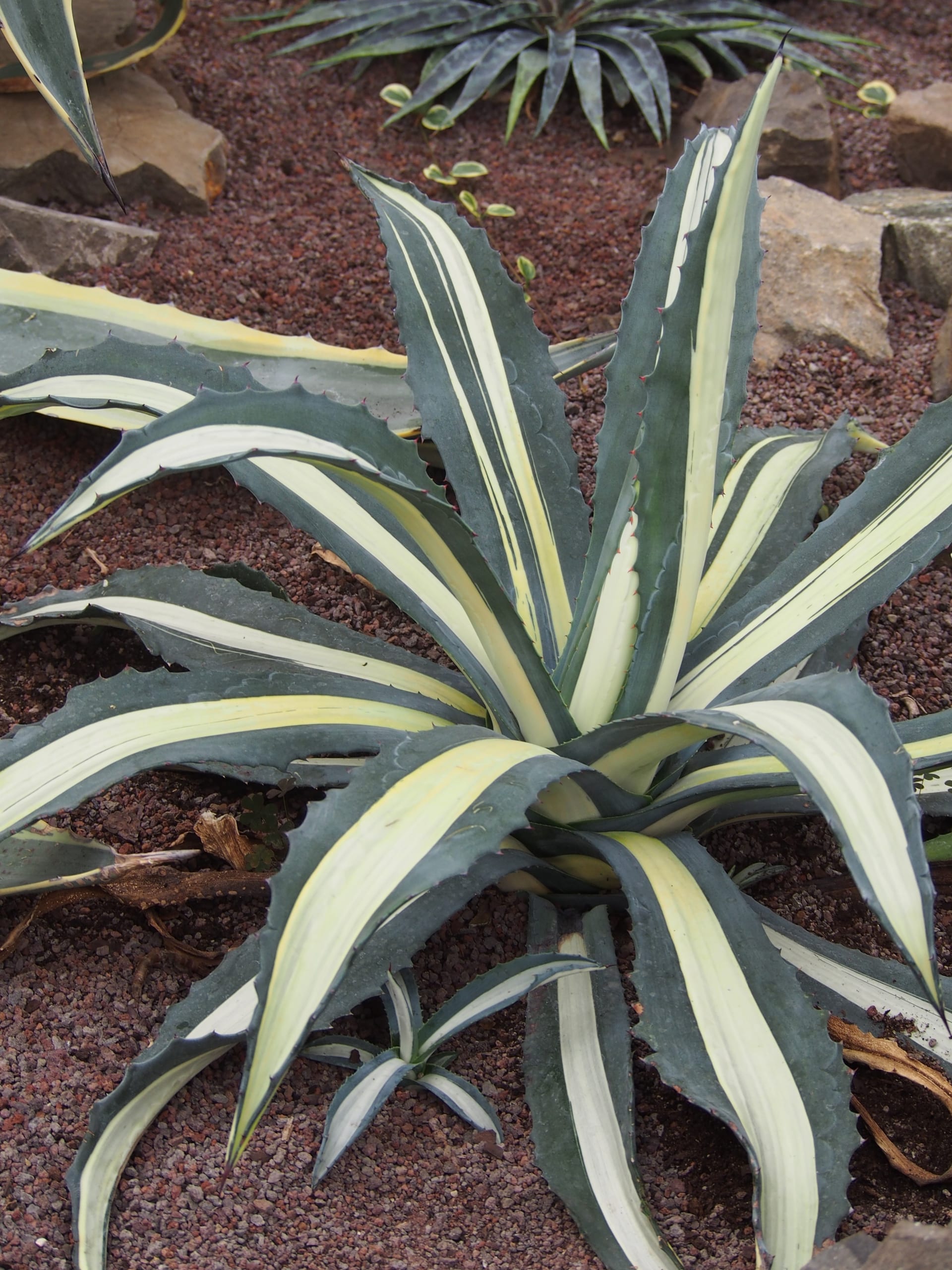
It closely resembles 'Blue Glow' and 'Burnt Burgundy', and labels get mixed up; check leaf width and edge colour on the actual plant.
Agave 'Blue Ember' FAQ
QWhat is the growing difficulty level for Agave 'Blue Ember'?
Beginner. A variety suitable for beginners. No special equipment or experience is required—you can grow it without problems by setting up a basic cultivation environment.
QHow large does Agave 'Blue Ember' get?
The mature size of Agave 'Blue Ember' is Recorded at about 60 cm tall and 90 cm wide at maturity. This may vary slightly depending on cultivation environment and individual differences.
QHow should I water and fertilize Agave 'Blue Ember'?
Agave 'Blue Ember': watering & fertilizer — Light feeder; a little slow-release fertiliser in the growing season is enough. Aim for appropriate frequency and amount.
QWhat is the typical price for Agave 'Blue Ember'?
The price of Agave 'Blue Ember' varies significantly by variety, characteristics, size, and lineage. Please check GrowerDirect's price guide for the latest market information.
Last updated: September 23, 2026
References & Sources
Edited & verified by: GrowerDirect Editorial Team
The classifications, regulations, and growing data on this page are created and verified based on the primary information database below.
Primary sources
- Species+ (CITES) query for Agave victoriae-reginae: Appendix II
- Arizona State University Library plant sheet: Agave x 'Blue Ember' (relation to 'Burnt Burgundy')
- Ministry of the Environment, list of Invasive Alien Species (no Agave listed)
- MAFF plant variety registration database (no registered Agave varieties)
- Rancho Tissue Technologies: Agave hyb. 'Blue Ember'
- PUKUBOOK succulent encyclopedia: ブルーエンバー
Regulations & Conservation Status
Its parentage has not been published, but it is thought by some to be the same plant as 'Burnt Burgundy', whose parent A. victoriae-reginae is in CITES Appendix II; if so, it falls under Appendix II. Check before importing or exporting. No registration or notification is needed to buy, sell or give plants within Japan. It is not designated as an Invasive Alien Species or Uncategorized Alien Species under Japanese law. It is not a registered variety under Japan's Plant Variety Protection and Seed Act (no Agave varieties were registered as of September 2026).
Sources: Species+ (CITES) query for Agave victoriae-reginae: Appendix II / Arizona State University Library plant sheet: Agave x 'Blue Ember' (relation to 'Burnt Burgundy') / Ministry of the Environment, list of Invasive Alien Species (no Agave listed) / MAFF plant variety registration database (no registered Agave varieties)
Regulations may change. Always verify the latest information with the relevant authorities.
Related Species
Agave 'Blue Ember' Listings
![Kodama-hime Sasanoyuki [Small] Rare High-Quality Specimen - Direct from Agave Grower | 五本幸二 Nursery](https://img.botachoku.com/listings/bd75d031-53ca-4369-b7e2-884bdb80f54f/c9a39afe-50e5-4e00-89d6-03b4060e4699_thumb.webp)
Find listings for this species
Related Articles
Preventing Leaf Burn in Agave and Light Management | Transition Strategy from Indoor to Outdoor Cultivation
Light management strategy to prevent agave leaf burn completely while successfully transitioning from indoor to outdoor environments. This article explains practical methods including gradual light intensity adjustment, seasonal placement changes, and UV protection measures.
Tips for Cultivating White Variegated Agave Varieties
Tips for Cultivating White Variegated Agave Varieties
Complete Care Guide for Agave oteroi | Tips for Training Beautiful Large Rosettes
We explain the characteristics and cultivation of Agave oteroi, a large agave native to Oaxaca, Mexico. From placement location and soil to watering and overwintering—a practical guide for those beginning to cultivate this species.
The Deep Connection Between Agave and Tequila | The Secret of a Distilled Spirit Born from Century Plant
Tequila is made from only Agave tequilana among the Agave genus. This essay explains the ecology of century plants, the Jalisco region as a production area, and the differences from ornamental agaves.
🩺 Common diseases
Can't find the plant you're looking for?
Post your wishes for free and growers with matching plants will contact you with introductions.