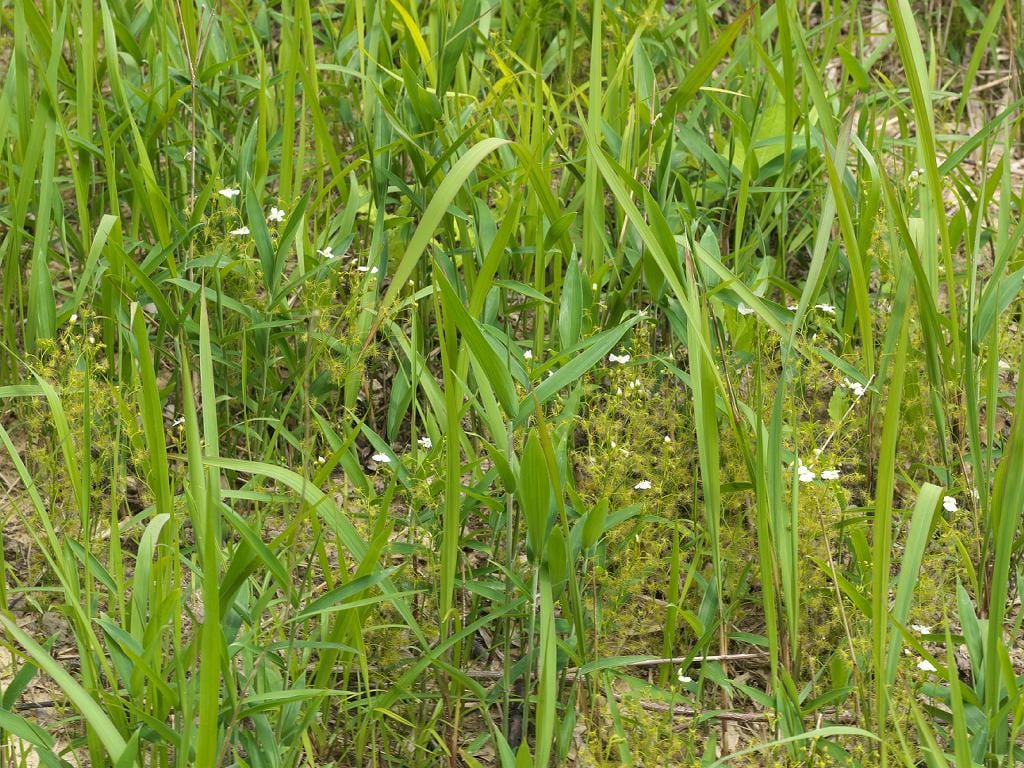
Source: Wikimedia Commons
Shield sundew
AdvancedDrosera peltata
A Japanese native sundew that raises an upright stem each spring from a small tuber, bearing crescent-shaped sticky leaves. The name means 'stone-holding plant', from its glue said to lift pebbles. White flowers appear in early summer, then it dies back and rests over summer.
About
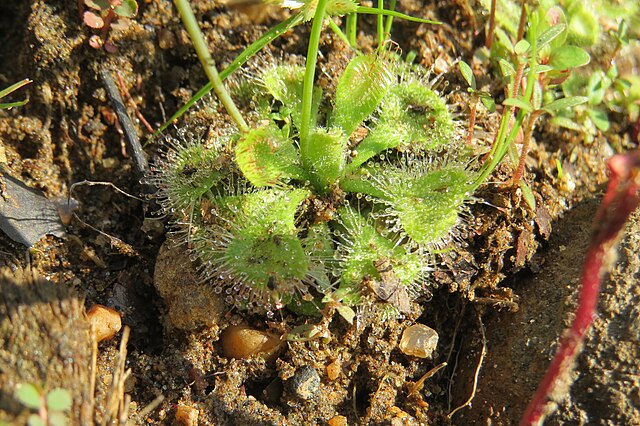
Drosera peltata is a perennial sundew that forms an underground tuber about 5-6 mm across, one of the tuberous Drosera. In spring it sends up a stem 10-30 cm tall bearing scattered crescent-shaped traps 4-6 mm wide on stalks 10-15 mm long. The Japanese name refers to the sticky glue supposedly lifting small stones, and 'peltata' is Latin for shield-shaped, after the leaves. It flowers in May and June with 2-10 white five-petalled flowers that open in the morning and close in the afternoon, then the top growth dies and the plant rests as a tuber over summer. In Japan it grows in sunny, damp, acidic ground from the Kanto region westward to Kyushu, but it has declined and is listed as Near Threatened on the Ministry of the Environment Red List and as threatened in many prefectures. Japanese plants were long treated as var. nipponica and some authors now call them D. lunata, but GBIF treats both names as synonyms of D. peltata. The similar upright D. indica is an annual with long narrow leaves. Tubers and plants are sold in Japan, but wild plants are protected or regulated in many areas, so buy only nursery-propagated stock. In cultivation the keys are cool, bright conditions while growing and keeping the tuber from rotting during dormancy.
Source: Wikipedia (CC BY-SA 4.0)
Size of the Shield sundew
The Shield sundew grows to 10-30 cm tall (Japanese plants).
Basic Info
Origin
Japan (Honshu west of Kanto to Kyushu), Korea, China, South-east Asia, India, Australia and elsewhere
Lifespan
Perennial (rests as a tuber in summer)
Size
10-30 cm tall (Japanese plants)
Temperature
10〜30℃
Humidity
60〜90%
Watering & Fertilizer
No fertilizer (catches small insects)
Growing Tips
Light & Placement
Grow in a bright, cool spot. Tuberous sundews are tough when cool and bright, but sustained heat above 25°C makes the top growth die back early.
Watering
Keep moist on a shallow water tray while growing. After the top dies back following flowering, cut back water and keep the soil just barely damp so the tuber does not rot.
Soil & Repotting
Roots are long and fragile, so use a deep pot and a mix of about 1 part peat to 2 parts sand. Avoid repotting while growing; do it during dormancy.
Dormancy Care
It rests as a tuber over summer; do not throw it out when the top dies. The resting tuber is hard to monitor, so long-term cultivation takes care.
Fertilizer
No fertilizer in the soil; small insects it catches supply nutrients.
Pests & Cautions
It is threatened in the wild in Japan; never collect wild plants and buy only nursery-propagated stock.
Shield sundew FAQ
QWhat is the growing difficulty level for Shield sundew?
Advanced. A variety suitable for advanced growers. Requires advanced cultivation techniques and specialized equipment, with careful environmental adjustments needed.
QHow large does Shield sundew get?
The mature size of Shield sundew is 10-30 cm tall (Japanese plants). This may vary slightly depending on cultivation environment and individual differences.
QHow should I water and fertilize Shield sundew?
Shield sundew: watering & fertilizer — No fertilizer (catches small insects). Aim for appropriate frequency and amount.
QWhat is the typical price for Shield sundew?
The price of Shield sundew varies significantly by variety, characteristics, size, and lineage. Please check GrowerDirect's price guide for the latest market information.
Last updated: September 23, 2026
References & Sources
Edited & verified by: GrowerDirect Editorial Team
The classifications, regulations, and growing data on this page are created and verified based on the primary information database below.
Taxonomy & Authority
Accepted name: Drosera peltata Thunb.
Synonyms: Drosera lunata Buch.-Ham. ex DC., Drosera peltata var. nipponica (Masam.) Ohwi
Authority databases: GBIF · GBIF Drosera peltata Thunb.
Nomenclature follows global taxonomic authority databases.
Regulations & Conservation Status
Native to Japan, where it is listed as Near Threatened on the Ministry of the Environment Red List and as threatened in many prefectures. It is not a nationally designated rare species, but collecting in the wild may be banned by local ordinances or national park rules, so buy only nursery-propagated plants. Not listed under CITES. Because the genus Drosera includes a designated Invasive Alien Species in Japan (D. intermedia), any Drosera imported into Japan must be accompanied by a species-name certificate. No paperwork is needed to buy or grow plants already in domestic trade.
Sources: Ministry of the Environment, Japan: list of Invasive Alien Species (Drosera requires a species-name certificate on import) / Wikipedia (ja) イシモチソウ
Regulations may change. Always verify the latest information with the relevant authorities.
Related Species
Find listings for this species
Related Articles
Drosera (Sundew) Care Guide | Diverse Carnivorous Plants That Trap Insects with Sticky Secretions
Explanation of how to grow carnivorous Drosera (Sundew). We introduce the characteristics of beginner-friendly varieties such as Spatulata, Capensis, and Adelae, methods for water tray watering, light conditions, overwintering, and propagation through leaf cuttings.
Drosera Propagation Guide — Leaf Cuttings, Division & Seeds
Propagating sundews: leaf cutting technique, division method, seed sowing, and species-specific propagation recommendations.
Complete Guide to Sundew (Drosera) Cultivation | How to Bring Out the Beauty of Its Sticky Secretions
Explains varieties such as D. adelae and D. capensis, water-tray management, light requirements, and differences between temperate and tropical species.
Sundew Species and Cultivation Techniques | Bringing Out the Beauty of Mucilage
This article explains the characteristics of major sundew species and cultivation techniques (light, humidity, soil) for making mucilage shine beautifully.
Can't find the plant you're looking for?
Post your wishes for free and growers with matching plants will contact you with introductions.