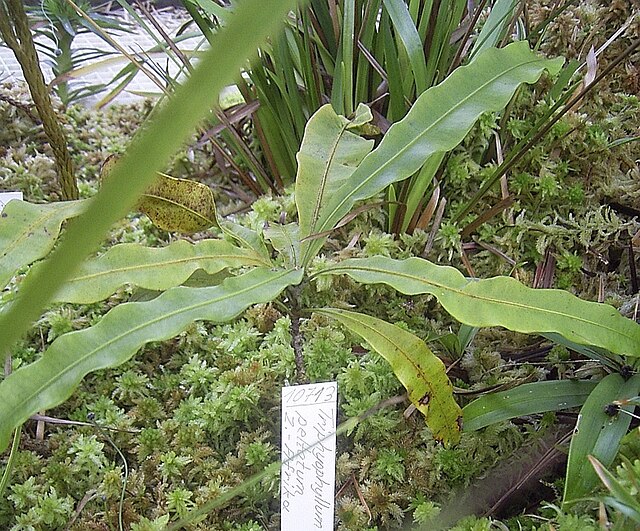
Source: Wikimedia Commons
Triphyophyllum Peltatum
AdvancedTriphyophyllum peltatum
A rare West African carnivorous plant whose leaves change form three times, temporarily developing sticky trapping leaves.
About
Triphyophyllum peltatum is a remarkable liana native to the tropical rainforests of West Africa (Sierra Leone, Ivory Coast, and neighboring countries). It is the only known species to belong to the family Dioncophyllaceae and exhibits a unique three-phase leaf dimorphism: juvenile plants produce conventional photosynthetic leaves; at a specific developmental stage, the plant briefly produces carnivorous leaves bearing glandular, mucilaginous tentacles resembling those of sundews; and mature climbing plants subsequently revert to non-carnivorous, hook-bearing leaves for scrambling. The carnivorous phase is thus temporary and conditional, making it one of the most unusual adaptations to carnivory known.
Lifespan of the Triphyophyllum Peltatum
The Triphyophyllum Peltatum lives 10+ years.
Temperature & humidity for the Triphyophyllum Peltatum
As a large tropical liana, it requires hot (25–35°C), humid rainforest conditions for cultivation—making it exceedingly rare in collections worldwide.
Basic Info
Origin
West Africa (Sierra Leone, Ivory Coast, and neighboring countries), lowland tropical rainforests
Lifespan
10+ years
Size
Vine, several meters
Temperature
10〜30℃
Humidity
60〜90%
Watering & Fertilizer
Insects (auto-capture)
Growing Tips
Temperature & Overwintering
A rainforest plant that needs hot, humid conditions at 25-35°C. It does not tolerate cold, so keep it in a greenhouse year-round.
Light & Placement
Native to the rainforest floor, it should be kept in bright shade out of strong direct sun, in a spot where high humidity can be maintained.
Watering
Use pure water and keep the medium constantly moist with high humidity. Environmental cues such as a dry period are thought to trigger the carnivorous leaves.
Pruning & Shaping
Once mature it becomes a vine several meters long. It climbs with hooked leaf tips, so provide a stake or net to train it on.
Pests & Cautions
Carnivorous leaves appear only for a limited period; it does not function as a carnivore all the time. Very difficult and best left to experienced growers.
Triphyophyllum Peltatum FAQ
QWhat is the growing difficulty level for Triphyophyllum Peltatum?
Advanced. A variety suitable for advanced growers. Requires advanced cultivation techniques and specialized equipment, with careful environmental adjustments needed.
QWhat is the lifespan of Triphyophyllum Peltatum?
The average lifespan of Triphyophyllum Peltatum is 10+ years. With proper cultivation environment and nutrient management, you can keep it healthy for a long time.
QHow should I water and fertilize Triphyophyllum Peltatum?
Triphyophyllum Peltatum: watering & fertilizer — Insects (auto-capture). Aim for appropriate frequency and amount.
QWhat is the typical price for Triphyophyllum Peltatum?
The price of Triphyophyllum Peltatum varies significantly by variety, characteristics, size, and lineage. Please check GrowerDirect's price guide for the latest market information.
Last updated: September 17, 2026
References & Sources
Edited & verified by: GrowerDirect Editorial Team
The classifications, regulations, and growing data on this page are created and verified based on the primary information database below.
Taxonomy & Authority
Accepted name: Triphyophyllum peltatum (Hutch. & Dalziel) Airy Shaw
Synonyms: Dioncophyllum peltatum Hutch. & Dalziel
Authority databases: GBIF · POWO · ICPS cultivar registration (International Carnivorous Plant Society)
Nomenclature follows global taxonomic authority databases.
Regulations & Conservation Status
This genus is not listed in CITES Appendices (among carnivorous plants, only Nepenthes/Sarracenia/Dionaea are subject to CITES).
Sources: CITES Appendices (carnivorous plants) - ICPS/Barry Rice / CITES & Carnivorous Plant Checklist (RBG Kew)
Regulations may change. Always verify the latest information with the relevant authorities.
Related Species
Find listings for this species
Related Articles
Carnivorous Plant Dormancy Awakening Guide | Correct Timing for Resuming Feeding, Fertilizing, and Watering
A step-by-step guide to the correct timing for resuming watering, restoring humidity, feeding, and fertilizing as your carnivorous plants emerge from dormancy and enter spring growth.
Why Carnivorous Plant Traps Fail and How to Fix Them | Optimizing Humidity, Nutrition, and Prey-Capture Systems
Investigate why carnivorous plant traps fail to capture insects. From humidity management to nutrient balance, gland secretion function, and dormancy, a detailed scientific approach to restoring trap function.
A Guide to Giving Carnivorous Plants as Gifts | How to Choose Unique Presents and Tips for Long-Term Enjoyment
A guide to selecting carnivorous plants as gifts. Covers how to choose varieties based on the recipient's type, and important care tips to communicate before gifting, such as water quality and dormancy periods.
Developing Nepenthes Pitcher Traps Completely: Cultivation Secrets Through Environmental Management and Physiological Approaches
The carnivorous leaves of Nepenthes represent the masterpiece of an insect-trapping mechanism evolved over 200 million years. This article explains how to mature the carnivorous leaves completely and develop healthy plants with actual predatory function through humidity, light, and nutrient management.
Can't find the plant you're looking for?
Post your wishes for free and growers with matching plants will contact you with introductions.